Search hotels in Bali on Booking.com
Bali is the most visited island in Indonesia and one of the most recognised travel destinations in the world. Around 6 million international visitors arrived annually before 2020, and the island has rebuilt substantially toward those numbers since. This volume creates a paradox that shapes the Bali experience: extraordinary cultural depth and natural beauty coexist with heavy tourist infrastructure, uneven development, and traffic that can make even short journeys slow. Understanding which part of the island suits your interests is more useful than a blanket recommendation.
The island is small by Indonesian standards - roughly 150 km across - but contains extraordinary geographic and cultural variety: active volcanoes, UNESCO-listed rice terrace systems, a continuous chain of Hindu temples, world-class surf breaks, coral reefs, and a performing arts tradition that remains alive in village life rather than solely staged for tourists. Bali is a Hindu island in a Muslim-majority archipelago, and this distinction permeates daily life - from the small offerings (canang sari) placed at every doorstep each morning to the ceremony calendar that fills the roads on dozens of occasions each year.
Regions of Bali
South Bali: Kuta, Seminyak, Canggu, Nusa Dua
South Bali holds the island’s most visited coastline, ranging from budget surf town to five-star enclave. Kuta is the original resort strip - dense, affordable, and the best base for beginner surfers. North of Kuta, Seminyak has evolved into Bali’s upscale beach and beach-club zone, while Canggu further north is the island’s digital nomad and surf culture hub. Nusa Dua at the south-east peninsula is the resort enclave of international five-star chains with calm lagoon beaches, and Uluwatu at the southern tip holds the island’s premier reef breaks alongside its famous clifftop temple.
Central Bali: Ubud
Ubud is the cultural and artistic heart of Bali, covered in detail in our Ubud city hub. The key references: Tegallalang Rice Terraces, Sacred Monkey Forest, Kecak dance performances, and the most developed wellness and retreat infrastructure on the island.
North Bali: Lovina, Munduk, Bedugul
Lovina on the north coast offers black-sand beaches, early-morning dolphin watching, and hot springs at Banjar - a quieter alternative to the busy south. The highland areas around Munduk and Bedugul (elevation 1,000–1,500 m) are significantly cooler, with terraced vegetable farms, waterfalls, and crater lakes including the twin lakes Buyan and Tamblingan. The Ulun Danu Beratan temple on Lake Beratan is one of the most photographed sites in Bali; entry approximately IDR 50,000.
East Bali: Amed, Candidasa, Tirta Gangga
Amed is the best base for diving and snorkelling on Bali’s east coast, with direct access to the USAT Liberty wreck at Tulamben - one of the most dived shore wrecks in Asia. The coastline is black volcanic sand and the pace is a fraction of the south.
Tirta Gangga is a royal water palace in east Bali with ornamental pools and carved stone, entry approximately IDR 50,000. The surrounding countryside - rice terraces climbing steep hillsides - is among the most beautiful agricultural landscape on the island.
The Nusa Islands: Nusa Penida, Nusa Lembongan, Nusa Ceningan
Three islands southeast of the Bali mainland. Nusa Penida is the largest and most dramatic, covered in our Nusa Penida guide. Nusa Lembongan is a small, easily cycled island with good snorkelling, surf breaks, and a laid-back village feel. Nusa Ceningan connects to Lembongan by a narrow suspension bridge. All three are accessible by fast boat from Sanur.
Key Temples
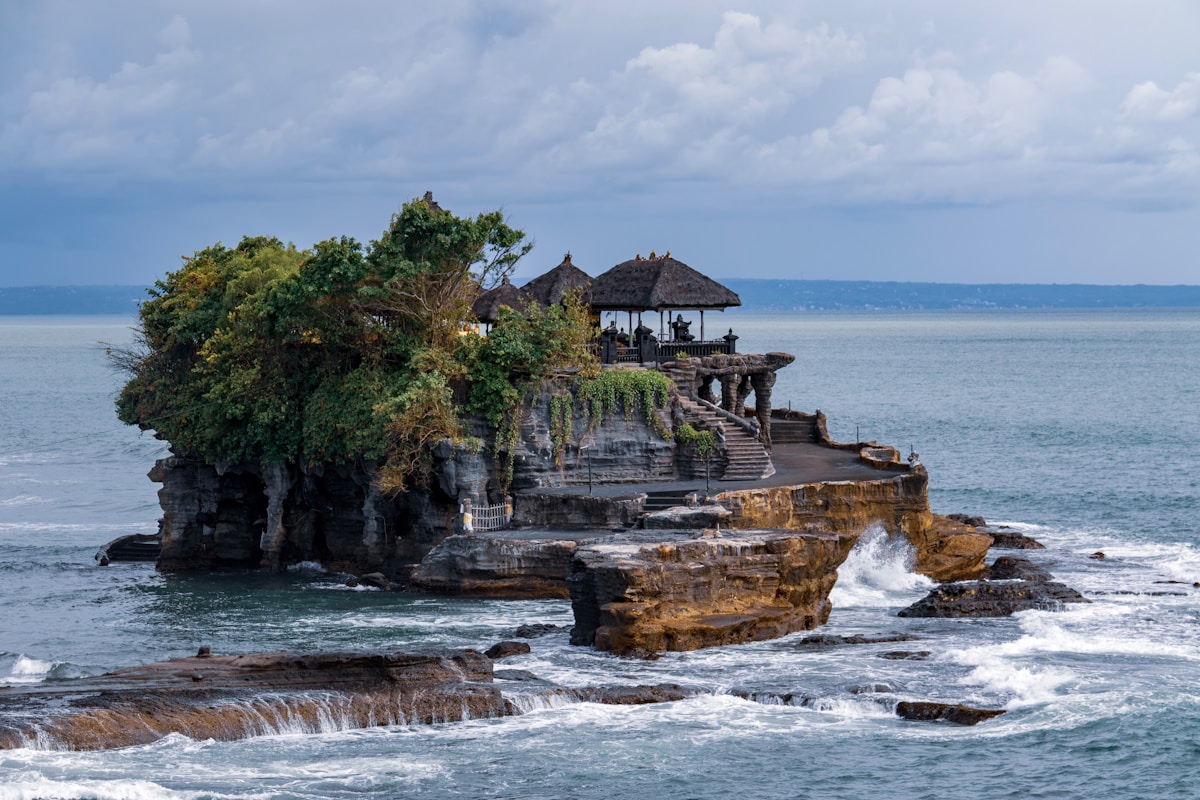
Tanah Lot - A sea temple on an offshore rock stack on the west coast, accessible on foot at low tide. Entry approximately IDR 60,000. Most visited for sunset, when the light catches the temple against the sky; arrive 90 minutes before sunset to secure a viewpoint and clear the car park queue.
Uluwatu Temple - A clifftop temple 70 metres above the Indian Ocean at the island’s southern tip. Entry approximately IDR 50,000. The evening Kecak fire dance at sunset, performed on the clifftop stage, costs approximately IDR 150,000–200,000 and runs for 45–60 minutes. Bring the camera but watch for the temple’s resident macaques, who steal sunglasses and phones.
Besakih Mother Temple - The largest and holiest temple complex on Bali, on the slopes of Gunung Agung. Entry approximately IDR 150,000; a licensed guide is compulsory (approximately IDR 100,000–200,000 additional). Open daily. The complex includes over 80 individual temples spread across a hillside that becomes smoke-shrouded in the afternoon.
Tirta Empul - A spring-fed bathing temple in Tampaksiring, where worshippers and visitors purify themselves in a series of fountain jets. Entry approximately IDR 50,000, including sarong. Open daily. Respectful participation in the purification ritual is generally welcome; observe what other bathers are doing and follow.
Getting to Bali
Ngurah Rai International Airport (DPS) in Denpasar serves direct flights from Australia (Melbourne, Sydney, Perth, Brisbane), Singapore, Kuala Lumpur, Hong Kong, Tokyo, and several other Asian hubs. European connections typically route via Doha (Qatar Airways), Dubai (Emirates), or Kuala Lumpur (Malaysia Airlines, AirAsia).
Visas
Most nationalities receive a 30-day visa on arrival free of charge. This can be extended once at the immigration office for a further 30 days; the extension costs approximately IDR 500,000 as of 2026. A tourist visa (B211A) can also be arranged in advance for 60 days.
Transport on the Island
Grab and Gojek - By far the most practical for point-to-point travel. Prices are regulated and transparent; a 10 km ride in the south costs approximately IDR 20,000–35,000 for a motorbike, IDR 40,000–70,000 for a car, depending on traffic.
Motorbike rental - From approximately IDR 60,000–80,000 per day. Essential for exploring the quieter roads of Ubud, Amed, and north Bali. An international driving licence is required; police checkpoints at temple ceremony days may check.
Metered taxi - Blue Bird taxis are the most trustworthy metered operator. Avoid unlicensed taxis at the airport.
Driver hire - A private car and driver for a full day costs approximately IDR 500,000–700,000 for 8–10 hours including fuel. The practical choice for multi-site days in the highlands or east coast.
Best Areas by Interest
- Surfing: Kuta (beginner), Canggu, Uluwatu and Padang Padang (advanced)
- Culture and arts: Ubud and the surrounding village network
- Diving and snorkelling: Amed/Tulamben, Nusa Penida
- Luxury and beach clubs: Seminyak, Nusa Dua
- Quieter pace: Munduk, Amed, north coast
Best Time to Visit
Dry season is May–October; peak crowds July–August. April–May and September–October offer better availability and prices with still-reliable weather. Wet season (November–March) brings heavy afternoon showers but rarely all-day rain; some surf breaks improve in the wet season. The Nyepi (Balinese New Year) silence day, falling in March or April, shuts the entire island down for 24 hours - flights do not operate, streets are empty, and all lights are extinguished. It is either an extraordinary experience or a logistical problem, depending on your perspective and whether you are booked to fly that day.
Practical Tips
Bali has a functioning currency exchange system but ATM skimming at standalone machines is a documented problem. Use bank-affiliated ATMs (BCA, Mandiri, BRI) rather than standalone exchange machines. Tip: carry small-denomination notes for temple donations, warungs, and taxis. Tap water is not safe to drink anywhere on the island. Bali has single-use plastic restrictions in place; bring a reusable water bottle. The offerings placed on the street each morning are not rubbish - step around them.
Where to Stay in Bali
Bali’s accommodation market is defined by area as much as budget. Choosing a base first matters more here than on almost any other Indonesian island: the traffic between zones is genuinely slow, and a hotel in Ubud is not a practical base for a beach day in Seminyak. Read the area breakdown below before booking.
Budget (from approximately USD 15–40/night as of 2026)
Puri Garden Hotel & Hostel in Ubud offers dormitory beds from approximately USD 15/night and private rooms from approximately USD 35/night. It is centrally located for the Monkey Forest, Ubud Market, and the main restaurant strip, and the shared spaces are well-maintained by Ubud budget standards. For south Bali, Legian Beach Hotel in Legian offers solid mid-entry rooms from approximately USD 40/night, within walking distance of the beach and close enough to Seminyak’s restaurant strip without the Seminyak price premium. Budget travellers based in Canggu tend to cluster around guesthouses on Jalan Batu Bolong from approximately USD 25/night, which put you within easy walking distance of the surf beach and cafes.
Expect basic air conditioning, a pool in most cases at this price point, and free breakfast at many guesthouses. At the lower end, Kuta remains the most affordable area for beach access.
Mid-Range (from approximately USD 80–200/night as of 2026)
Alaya Resort Ubud (from approximately USD 150/night) offers well-designed rooms in the centre of Ubud with a pool and spa. The location is walkable to all major Ubud sights, and the in-house restaurant is one of the better mid-range options on the strip. For south Bali, Alaya Resort Kuta (from approximately USD 80/night) delivers a similar standard in a more affordable setting near the beach and night market. In Seminyak, Katamama (from approximately USD 300/night) sits at the upper end of mid-range and into boutique territory: a hand-crafted Balinese villa property on Petitenget Road with a small pool, traditional materials throughout, and strong attention to detail. It suits travellers who want Seminyak’s dining and beach club access with a less corporate feel.
The mid-range bracket in Bali extends wide. USD 100–150/night in Ubud buys a genuinely good private pool villa; the same money in Seminyak buys a well-appointed hotel room.
Luxury (from approximately USD 800/night as of 2026)
Four Seasons Resort Bali at Sayan (from approximately USD 800/night) sits above the Ayung River gorge 10 minutes from central Ubud. The setting is among the finest of any resort in Indonesia: rice terrace views, a lotus pond centrepiece, and villas cantilevered over the jungle. It is consistently ranked among Southeast Asia’s best luxury properties and books up months ahead for peak season. COMO Shambhala Estate (from approximately USD 900/night), also in the Ubud hills, is the island’s leading wellness resort: a programme of treatments, yoga, and nutrition overseen by resident practitioners, combined with private villa accommodation on a riverside site. For the south, Aman Villas Nusa Dua (from approximately USD 1,200/night) on the Nusa Dua peninsula delivers Aman’s characteristic understated luxury on a calm lagoon beach - the most insulated from Bali’s traffic and density.
The gap between Bali’s budget and luxury brackets is wider than most destinations. A four-person family can stay adequately in Kuta for USD 40/night or spend USD 1,500/night on a private Aman villa 8 kilometres away.
Search hotels in Bali on Booking.com
Bali Area Guides
- Jimbaran travel guide - Bali’s seafood bay: beach restaurants, airport proximity, and luxury resorts
- Nusa Dua travel guide - Bali’s resort enclave: five-star hotels, calm beaches, and convention centre
- Lovina travel guide - north Bali’s black-sand beach: dolphin watching and a quieter pace
- Munduk travel guide - highland Bali: waterfalls, coffee plantations, and cool mountain air
- Candidasa travel guide - east Bali’s quiet coast: diving, Tirta Gangga, and the off-the-beaten-path alternative
- Sidemen travel guide - terraced rice fields, Agung volcano views, and traditional village life
Book tours and day trips in Bali - most include transport from your guesthouse and a local guide familiar with the island’s best spots. Bookaway covers the main ferry routes between the islands - book in advance during peak season when boats fill quickly.
Bali Itineraries and Guides
- 3 days in Bali - the key temples, rice terraces, and beaches for a short trip
- 1-week Bali itinerary - a full week covering south Bali, Ubud, and the east coast
- Bali honeymoon 5 days - romantic resorts, private dining, and spa experiences
- Best beaches in Bali - Seminyak, Nusa Dua, Amed, and the hidden south coast coves
- Nusa Islands from Bali - Nusa Penida, Nusa Lembongan, and Nusa Ceningan day trips by fast boat from Sanur
- Day trips from Bali - all day excursions including Ubud, Mount Batur, Tanah Lot, and Bedugul
- Bali street food guide - the best warungs, night markets, and street-food areas
- Balinese food guide - the dishes to eat, where to find them, and the cuisine explained
- Bali temples guide - Tanah Lot, Uluwatu, Besakih, and Bali’s most sacred sites
- Bali Hinduism guide - the beliefs, ceremonies, and traditions that shape daily life
- Bali tourist levy - the IDR 150,000 fee, who pays it, and how it works
- Getting around Bali - Grab, scooters, drivers, and the options between regions
- Airport transfer Bali - getting from Ngurah Rai to Ubud, Seminyak, or Canggu
- Fast boats from Bali - services to Lombok, Gili Islands, and Nusa Penida
- Nyepi: Bali Day of Silence - what happens, who it affects, and what to expect
- Bali festivals calendar - Galungan, Kuningan, Nyepi, and the major ceremony dates
- Bali villas guide - private pool villas in Seminyak, Ubud, and Uluwatu
- Where to stay in Bali: area guide - comparing Kuta, Seminyak, Canggu, Ubud, and the east coast
- Vegan and vegetarian Bali - the best plant-based restaurants and warungs across the island
- Bali coworking guide - the best spaces for remote workers on the island
- Learn to dive in Bali - PADI courses, costs, and the best dive schools
- Bali diving guide - Tulamben, Amed, Nusa Penida, and the best dive sites
- Mount Batur sunrise trek - the most popular volcano hike in Bali
- Bali waterfalls - Sekumpul, Tegenungan, and the best falls by region
- Bali coffee plantations - luwak coffee tours, processing visits, and the best highland estates
- Bali yoga retreats - the best studios and retreat centres in Ubud and Canggu
- Beach clubs in Bali - Potato Head, Ku De Ta, Mrs Sippy, and the best day-club experiences
- White water rafting in Bali - the Ayung and Telaga Waja rivers, costs, and operators
- Rice terrace walks in Bali - Tegallalang, Jatiluwih, and the subak irrigation landscape