Search hotels in Bali on Booking.com
Bali is the only Hindu-majority province in Indonesia, and its religious culture permeates every aspect of daily life. Approximately 84% of Bali’s population practice Balinese Hinduism - a local synthesis of Indian Hinduism, Buddhism and indigenous Austronesian spiritual traditions that developed over centuries of relative isolation from the Islamic conversion that swept the rest of Java and the archipelago.
The result is an island with approximately 20,000 temples (pura) - from village shrines smaller than a garden gate to massive royal complexes spanning several hectares. Virtually every home, paddy field, beach and mountain has its associated temple and its cycle of ceremony. Visiting Bali without engaging with its temple culture is visiting only half the island.
Dress Code & Etiquette
A sarong and sash are required at all temples. Most temples provide these free of charge at the entrance (or for a small rental deposit). The sarong covers the lower body; the sash wraps around the waist.
Additional etiquette:
- Dress modestly beyond the sarong - covered shoulders are appreciated at most sites, though not always enforced
- Remove footwear before entering inner sanctuaries
- Do not step on or point feet toward shrines or offerings
- Women who are menstruating are asked not to enter some inner temple compounds - notice signs at entrances
- Ask permission before photographing religious ceremonies, and be discreet during active worship
- Attend ceremonies with respectful silence; they are not performances
Uluwatu Temple (Pura Luhur Uluwatu)
Location: Bukit Peninsula, southwestern Bali; approximately 30km from Kuta. Entry: approximately IDR 50,000 (as of 2026). Hours: 9am–7pm.
Pura Luhur Uluwatu sits on a sheer cliff 70m above the Indian Ocean at the southwestern tip of the Bukit Peninsula. The temple itself is relatively small - what makes it exceptional is the position: perched on the cliff edge with the open ocean directly below and the coastline curving away in both directions.
The Kecak fire dance is performed here daily at sunset in an open-air amphitheatre cut into the cliff. The performance dramatises the Ramayana battle scene - Rama, Sita, Hanuman and Ravana - through the chanting of 100 male performers rather than gamelan instruments. The combination of the performance, the cliff setting and the sunset is one of Bali’s most memorable experiences.
Kecak fire dance: approximately IDR 150,000 per person (as of 2026); performances daily at approximately 6pm. Arrive by 5:30pm for a good position - it fills quickly.
Note on monkeys: the temple area hosts a large resident long-tailed macaque population. They are aggressive thieves of sunglasses, cameras, hats and food. Keep valuables secured and be alert.
Tanah Lot
Location: Tabanan regency, approximately 20km northwest of Kuta. Entry: approximately IDR 60,000 (as of 2026). Hours: open daily, best at low tide (temple platform accessible) and sunset.
Tanah Lot (“land in the sea”) is a 16th-century sea temple built on a rock outcrop approximately 50m from the Tabanan coastline. At high tide, the rock is fully surrounded by water; at low tide, the causeway is accessible on foot. Pilgrims wade across for blessings from temple priests, who mark foreheads with holy water and rice.
Tanah Lot is among the most photographed temples in Bali - its silhouette against a Balinese sunset, with crashing waves and a dark sky, is iconic. The temple itself is entry by Balinese Hindu pilgrims only; visitors view from the surrounding rock platforms.
The area around the entrance is heavily commercialised with souvenir stalls - this does not diminish the temple itself but sets expectations for arrival.
Besakih (The Mother Temple - Pura Besakih)
Location: slopes of Mount Agung, approximately 70km northeast of Kuta; 3 hours from most southern Bali hotels. Entry: approximately IDR 150,000 foreign visitors; mandatory licensed guide approximately IDR 150,000–250,000 per group (as of 2026). Hours: 8am–5pm.
Besakih is the largest and most sacred temple complex in Bali - a city of temples rather than a single structure. The complex spans the lower slopes of Gunung Agung, Bali’s holiest mountain and highest peak (3,031m), comprising 23 separate temples spread across the mountainside.
The main temple, Pura Penataran Agung, rises through six terraces toward the mountain. Access to the inner sanctuaries is restricted to Balinese Hindu worshippers; visitors walk the outer terraces and lower paths.
The mandatory guide requirement is rigidly enforced at the entrance gate - negotiating down the guide price is acceptable; avoiding the guide entirely is not possible. The guides are genuine locals from the Besakih area; choose one who speaks good English and agrees on a fee before entering.
Besakih hosts major ceremonies throughout the Balinese calendar year, including the month-long Eka Dasa Rudra ceremony (held every 100 years, last in 1979) and smaller monthly observances. Visiting on a ceremony day adds enormously to the experience but means larger crowds.
Tirta Empul (Holy Spring Temple)
Location: Tampaksiring village, approximately 30km north of Ubud. Entry: approximately IDR 50,000 (as of 2026). Hours: 8am–5pm.
Tirta Empul (“sacred water spring”) is one of Bali’s most actively used religious sites - a purification temple where Balinese pilgrims bathe in a large courtyard of holy spring water pools fed by a natural spring that has flowed since the temple was founded in 962 CE according to inscriptions.
Visitors may join the purification ritual with appropriate clothing (a sarong covering the entire lower body to the knee; bring or borrow one from the entrance). The ritual involves moving along a row of stone water spouts, submerging under each. The experience is accessible to non-Hindus but should be approached with the same seriousness as the worshippers who join you.
The temple complex is on the grounds of the Tampaksiring Presidential Palace - visible on the hillside above the temple.
Pura Ulun Danu Bratan
Location: Bedugul highlands, approximately 50km north of Ubud; 1.5 hours from Ubud, 2 hours from Kuta. Entry: approximately IDR 50,000 (as of 2026). Hours: 7am–7pm.
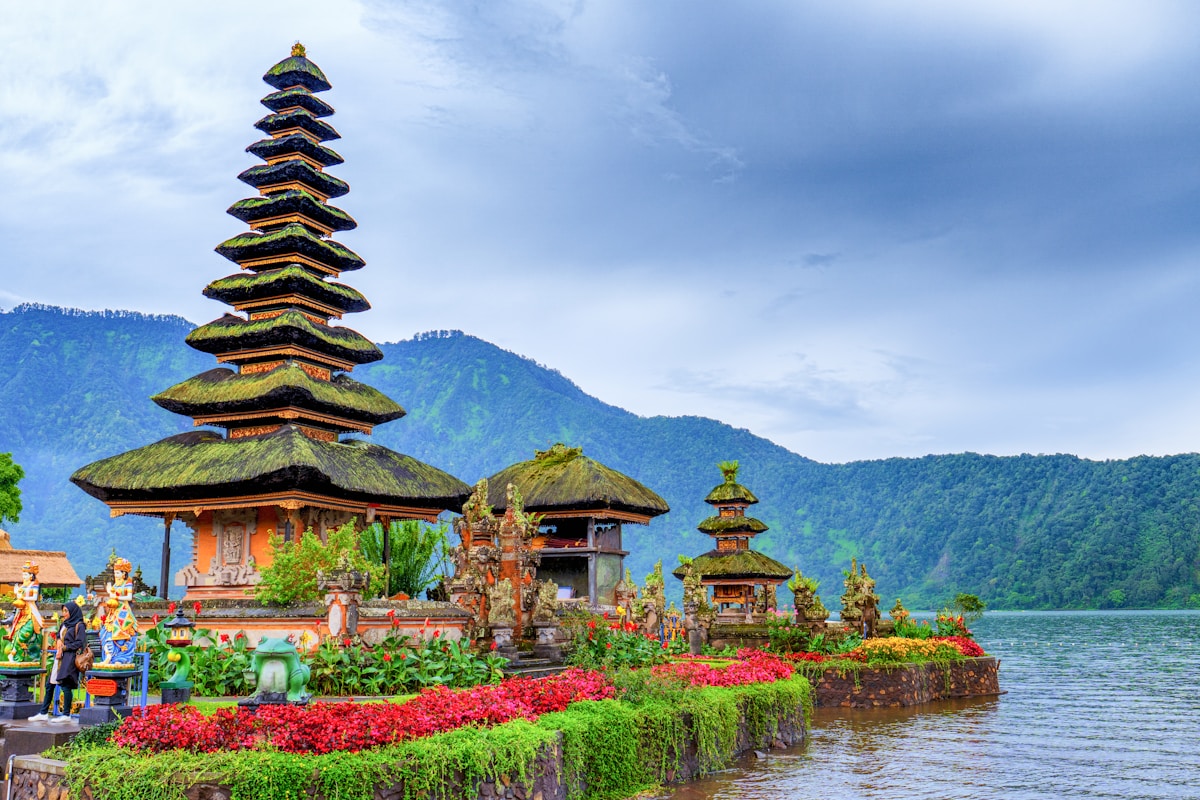
Pura Ulun Danu Bratan sits on a promontory at the edge of crater lake Danau Bratan, 1,239m above sea level. The pagoda towers appear to float on the lake surface at normal water levels - the image that appears on the 50,000 rupiah banknote. The highland setting is cool and frequently misty, with temperature around 18–22°C.
The temple is dedicated to the goddess Dewi Danu, deity of lakes and rivers - an important figure in Bali’s agricultural calendar. The surrounding Bedugul Botanical Gardens can be visited on the same trip.
Goa Gajah (Elephant Cave)
Location: 6km east of Ubud on the road toward Gianyar. Entry: approximately IDR 50,000 (as of 2026). Hours: 8am–5pm.
Goa Gajah is an 11th-century rock-carved cave in the Petanu River gorge. The entrance is carved in the form of a demon face - a kala head with bulging eyes and hands spreading across the stone - large enough to step through. Inside the small cave, a Ganesha statue and three-headed Shiva linga occupy the rear wall.
Below the cave, stepped terraces lead to a river valley where bathing pools and Buddhist stupas were uncovered during 1950s excavations. The site is compact but the craftsmanship of the cave entrance carving is exceptional.
Guided cultural tours in Bali offer expert commentary at temples and historical sites - especially useful at complex sites like Borobudur and Prambanan where the iconography needs explaining.
See Also
- Bali Hinduism guide - the beliefs and traditions behind Bali’s temple culture
- Bali festivals calendar - ceremony days when temples are most active and visually dramatic
- Uluwatu travel guide - the clifftop temple and the surrounding surf and dining area
- Things to do in Ubud - temple visits, rice terrace walks, and cultural experiences from Ubud
- Getting around Bali - how to reach outlying temples by scooter or hired driver