The colonial history of Indonesia is, at its origin, a story about nutmeg and cloves. In the early sixteenth century, these spices - available only from a handful of small islands in the eastern Indonesian archipelago - were worth more by weight than gold in European markets. The nation-state that emerged in 1945 was built on the ruins of a colonial enterprise that began with the spice trade and lasted three and a half centuries.
The Spice Trade and Portuguese Arrival
The Banda Islands in Maluku, a remote cluster of ten volcanic islands, were the only source of nutmeg in the world. The Moluccas more broadly produced the global supply of cloves. When Portuguese navigator Alfonso de Albuquerque captured Malacca in 1511, he opened the direct sea route to the Spice Islands and began European involvement in Indonesian trade.
The Portuguese established a presence in the Moluccas but never controlled the islands comprehensively. They left a more durable mark in eastern Indonesia, particularly Flores: Catholicism remains the dominant religion in Flores today, and Portuguese surnames persist in the Larantuka area on the island’s eastern tip. Place names across eastern Indonesia still reflect Portuguese usage.
The VOC: The World’s First Multinational Corporation
The Dutch arrived in the archipelago at the end of the sixteenth century with a more systematic commercial approach. In 1602, the Dutch Republic chartered the Vereenigde Oost-Indische Compagnie - the VOC, or Dutch East India Company - merging rival Dutch trading companies into a single entity with the legal power to wage war, negotiate treaties, establish colonies, and mint currency. It was effectively a state-sanctioned monopoly corporation.
The VOC’s strategy in the Banda Islands was brutal and consequential. In 1621, VOC Governor-General Jan Pieterszoon Coen ordered the systematic massacre of the Bandanese population after they continued to trade nutmeg outside the Dutch monopoly. An estimated 15,000 of the 17,000 Bandanese people were killed or died through starvation and displacement. The islands were subsequently repopulated with Dutch-owned plantations worked by slaves and indentured labourers.
This established the operational template: monopoly control over specific commodities, enforced through extreme violence where necessary, with the primary purpose of extracting profit for shareholders in Amsterdam.
Batavia: The Colonial Capital
The VOC established its Asian headquarters at the site of the Javanese city of Jayakarta in 1619, which Coen renamed Batavia. The city was designed to resemble Amsterdam - complete with canals, which proved disastrous in the tropical climate as standing water bred disease. Batavia became the administrative and commercial hub of the Dutch colonial empire in Asia, the centre through which spices, coffee, sugar, and later oil revenues flowed.
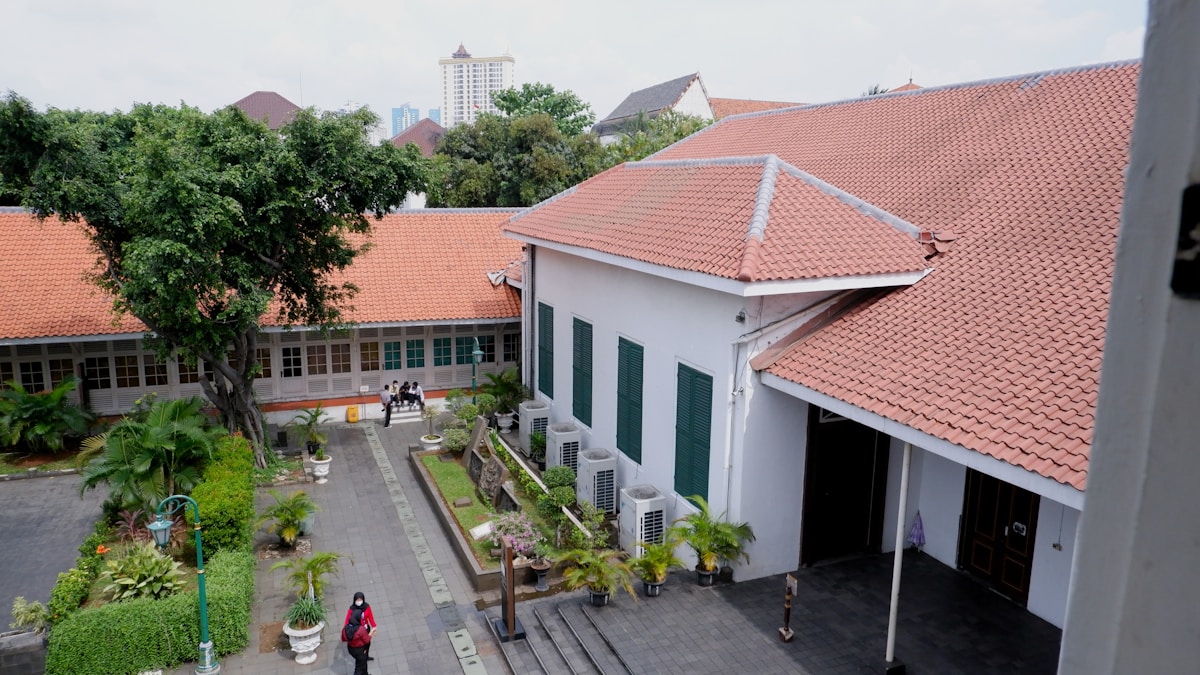
The old core of Batavia survives as Kota Tua (Old Town) in the north of modern Jakarta. The Fatahillah Square - previously the town square of colonial Batavia - is surrounded by restored colonial buildings including the Jakarta History Museum (entry approximately IDR 20,000 as of 2026), housed in the former town hall. The Dutch-designed canal network is still visible, though the canals are no longer navigable. Kota Tua is the most concentrated site of physical colonial heritage accessible to visitors in Indonesia.
From VOC to Crown Colony
The VOC collapsed under the weight of its own corruption and debt by the end of the eighteenth century, formally dissolved in 1799. Its assets and territories - including the entire Dutch East Indies - were transferred to the Batavian Republic, and later directly to the Kingdom of the Netherlands. What had been a corporate colony became a sovereign colony.
The early nineteenth century brought a period of particular hardship. The Cultivation System (Cultuurstelsel), introduced by Governor-General Van den Bosch in 1830, required Javanese farmers to devote 20 percent of their land - or 66 days per year of labour - to growing government-mandated export crops: coffee, sugar, indigo, and tea. The system generated enormous revenues for the Netherlands; it simultaneously produced famines in Java as food production was displaced by export cultivation. A series of crop failures in the 1840s and 1850s killed hundreds of thousands of people.
The Cultivation System was eventually phased out after the publication of Eduard Douwes Dekker’s 1860 novel Max Havelaar, a fictionalised account of colonial abuses that generated significant public pressure for reform in the Netherlands. Colonial policy shifted toward a more paternalistic “Ethical Policy” in the early twentieth century, which included limited investment in education and infrastructure - and which inadvertently created the educated Indonesian class that would lead the independence movement.
The Physical Legacy
Colonial architecture is visible across Java and in parts of eastern Indonesia:
Lawang Sewu, Semarang: A monumental Dutch-built colonial office complex completed in 1919 for the Dutch East Indies Railway Company. The name means “Thousand Doors” in Javanese, referring to the extraordinary number of floor-to-ceiling door panels throughout the building. Entry approximately IDR 20,000 as of 2026. The building also served as a Japanese prison during the Second World War; both histories are documented inside.
Fort Rotterdam, Makassar: A seventeenth-century Dutch fort built over the site of a Gowa Kingdom fortification after the Dutch defeated the Makassar Sultanate in 1669. The fort is well-preserved and houses two museums covering South Sulawesi history and the La Galigo manuscripts - among the world’s longest literary works. Entry approximately IDR 20,000 as of 2026.
Bandung’s colonial centre: The Dutch developed Bandung as a hill station retreat from the heat of Batavia. The city retains a significant concentration of Art Deco buildings from the 1920s–1930s. A walking map of Bandung colonial architecture is available from the tourism office near Merdeka Square.
Indonesian Independence
The Indonesian nationalist movement developed throughout the early twentieth century, accelerating after the Dutch colonial administration imprisoned and exiled key nationalist figures. Sukarno - who would become Indonesia’s first president - was exiled by the Dutch to Flores (1934–38) and then Bengkulu in Sumatra. It was during his exile in Ende, Flores, that he is credited with articulating the Pancasila, the five principles that became the ideological foundation of the Indonesian state.
The Japanese occupation of the Dutch East Indies from 1942–45 effectively destroyed Dutch colonial authority by demonstrating that a European colonial power could be expelled by an Asian military force. When Japan surrendered in August 1945, Sukarno and Mohammad Hatta moved quickly to fill the vacuum. On August 17, 1945, two days after Japan’s surrender, Sukarno proclaimed Indonesian independence from the residence of a Japanese Admiral in Jakarta.
The Dutch attempted to reassert control through two military operations (1947 and 1948–49) that they termed “police actions” - a designation rejected by both Indonesians and much of the international community. Under sustained pressure from the United States and the United Nations, the Netherlands formally recognised Indonesian sovereignty on December 27, 1949.
The Sukarno Museum in Ende (entry approximately IDR 15,000 as of 2026) is an accessible starting point for understanding the independence era. The proclamation site in Jakarta, now Jalan Proklamasi, has a monument and small park. The National Museum in Jakarta (entry approximately IDR 25,000 as of 2026) holds the most comprehensive collection of pre-colonial and colonial-era artefacts in the country.
Guided cultural tours in Indonesia offer expert commentary at temples and historical sites - especially useful at complex sites like Borobudur and Prambanan where the iconography needs explaining.
Search hotels in Indonesia on Booking.com
See Also
- Jakarta travel guide - the former Batavia: Kota Tua, Museum Fatahillah, and colonial-era landmarks
- Borobudur guide - pre-colonial monument that predates Dutch arrival by nine centuries
- Things to do in Jakarta - Kota Tua walking tour and the National Museum
- Ende travel guide - where Sukarno was exiled: the Sukarno Museum and Flores context
- Java island guide - the island where the VOC’s power was most deeply embedded