Search hotels in Bali on Booking.com
Bali is the only Hindu-majority island in Indonesia, a country that is otherwise approximately 87 percent Muslim. This is not an accident of geography but the result of a specific historical process: when Islamic kingdoms expanded through Java in the fifteenth and sixteenth centuries, the Majapahit Hindu-Buddhist court fled east to Bali, carrying with it the religious, artistic, and literary traditions that had defined Javanese high culture for centuries.
What developed on Bali over the subsequent five hundred years was not a transplanted Indian Hinduism preserved in amber, but something distinct - a synthesis of Indian Hindu theology, Mahayana Buddhist elements, and a pre-existing Balinese animist tradition that gave spiritual significance to local mountains, rivers, forests, and ancestral spirits. The result is Agama Hindu Dharma, the formal name for Balinese Hinduism as it is practised today.
How Balinese Hinduism Differs from Indian Hinduism
Visitors familiar with Indian Hindu traditions will notice significant differences in Bali.
The central organising principle of Balinese religious life is Tri Hita Karana - roughly translated as “three causes of well-being”. These are harmony between humans and God, harmony between humans and each other, and harmony between humans and the natural environment. This framework is not drawn from Sanskrit theology but from Balinese cosmological thinking, and it shapes how religious obligations are understood: ceremonies are not simply acts of personal devotion but maintenance of a cosmic order that requires constant attention.
The Balinese pantheon incorporates the major Hindu deities - Brahma, Vishnu, Shiva (unified in Bali as Sanghyang Widi Wasa, the Supreme Being) - but they share space with a vast array of local deities, ancestral spirits (pitara), and nature spirits (bhuta kala) that have no direct Indian equivalent. The mountain Gunung Agung is considered the seat of the gods; the sea is associated with negative forces and requires spiritual counterbalancing.
Buddhist elements are integrated rather than separate. The role of the high priest (Pedanda) and the use of Sanskrit mantras in ceremonies reflects the Majapahit court’s Shaivite-Buddhist religious synthesis. Balinese people do not generally distinguish between “Hindu” and “Buddhist” elements of their practice.
The Temple System
Bali is home to an estimated 20,000 temples (pura). Every village maintains three core temples corresponding to the Tri Hita Karana principle:
Pura Puseh (Temple of Origin): dedicated to the village founders and Vishnu. Typically sited at the upper (kaja, mountain-facing) end of the village.
Pura Desa (Temple of the Village): dedicated to Brahma, serving the social and community functions of the living village.
Pura Dalem (Temple of the Dead): dedicated to Shiva in his aspect as lord of death, associated with the cremation ground. Sited at the lower (kelod, sea-facing) end of the village.
Beyond the village triad, there are family temples, clan temples, rice-field temples, and a hierarchy of regional and state temples. The Pura Besakih (Besakih Temple) on the slopes of Gunung Agung is the most sacred of these - sometimes described as the Mother Temple of Bali. It is not a single temple but a complex of 23 separate temples, the largest and most important of which, Pura Penataran Agung, rises in a series of terraced courtyards up the volcano’s flank. Entry to the outer grounds is approximately IDR 60,000 as of 2026; inner sanctum access requires ceremonial dress and a guide arranged at the entrance.
Pura Luhur Batukaru on the slopes of Gunung Batukaru in Tabanan Regency is among the most atmospheric temple sites in Bali - set within dense rainforest at around 1,000 metres elevation, rarely crowded, and genuinely in use for active worship. Entry approximately IDR 30,000 as of 2026.
Pura Tanah Lot on the southwest coast is the most visited temple in Bali, set on an offshore rock accessible at low tide. It is most famous at sunset and correspondingly crowded; visit at mid-morning for a calmer experience. Entry approximately IDR 60,000 as of 2026.
The Pawukon Calendar and Odalan
Balinese religious life operates on two simultaneous calendrical systems. The Saka calendar (a lunar-solar calendar aligned with the wider Hindu calendar) governs major annual festivals. The Pawukon calendar - unique to Bali - is a 210-day cycle of interlocking weeks (ranging in length from one to ten days running simultaneously) that determines the timing of most temple ceremonies.
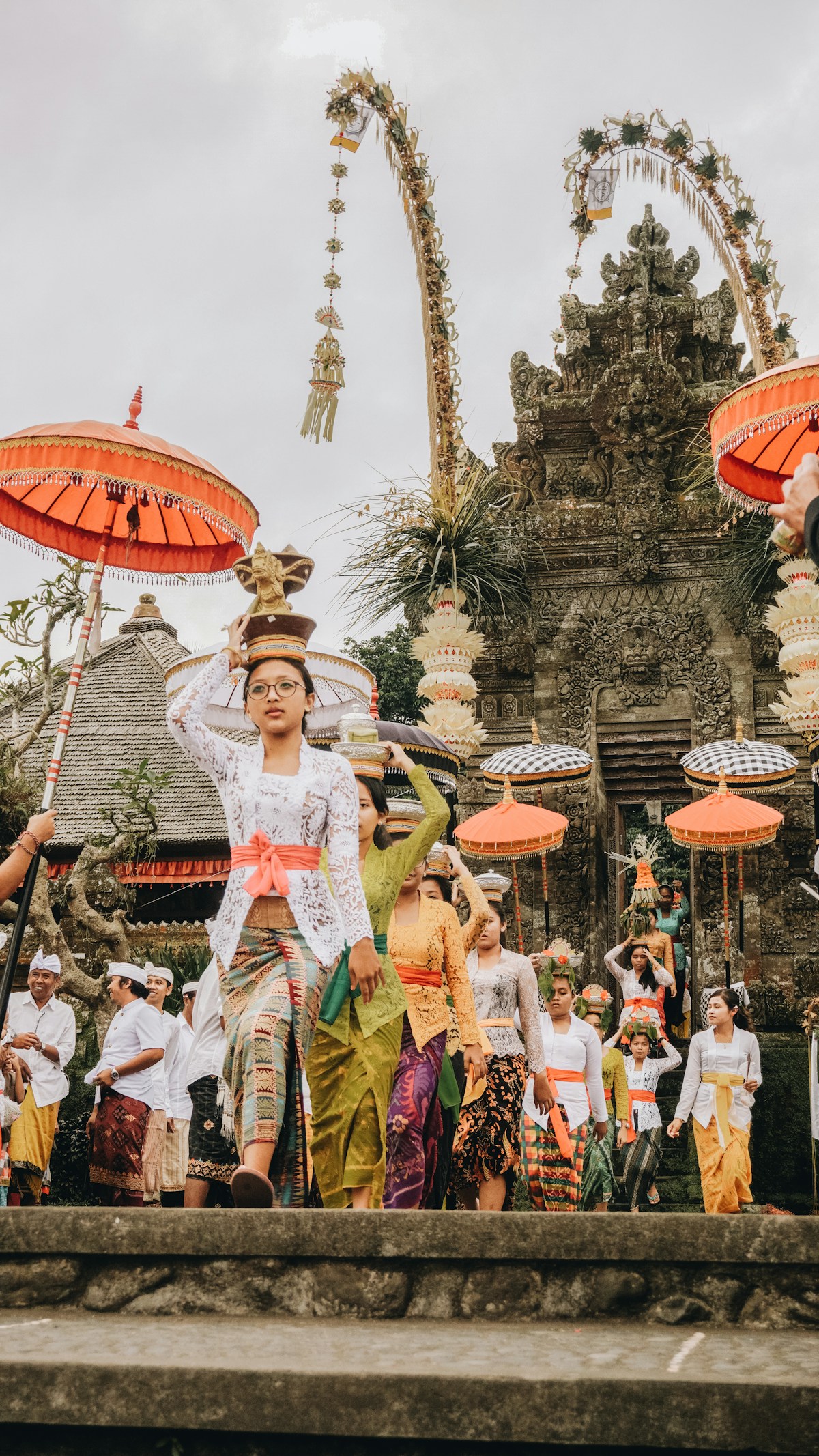
Each temple has an odalan - an anniversary celebration that recurs every 210 days. This is when the temple’s associated deities are considered to be present and when the full spectrum of offerings, music, dance, and prayer are performed. Depending on when you visit Bali, you will very likely encounter an odalan at a temple nearby - the frequency is approximately every six months per temple, and with 20,000 temples on the island, ceremonies are effectively constant somewhere.
Visitors are generally welcome to observe odalan ceremonies from outside the inner sanctum, provided they are dressed appropriately (sarong and sash, both required and available for rent at temple entrances for approximately IDR 20,000 as of 2026). Photography is permitted from outside but pointed cameras directly at worshipping people are intrusive.
Major Festivals
Galungan: Held once per Pawukon cycle (every 210 days), Galungan marks the victory of dharma over adharma. The 10-day festival begins with elaborate preparations - penjor (tall decorated bamboo poles) are erected outside every household - and culminates in Kuningan, when ancestral spirits are believed to return to their homes for a final visit before departing. The streets of Bali during Galungan are among the most visually compelling things the island offers.
Kuningan: The tenth day of the Galungan period. Yellow rice offerings (nasi kuning) are distinctive on this day. The morning is spent at family and village temples; the atmosphere is quieter and more personal than the Galungan opening.
Nyepi (Bali’s Day of Silence): Nyepi falls on the Saka new year, typically in March. It is the only day of genuine silence in Bali - no lights, no fires, no work, no travel, no noise. The entire island shuts down for 24 hours. Tourists staying in hotels must remain on the property. The night before Nyepi, the Ogoh-Ogoh parade takes place - enormous papier-mâché demon figures are paraded through the streets and burned to purge negative spirits before the new year begins.
Nyepi is the most unusual event on the Balinese calendar and one of the more extraordinary experiences available in Indonesia. The pre-Nyepi Ogoh-Ogoh parade is participatory, chaotic, and very loud; the silence that follows is total.
Visitor Etiquette at Temples
A few firm rules apply across all Balinese temples:
Sarong and sash are required. These can be rented at every major temple entrance. Shorts and sleeveless tops are not acceptable in the inner areas of any pura.
Menstruation: By traditional Balinese practice, women who are menstruating are asked not to enter temple inner sanctums. This is respected by most Balinese women and is posted at many temple entrances.
Behaviour: Loud voices, backs turned to shrines, and sitting in elevated positions (standing above an active offering is considered disrespectful) are all inappropriate. The guidance from temple staff should be followed without argument.
Offerings (canang sari): The small woven palm-leaf trays containing flowers, incense, and food that appear across Bali - on pavements, at shop entrances, on dashboards - are daily offerings made by Balinese women. Do not step on them, disturb them, or treat them as decorations for photographs.
The constant presence of ceremony, offering, and active faith in Bali is not a performance staged for tourism. It is how life on the island is organised. The most respectful approach is to observe carefully and follow local guidance.
Guided cultural tours in Bali offer expert commentary at temples and historical sites - especially useful at complex sites like Borobudur and Prambanan where the iconography needs explaining.
See Also
- Bali temples guide - Tanah Lot, Uluwatu, Besakih, and the most important sacred sites
- Bali festivals calendar - the ceremonial events that flow from the beliefs described here
- Nyepi: Bali’s Day of Silence - the most significant day in the Balinese Hindu calendar explained for visitors
- Bali island guide - the full Bali overview including cultural calendar
- Ubud travel guide - the cultural centre of Bali where Hinduism is most visibly practised