Search hotels in Bali on Booking.com
Bali’s festival calendar is among the richest in Asia - a consequence of the island’s living Balinese Hindu tradition, which maintains a ceremonial rhythm that governs everything from rice harvests to temple anniversaries to the positioning of the planets. For travellers, this means there is almost always something happening, but some events demand specific planning or impose genuine constraints on movement.
The Balinese Calendar System
Understanding Bali’s festivals requires knowing that the island follows two parallel calendar systems:
Saka calendar: A lunar calendar, used for temple ceremonies tied to the moon’s phases. Galungan, Kuningan, and Nyepi are calculated on this system.
Pawukon calendar: A 210-day cycle of 35 weeks, each week having different ritual significance. Galungan falls on Budha Kliwon Dungulan (a specific intersection of days in this cycle). Because 210 days does not align cleanly with a solar year, Galungan falls on different Gregorian dates each year and can occur twice in one Gregorian year.
The practical implication: always verify festival dates for your specific travel year before booking.
Major Bali Festivals
Galungan
What it is: The most important festival in the Balinese Hindu calendar. Galungan marks the victory of dharma (good) over adharma (evil) and celebrates the return of ancestral spirits to earth for 10 days.
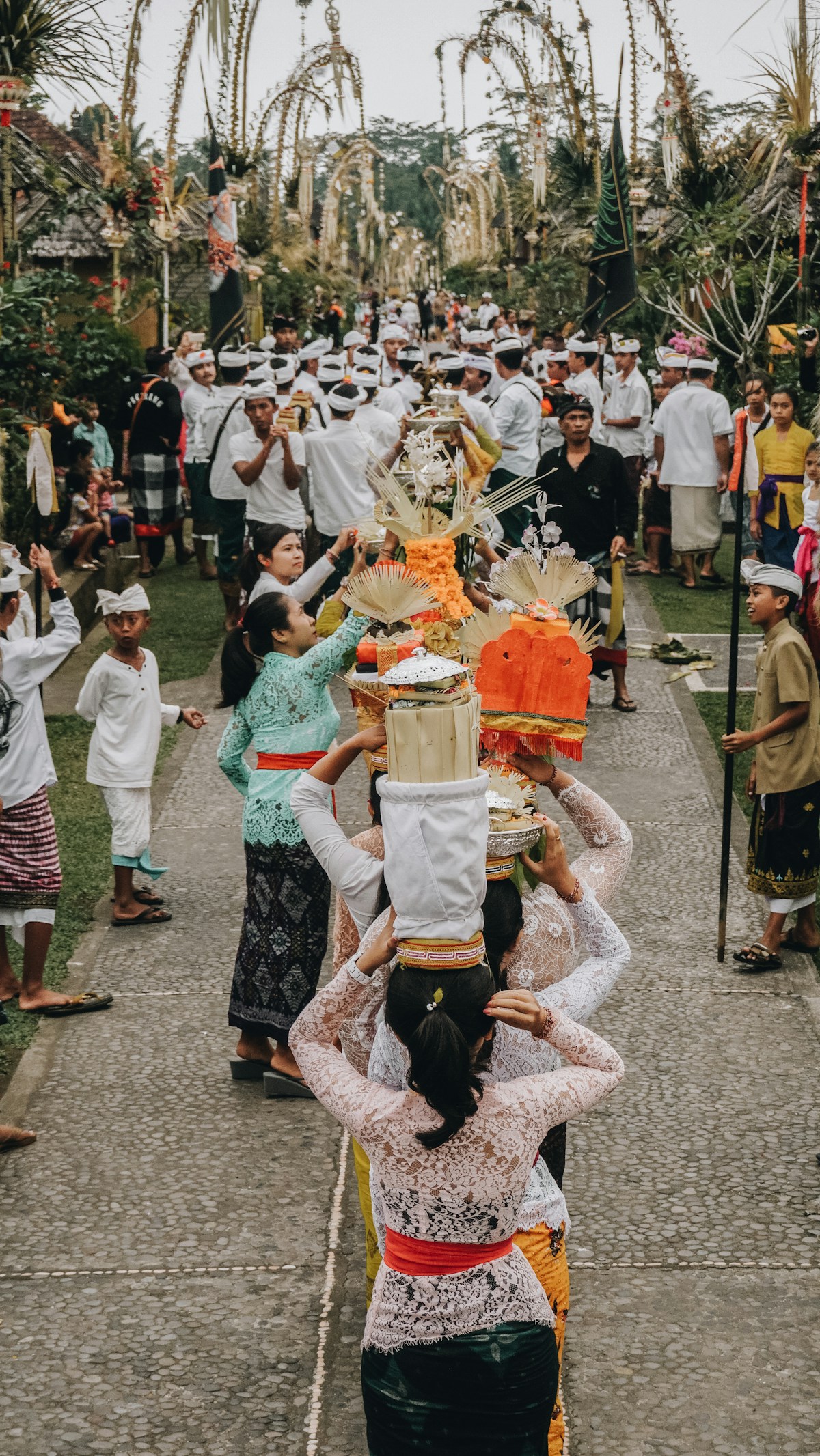
What happens: Every village and family compound erects tall bamboo poles decorated with coconut-leaf offerings called penjor along the roadsides. The effect - tens of thousands of arching bamboo poles lining every street - transforms the island visually. Families gather for prayers, offerings are brought to temples, and there is a quiet, celebratory atmosphere.
For travellers: This is one of the best times to be in Bali if you want to see Balinese culture in full expression. The atmosphere is warm and community-focused. Accommodation books out quickly - reserve at least 8 weeks ahead.
When: Every 210 days. 2026: 17 June (Kuningan 27 June). 2027: 13 January and 11 August. Verify current year dates before booking.
Kuningan
What it is: The final day of the Galungan period, 10 days after Galungan itself, when the ancestral spirits return to the spiritual realm. Marked by yellow rice (nasi kuning) and yellow decorations throughout the island.
What happens: Morning temple prayers across the island. The penjor poles come down. A quieter, more reflective atmosphere than the Galungan opening days.
When: 10 days after Galungan.
Nyepi - The Day of Silence
What it is: The Balinese New Year according to the Saka calendar, and one of the most distinctive events in Southeast Asia. Nyepi is a mandatory day of silence, fasting, and meditation across the entire island.
The four prohibitions (Catur Brata Penyepian):
- No fire or light (Amati Geni)
- No working (Amati Karya)
- No travelling (Amati Lelungan)
- No entertainment (Amati Lelanguan)
What this means in practice: Ngurah Rai Airport closes entirely for approximately 24 hours. All road traffic stops - even motorbikes. Shops and restaurants are shuttered. Tourists must remain in their accommodation. The only people permitted outdoors are Pecalang (traditional Balinese security guards) who patrol to enforce silence.
The result: Bali at night on Nyepi is completely dark and silent - an almost unimaginable stillness. From hotel rooftops, you can see the Milky Way without light pollution. Many travellers who experience it describe it as one of the most memorable nights of their lives.
Practical note: If you are flying into Bali around Nyepi, check your flight date meticulously. Flights are cancelled the day before (check-in is complicated) and on Nyepi day. The airport typically reopens early morning the day after.
When: Usually March or April. Date changes annually with the Saka lunar calendar.
Ogoh-Ogoh Parade (Eve of Nyepi - Pengerupukan)
What it is: The evening before Nyepi, every banjar (village community) parades their Ogoh-Ogoh - enormous papier-mâché demonic figures - through the streets in an explosion of torchlight, gamelan percussion, and ceremonial noise.
Purpose: To drive away bhuta kala (malevolent spirits) before the silence of Nyepi. The noise and procession are intended to purify the island.
What to expect: Ogoh-Ogoh figures can reach 4–6 metres in height. They are built over weeks by village youth groups in a community effort that is itself a major social event. The best processions are in Denpasar (the most elaborate, with dozens of villages competing) and in Ubud (more accessible for tourists, slightly smaller scale).
Viewing tips: Position yourself on the roadside by early evening - processions typically start around 6–8pm. Denpasar’s central streets and Ubud’s main market area are popular viewing spots. The atmosphere is carnival-like, with food stalls and crowds, until the procession ends and silence begins at midnight.
Saraswati Day
What it is: A celebration of Saraswati, the Hindu goddess of knowledge, arts, and wisdom. On this day, books, lontar manuscripts, and tools of learning are considered sacred and should not be read or used.
What happens: Schools and offices hold ceremonies. Balinese children bring offerings of books and stationery to their school shrines. Temples hold special prayers. The atmosphere is warm and family-oriented.
When: Every 210 days on the Pawukon calendar - coincides roughly with every Galungan cycle. Usually falls on a Saturday.
Bali Arts Festival (Pesta Kesenian Bali)
What it is: An annual government-sponsored arts festival held at the Werdi Budaya Cultural Centre in Denpasar every June–July. The festival runs for approximately one month and showcases traditional Balinese and Indonesian performing arts - Kecak dance, Barong dance, gamelan competitions, weaving demonstrations, and visual arts exhibitions.
For travellers: One of the best opportunities to see multiple forms of traditional Balinese performance in one venue. Entry to most events is free or very low cost (approximately IDR 25,000–50,000 as of 2026).
Location: Taman Werdhi Budaya, Denpasar | When: June–July annually (check Bali Tourism for exact dates)
Purnama (Full Moon Ceremonies)
Every full moon, Balinese temples hold Purnama ceremonies. Near major temples - Pura Besakih, Pura Tanah Lot, Pura Ulun Danu Bratan - full moon evenings draw considerable numbers of worshippers and are particularly atmospheric.
Practical note: Full moon is also the time for prayers at sea temples and beach shrines. On Kuta beach and Sanur beach, you may encounter small community ceremonies at dusk on full moon evenings.
Melasti Purification Ceremony
What it is: The large purification procession held 3 days before Nyepi. Entire villages make a pilgrimage to the sea or nearest body of water to purify sacred objects (pratima) from their temples. Long processions of thousands of people in white traditional dress carry gilded temple palanquins, umbrellas, and offerings.
Where to see it: On the beach at Kuta, Sanur, and Seminyak. The processions along coastal roads in southern Bali are particularly striking. Check the date of Nyepi and subtract 3 days.
Festival Calendar at a Glance
| Event | Timing | Notes |
|---|---|---|
| Galungan | Every 210 days (2026: 17 Jun; 2027: 13 Jan, 11 Aug) | 10-day celebration period |
| Kuningan | 10 days after Galungan | End of Galungan period |
| Saraswati | Every 210 days | Day before Galungan period opens |
| Melasti | 3 days before Nyepi | Coastal purification procession |
| Ogoh-Ogoh Parade | Eve of Nyepi (Mar/Apr) | Best in Denpasar and Ubud |
| Nyepi | Mar/Apr (Saka New Year) | Full island shutdown - check flights |
| Bali Arts Festival | June–July | Month-long, Denpasar |
| Purnama (Full Moon) | Monthly | Temple ceremonies island-wide |
All dates shift annually - verify for your travel year on the Bali Government Tourism Board website.
Visitor Guidelines at Balinese Ceremonies
Dress appropriately: A sarong and sash (selendang) are required near active temple ceremonies. Most temple entrances have loaners available; buying your own from a market (approximately IDR 30,000–50,000) is worth it for regular visits.
Ask before photographing: In most procession settings, photography is welcomed. Inside active inner temple courtyards (jeroan), ask permission before photographing priests or sacred objects. If someone signals no, respect it immediately.
Keep a respectful distance: Stand to the side of processions rather than in the middle. Don’t block or cross a line of offerings being carried. If you’re unsure, watch what respectful Balinese observers do and follow their lead.
During Nyepi: Your accommodation will brief you on the rules. Most hotels provide candles and meals in your room. The silence is real - staff walking the grounds speak quietly and lights are kept low.
Browse Bali tours and experiences - activities can be booked last-minute in most cases, though peak season (July–August) fills up quickly. For inter-island travel, Bookaway lets you search and book ferry, bus, and train connections across the archipelago in one place.
See Also
- Nyepi: Bali’s Day of Silence - the full guide to what Nyepi involves and how it affects visitors
- Bali Hinduism guide - the beliefs and ceremonies behind Bali’s festival calendar
- Bali temples guide - Pura Besakih, Tanah Lot, and the temples where ceremonies take place
- Best time to visit Indonesia - how Bali’s festival calendar affects the ideal travel months
- Bali island guide - the full Bali overview including cultural calendar and travel planning
Ready to Plan Your Trip?
See our itineraries for inspiration:
- 1 Week in Bali - day-by-day first-timer’s guide with costs
- 3 Days in Bali - the perfect short trip covering the essentials
- 5-Day Bali Honeymoon Itinerary - Seminyak, Ubud and Uluwatu
- 2 Weeks in Bali & Lombok - Ubud, Nusa Penida, Amed, and the Gili Islands
Plan Your Trip
✈️ Book your flights to Indonesia 🛡️ Get travel insurance 📱 Stay connected with an eSIM 🚗 Rent a car