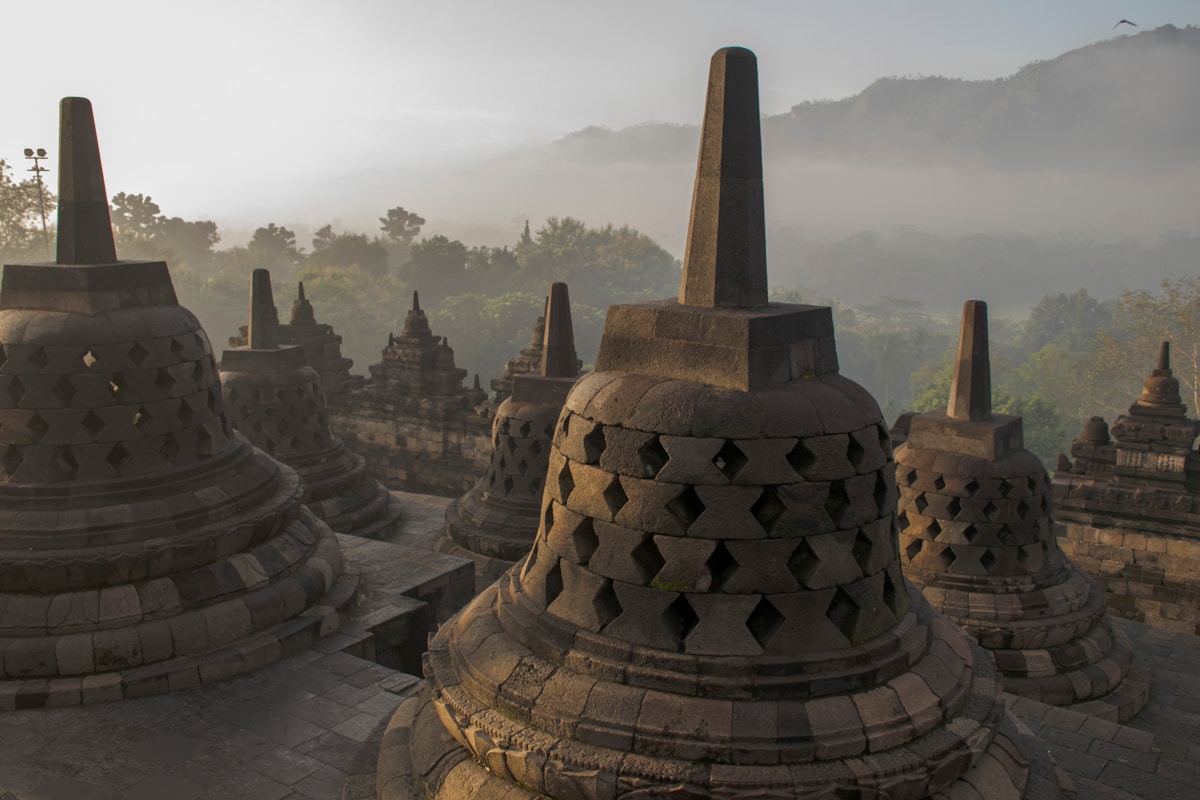
If Borobudur represents the Buddhist peak of ancient Java, Prambanan is its Hindu counterpart - a dramatic compound of slender spires rising 47m above the Yogyakarta plain, built by the rival Sanjaya dynasty roughly in the same era as Borobudur, just 17km to the east. The two great temple complexes, standing within sight of each other, represent the extraordinary religious and architectural output of 9th-century Central Java at its most ambitious.
Prambanan was designated a UNESCO World Heritage Site in 1991 alongside Borobudur.
History
Construction began around 850 CE under the Sanjaya dynasty - the Hindu ruling house of Mataram Kingdom - as a statement of dynastic power and religious devotion to the Trimurti: Brahma (the creator), Vishnu (the preserver) and Shiva (the destroyer). The Shiva temple - the tallest at 47m - is dedicated to Shiva in his aspect as Mahadeva; inside the main chamber stands a 3m statue of the god.
At its height, the compound contained 240 temples across three concentric zones. Most of the outer temples are now collapsed; the inner compound containing the three Trimurti temples and their paired vahana (vehicle) temples has been partially restored.
A catastrophic earthquake - scholars believe a major seismic event struck Central Java around the 10th century - severely damaged the complex. The court moved east; the temples were abandoned and further damaged by later earthquakes over the centuries. The 2006 Yogyakarta earthquake caused additional structural damage to restored sections; restoration work continues at several points of the complex.
Despite incomplete restoration, the standing temples are extraordinary: the Shiva temple’s internal chambers hold four niches with statues of Shiva, Agastya, Ganesha and Durga (the Durga statue, locally called Loro Jonggrang after a princess of local legend, is the finest sculpture in the complex).
The Main Temples
Shiva Temple (Candi Siwa) - 47m tall; the centrepiece of the compound; inner sanctuary contains the Shiva Mahadeva statue and the Durga sculpture; the most important temple in the complex.
Brahma Temple (Candi Brahma) - 33m; south of the Shiva temple; Ramayana reliefs continue from the Shiva temple onto this building - visitors walk the gallery clockwise to follow the narrative.
Vishnu Temple (Candi Wisnu) - 33m; north of the Shiva temple; Krishna reliefs.
Vahana Temples - Three smaller temples opposite the Trimurti temples house the divine vehicles: Nandi (bull) for Shiva, Angsa (goose) for Brahma, and Garuda (eagle) for Vishnu.
The Ramayana Ballet
The Prambanan Ramayana Ballet is one of the great cultural performances of Southeast Asia. Performed outdoors on a stage with the illuminated Prambanan towers as backdrop, the performance runs on full moon nights from June through October and also on selected dates in an indoor amphitheatre year-round.
The ballet tells the Ramayana epic - the abduction of Sita by the demon king Ravana, Rama’s alliance with the monkey general Hanuman, the battle and rescue - through classical Javanese dance, gamelan music and elaborate costumes. The outdoor full moon performance is the definitive experience.
Tickets: approximately IDR 150,000 for the indoor performance to IDR 350,000 for the outdoor full moon show (as of 2026). Book in advance through prambanan.com - outdoor performances sell out, particularly in peak season (July–August).
Entry
Entry fee: approximately IDR 525,000 per foreign visitor (as of 2026). Hours: 6am–5pm daily.
A sarong must be worn when walking in the inner temple compound - available free at the entrance. The standard circuit through the inner compound and around the main temple galleries takes approximately 1.5–2 hours.
Combo Ticket with Borobudur
A combo ticket covering both Prambanan and Borobudur costs approximately IDR 1,000,000 (as of 2026) - a significant saving versus separate admission. Valid for visits to both sites within 2 consecutive days. Most Yogyakarta visitors do both in a single day: Borobudur sunrise + morning, Prambanan afternoon.
Getting There
Prambanan lies 17km east of central Yogyakarta on the main road toward Solo, on the border of the Special Region of Yogyakarta and Central Java province.
- Trans Jogja bus (Route 1A/1B): departs from several points in central Yogyakarta; approximately IDR 4,500; stops directly at the Prambanan temple complex. Allow 45–60 minutes.
- Taxi / ride-share: approximately IDR 60,000–100,000 one-way from central Yogyakarta; approximately 30 minutes by road.
- Bicycle: several guesthouses in Yogyakarta rent bicycles; the route via back roads is flat and approximately 1.5 hours each way - a popular option for visitors with a day to spare.
- From Solo: 1 hour by taxi (approximately IDR 100,000–150,000); regular bus connection (approximately IDR 8,000).
Search hotels in Prambanan on Booking.com
Practical Notes
- The compound is exposed with minimal shade - visit in the morning before 11am or in the late afternoon (after 3pm) to avoid the midday heat.
- A licensed guide can be hired at the entrance for approximately IDR 100,000–150,000 for a 1.5-hour tour; the Ramayana relief sequence on the temple galleries is difficult to follow without explanation.
- The surrounding Prambanan Archaeological Park contains additional temple sites within walking distance, including Candi Lumbung (Buddhist) and Candi Bubrah - entry is included with the main ticket.
- Photography inside the temples is permitted but flash photography in the dark inner chambers is best avoided to preserve the atmosphere.
Guided cultural tours from Yogyakarta offer expert commentary at temples and historical sites - especially useful at complex sites like Borobudur and Prambanan where the iconography needs explaining.
See Also
- Yogyakarta travel guide - the full city guide: where to stay, eat, and explore during your Prambanan base
- Borobudur guide - the world’s largest Buddhist temple, 40 km west of Yogyakarta and a natural pairing
- Yogyakarta 3-day itinerary - the most efficient route through Borobudur, Prambanan, the Kraton, and Taman Sari
- Batik Java guide - the textile tradition woven into the culture surrounding these temple sites
- Things to do in Yogyakarta - Prambanan in context with the Kraton, Taman Sari, and other cultural sites