Search hotels in Borobudur on Booking.com
There is a moment at Borobudur - typically just after the sun clears the ridge of the Menoreh Hills to the east and sends the first light across the stone terraces - when the scale of what was built here in the 9th century becomes fully apparent. Ten million stone blocks. Five hundred Buddha statues. Two thousand six hundred relief panels that wrap around nine stacked terraces in a continuous narrative of Buddhist cosmology. The temple was abandoned for centuries and swallowed by jungle before a young colonial administrator named Thomas Stamford Raffles rediscovered it in 1814.
Borobudur is the world’s largest Buddhist monument. It is also one of the great religious achievements of human civilisation.
History
Construction began around 760 CE under the Sailendra dynasty, the Buddhist rulers of Central Java who dominated the region through trade and agricultural wealth. The temple was completed approximately 75 years later, around 830 CE. It was a functioning pilgrimage and ritual site for roughly 500 years.
By the 14th century, as Islam spread across Java and the Sailendra dynasty declined, Borobudur fell out of use. The jungle reclaimed it; by 1800 it was largely buried under volcanic ash and overgrowth, known to locals but not documented by European observers.
Raffles, then Lieutenant-Governor of Java under British administration, assigned Dutch engineer Herman Cornelius to lead excavation in 1814. The first systematic clearing revealed the temple’s true scale. Later restorations, including a UNESCO-sponsored project from 1975–1982 that dismantled and reassembled over 800,000 stones, brought Borobudur to its current state.
UNESCO World Heritage Site designation followed in 1991.
Architecture & Structure
Borobudur is built on a natural hill and consists of nine stacked platforms - six square lower levels and three circular upper levels - representing the three realms of Buddhist cosmology:
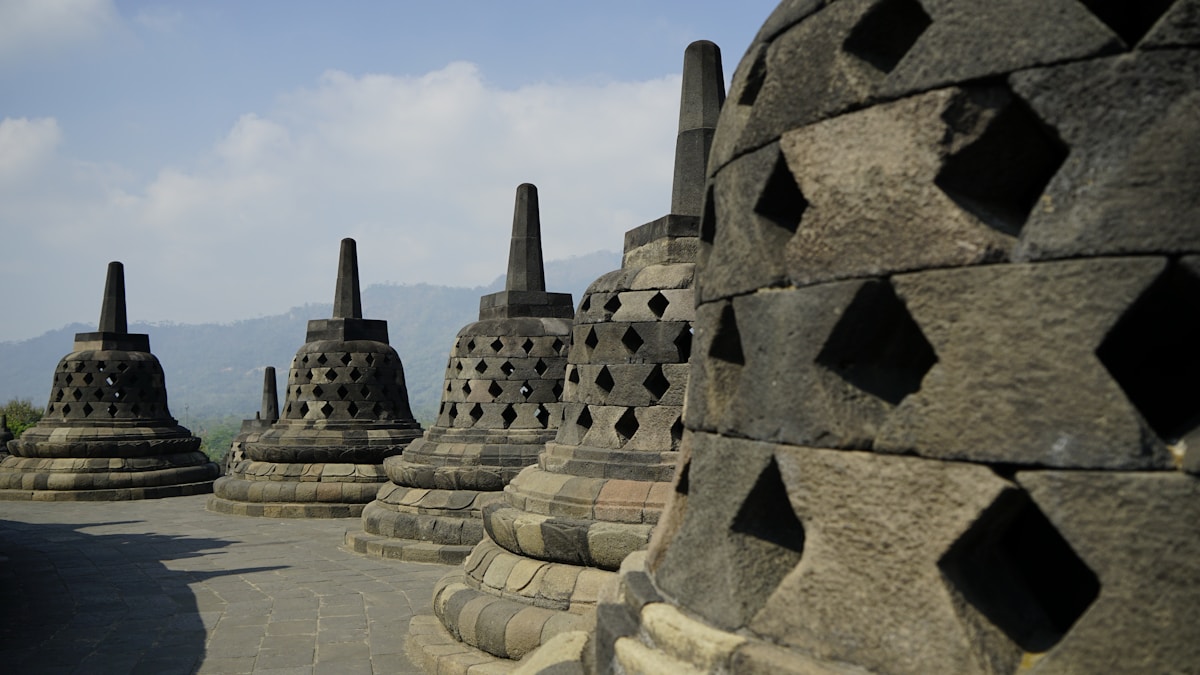
Kamadhatu (realm of desire) - the base, partially buried; some relief panels visible Rupadhatu (realm of form) - the six square terraces; 2,672 relief panels depicting scenes from the life of Buddha, Jataka tales and illustrations of cause and effect Arupadhatu (realm of formlessness) - the three circular terraces; 72 perforated stupas each containing a seated Buddha statue; the main stupa at the centre rises 35m above the base
The relief panels on the Rupadhatu terraces, if laid end to end, would stretch approximately 6km. They represent the most extensive and best-preserved collection of Buddhist narrative carving in the world.
The Sunrise Tour
The most popular way to visit Borobudur is the sunrise package - access before the general public entry opens, allowing visitors to climb the terraces as the sun rises over the volcanic landscape.
Sunrise package: approximately IDR 925,000 per foreign visitor (as of 2026), including access from approximately 4:30am and a small buffet breakfast. Book in advance at borobudurpark.com - tickets sell out on popular dates, particularly weekends.
The sunrise view from the upper circular terraces is genuinely exceptional: the three volcanic peaks of Merapi, Merbabu and Sundoro visible on clear mornings, the temple lit in warm light, and the density of surrounding forest turning gold. Go on a weekday for the least crowded experience.
Standard Entry
Standard entry opens at 6am. Entry fee: approximately IDR 750,000 per foreign visitor (as of 2026). Hours: 6am–5pm daily.
A sarong must be worn over clothing while in the temple complex - sarongs are provided free of charge at the entrance.
Guides
Temple guides are available at the entrance for approximately IDR 150,000–250,000 for a 1.5-hour tour (as of 2026). A good guide transforms the relief panels from decorative stone carvings into a comprehensible narrative - understanding the sequence of stories depicted across the nine terraces significantly deepens the experience. Recommended particularly for first-time visitors.
Getting There
Borobudur is 40km northwest of Yogyakarta in Magelang regency. Transport options from Yogyakarta:
- Taxi / ride-share: approximately IDR 200,000–350,000 one-way; approximately 1 hour. Most efficient option and widely used.
- Organised tour: most Yogyakarta hotels and guesthouses offer half-day Borobudur tours including transport, guide and entry from approximately IDR 300,000–500,000 per person. Verify whether entry fee is included. For sunrise packages and combo tours that include Prambanan, Borobudur sunrise tours and guided visits can be booked in advance with instant confirmation.
- Trans Jogja bus: public bus to Jombor terminal, then direct bus to Borobudur; cheapest option at approximately IDR 30,000–50,000 total but slower.
The temple grounds include a large car park and a full complex with restaurants, toilets and museum buildings. The main temple itself has a timed entry quota - in peak season, access to the upper terraces is managed.
Combining Borobudur with Prambanan
A combo ticket covers both Borobudur and Prambanan (Java’s great Hindu temple complex, 17km east of Yogyakarta) and offers better value than purchasing separately - approximately IDR 1,000,000 as of 2026 compared to approximately IDR 1,275,000 for separate tickets. The two temples are on the same day-trip circuit from Yogyakarta and complement each other perfectly: Borobudur in the morning, Prambanan in the afternoon.
Practical Notes
- Bring water and a hat; the upper terraces are exposed and can be very hot by mid-morning.
- Comfortable flat shoes are essential - the stone paths and terrace edges are uneven.
- Drones are prohibited within the temple complex.
- Photography is unrestricted in most areas; touching or climbing on the stupas is not permitted.
- The Borobudur Archaeological Park surrounding the temple also includes Mendut Temple and Pawon Temple - smaller Buddhist temples along the original pilgrimage route from Borobudur. Both are free to enter and worth a brief visit if time allows.
- The temple village below sells batik, handicrafts and snacks; prices are higher than in Yogyakarta - save shopping for the city.
See Also
- Yogyakarta travel guide - the base city for Borobudur: accommodation, restaurants, and the wider temple circuit
- Prambanan temple guide - Java’s great Hindu temple complex, 40 km east - the natural pairing with Borobudur
- Yogyakarta 3-day itinerary - Borobudur sunrise, Prambanan, and the Kraton in three days
- Indonesia colonial history - the Dutch era and how colonial archaeology shaped our understanding of Borobudur
- Batik Java guide - the textile tradition connected to the Magelang region and Java’s Buddhist heritage