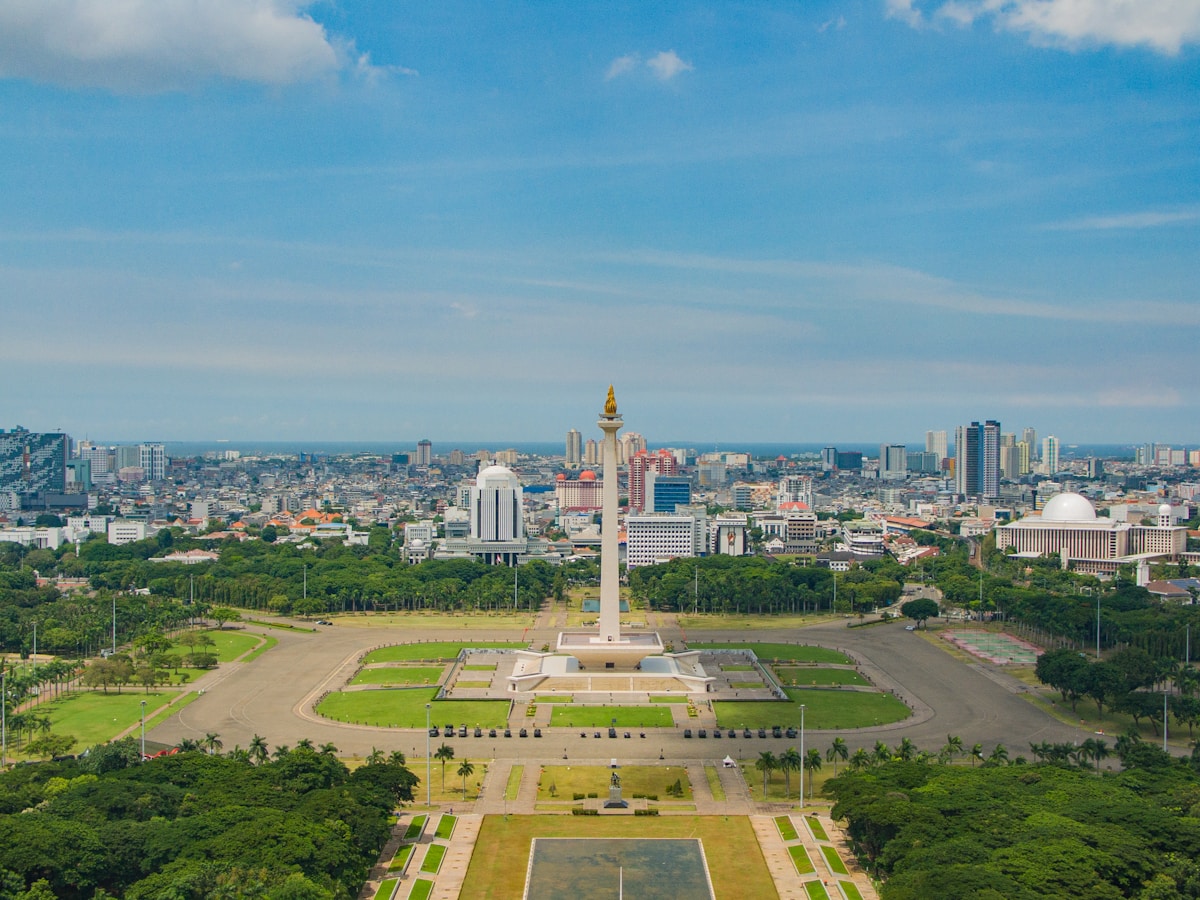
Jakarta is not the easiest city to love at first encounter - a megalopolis of 30 million people spread across a flat, traffic-clogged coastal plain is not naturally tourist-friendly. But it contains genuinely world-class sights: a Dutch colonial old town, one of Southeast Asia’s best modern art museums, two of Indonesia’s most symbolically important religious buildings standing side by side, and a food scene that draws from every Indonesian region. The key is planning around the MRT and avoiding road travel during peak hours.
1. Kota Tua (Old Batavia)
The former Dutch colonial town centre - known as Batavia under VOC rule from 1619 to 1799 - survives as a cluster of well-preserved 17th and 18th-century buildings around Fatahillah Square. The square itself is one of the largest in Jakarta and fills with locals cycling hired bicycles on weekend mornings.
Fatahillah Square Museums
Museum Fatahillah (Jakarta History Museum) occupies the 1707 City Hall building and houses collections on Batavia’s colonial history, including the original city scale models, colonial furniture, and documentation of the trade empire that made Batavia one of Asia’s wealthiest ports.
- Entry: IDR 20,000 | Hours: Tuesday–Sunday 9am–3pm
Wayang Museum holds one of Indonesia’s most significant collections of wayang (puppet) art - kulit (shadow), golek (wooden rod), and klitik puppets from across the archipelago. Small, walkable, and undervisited.
- Entry: IDR 5,000 | Hours: Tuesday–Sunday 9am–3pm
Museum Bank Indonesia tells the story of Indonesian economic history from colonial trade through to the modern central bank. Free and considerably more interesting than it sounds - the building itself is a 1909 Dutch bank HQ.
- Entry: Free | Hours: Monday–Friday 8am–3:30pm, Saturday–Sunday 9am–4pm
Café Batavia
The most atmospheric colonial-era café in Jakarta, occupying a 19th-century trading house on the northern edge of Fatahillah Square. Vintage photographs crowd the walls; the upstairs dining room overlooks the square. Come for the setting; the food and prices (approximately IDR 100,000–200,000 for mains) are secondary.
2. National Monument (Monas)
The 132-metre obelisk at the centre of Merdeka Square is Jakarta’s most recognisable landmark - a 1975 monument to Indonesian independence built at the direction of President Sukarno. The viewing gallery at the top provides a panoramic view across a city whose scale only becomes apparent from altitude.
Grounds: Free to enter | Lift to top: Approximately IDR 20,000 | Hours: Tuesday–Sunday 9am–4pm (check for closures during national events, which frequently take over the square)
The underground national history museum within the monument base is worth the additional entry fee for context before exploring the rest of the city.
3. Istiqlal Mosque and Cathedral Jakarta
Two of Jakarta’s most powerful symbols stand directly across the street from each other on Jl Lapangan Banteng: Istiqlal Mosque - the largest mosque in Southeast Asia, completed in 1978 - and the Dutch-built Cathedral of Our Lady of the Assumption (1901). The juxtaposition is intentional and is frequently cited as an expression of Indonesian religious pluralism (Pancasila’s first principle: belief in one God).
Istiqlal Mosque: Free entry for visitors; dress modestly - long clothing, head covering for women | Hours: Saturday–Thursday for non-worshippers; closed during Friday prayers
Cathedral: Free entry | Hours: Open to visitors daily except during services
Guided tours of Istiqlal are available and provide context about the mosque’s scale (can hold 120,000 worshippers), architecture, and significance.
4. MACAN Museum of Modern and Contemporary Art in Nusantara
The most serious contemporary art museum in Indonesia, MACAN opened in 2017 with a permanent collection spanning Indonesian and international modern and contemporary art and a rotating programme of major international exhibitions.
Entry: IDR 100,000–150,000 depending on exhibition | Hours: Tuesday–Sunday 10am–8pm
The building (in the Kebon Jeruk area, accessible by Grab) is well-designed for the work shown. The café is good. If you have even a passing interest in contemporary art, this is worth two hours of a Jakarta visit. Check the current exhibition programme before visiting - the rotating shows vary considerably in ambition.
5. Ragunan Zoo
Jakarta’s zoo is one of Southeast Asia’s largest - 147 hectares of green space in the Pasar Minggu area containing over 4,000 animals including Sumatran tigers, orangutans, Javan rhinoceroses, Komodo dragons, and the full array of Indonesian endemic species.
Entry: IDR 25,000 | Parking: IDR 5,000 | Hours: 7am–5pm daily
Ragunan is as much a park as a zoo - Jakartans use it for morning exercise, family picnics, and weekend escapes from the city’s density. For visitors interested in Indonesian wildlife before (or instead of) visiting national parks, the concentration of endemic species is unmatched.
6. Tanah Abang Textile Market
The largest textile market in Southeast Asia occupies a multi-storey complex in central Jakarta. Thousands of stalls sell batik, ikat, songket, lace, sarongs, and industrial quantities of fabric by the roll. The busiest section is the main building on Jl Jatibaru Raya.
Entry: Free | Hours: Monday–Saturday approximately 8am–5pm; closed Sunday
The market is not tourist-oriented - it serves Indonesian fashion businesses, tailors, and retailers. This makes it more authentic and more chaotic. Navigation requires patience; taxis and ojek (motorcycle taxi) are the practical way in and out, as the surrounding roads are perennially jammed.
Practical Tips for Getting Around Jakarta
Jakarta’s traffic is among the worst of any city in the world. The MRT Jakarta (currently running from Lebak Bulus in the south to Bundaran HI in the centre, with extensions underway) reduces cross-city travel time significantly for north–south journeys. Use it wherever the route permits.
For sights not on the MRT line: Grab and Gojek are reliable and significantly cheaper than conventional taxis. Avoid booking road transport during morning peak (7–9am) and evening peak (5–8pm) when journey times double or triple.
Kota Tua is accessible from Kota station on the Commuter Line - a fast, cheap option from the central hotel districts.
Browse tours and activities in Jakarta - a local guide makes a big difference for navigating temples, wildlife sites, and the less-visited corners of the island. Travel insurance for Indonesia is strongly recommended before any trip - emergency medical cover is especially important given the distances between islands.
Search hotels in Jakarta on Booking.com
Book via GetYourGuide
Prices are approximate starting rates from GetYourGuide Jakarta listings as of August 2026 - confirm current rates before booking.
| Tour | Duration | From |
|---|---|---|
| Jakarta: Kota Tua Old Batavia Walking Tour | ~2.5 hours | ~$15 |
| Jakarta: City Highlights Private Full-Day Tour | ~8 hours | ~$40 |
| Jakarta: Thousand Islands Snorkelling Day Trip | ~8 hours | ~$45 |
| Jakarta: National Museum, Monas & Chinatown Tour | ~4 hours | ~$25 |
| Jakarta: Street Food Night Tour by Motorcycle | ~3 hours | ~$30 |
[Browse all Jakarta tours on GetYourGuide →](/go/tours-jakarta/)
More Jakarta Guides
- Jakarta travel guide - the full Jakarta overview: neighbourhoods, hotels, restaurants, and getting around
- Jakarta food guide - Betawi, Sundanese, and Padang cuisines: the best restaurants and street food
- Where to stay in Jakarta - Sudirman hotels, Menteng boutique stays, and budget options by neighbourhood
- Jakarta digital nomad guide - the best coworking spaces and neighbourhoods for remote workers
- Vegan Jakarta guide - the best plant-based restaurants and vegetarian-friendly spots in the capital