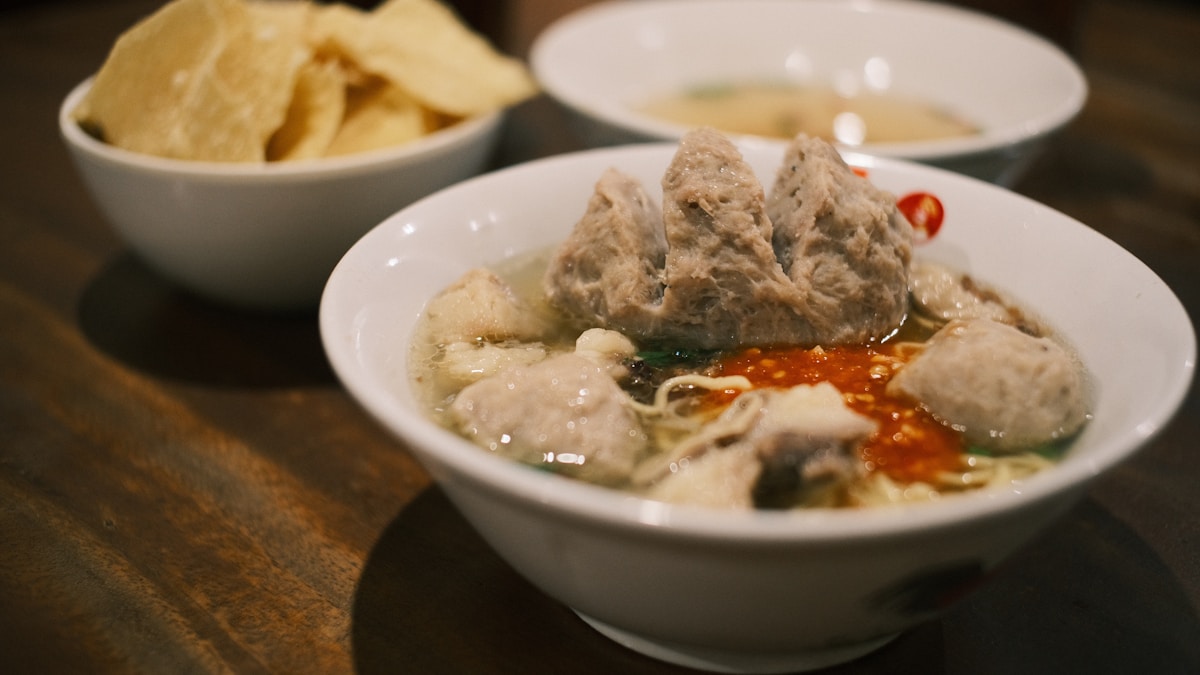
Jakarta is Indonesia’s best city for eating. The national capital draws migrants from every province - Javanese, Sundanese, Batak, Minangkabau, Balinese, Manadonese, Acehnese, Papuan - and each community has brought its food culture to the city. You can eat regional Indonesian cuisine here that would require weeks of island-hopping to sample in situ. Add to this the city’s own indigenous Betawi cooking, Chinese-Indonesian tradition, and a growing crop of serious restaurants, and Jakarta justifies more food attention than most visitors give it.
Betawi Food: Jakarta’s Indigenous Cuisine
The Betawi people are the indigenous population of the Batavia/Jakarta region, their culture a centuries-old fusion of Javanese, Sundanese, Malay, Arabic, Portuguese, and Dutch influences. Their food reflects this layering.
Soto Betawi
The definitive Betawi dish: a rich, milky coconut milk-based beef soup with potato, tomato, and fried shallots, served on rice or with lontong (compressed rice cake). The coconut milk distinguishes it from other Indonesian soto varieties, which tend toward clearer broths.
Found across the city at both dedicated restaurants and general Indonesian warungs. Soto Betawi H. Ma’ruf near Kota Tua is one of the oldest and most frequently cited sources. From approximately IDR 40,000–70,000 as of 2026.
Ketoprak
A Betawi street food assembled from boiled egg noodles, bean sprouts, fried tofu, lontong, and cucumber, all bound in a peanut sauce thinned with sweet soy. Simple, vegetarian-friendly, and found on street corners across Jakarta.
From approximately IDR 20,000–30,000 at a street cart. Look for the cart with the peanut grinder - fresh-ground peanut sauce is the mark of a good ketoprak.
Kerak Telor
The most distinctly Betawi street snack: glutinous rice cooked with egg (chicken or duck), dried shrimp, grated coconut, and spices on a flat iron wok. The cook flips the wok upside down over the charcoal to crisp the top crust. The result is sticky, smoky, and intensely savoury.
Kerak telor is most commonly found at Betawi cultural festivals and around the Kota Tua area, particularly on weekends. From approximately IDR 15,000–25,000 as of 2026.
Padang Food
Minangkabau cuisine from West Sumatra is the most widely eaten regional food across all of Indonesia - and nowhere more so than Jakarta, where Padang restaurants (rumah makan Padang) occupy every neighbourhood and price point.
The model is distinctive: you sit, and small dishes are placed on your table - rendang (the slow-cooked dry beef curry that has been voted the world’s best food in multiple international polls), gulai (coconut milk curry, made with fish, goat, or offal), sambal hijau (green chilli sauce), boiled cassava leaves, and more. You pay for what you eat; untouched dishes are returned.
Restoran Garuda is among Jakarta’s most established Padang restaurants, with multiple locations citywide. The rendang is properly dry and caramelised rather than wet. From approximately IDR 60,000–100,000 per person for a full meal.
Sari Bundo (multiple branches) offers similar quality at accessible prices in a canteen format. From approximately IDR 50,000–80,000.
Street Food Corridors
Jl Sabang Night Food Street
The most concentrated street food scene in central Jakarta. Dozens of carts and small restaurants line the pedestrianised section of Jl Wahid Hasyim (locally known as Jl Sabang), serving grilled corn, satay, mie goreng, seafood, and a rotating cast of regional dishes. Active from approximately 6pm until late.
From approximately IDR 30,000–80,000 per dish. Crowded on weekend evenings - arrive at 6–7pm for the best selection before the most popular items sell out.
Pasar Santa
A former wet market in South Jakarta converted into a food and craft hall that leans younger and more experimental than the traditional food streets. Stalls cycle through but typically include Indonesian regional specialties, specialty coffee, and independent dessert makers.
From approximately IDR 30,000–60,000 per portion. More relaxed seating than Jl Sabang; popular with the young Jakarta creative scene.
Malls as Food Destinations
This requires a moment of explanation for travellers who haven’t spent time in Southeast Asian cities. Indonesian mall food courts are not airport food courts - they are legitimate food destinations. The air-conditioning, wide variety of regional options, consistent food safety standards, and competitive pricing make them a practical choice in a hot, traffic-heavy city.
Grand Indonesia (central, MRT access at Dukuh Atas) has multiple food hall levels with Padang, Javanese, Chinese-Indonesian, Japanese, Korean, and international options. From approximately IDR 40,000–80,000 for a full meal.
Pacific Place (SCBD district) skews slightly higher-end with more polished restaurant concepts.
Plaza Senayan has an established food court and restaurant floor popular with Jakarta’s business community.
Fine Dining
Tesate
An Indonesian fine dining restaurant that takes seriously the project of elevating regional Indonesian ingredients and techniques into a contemporary tasting-menu format. One of Jakarta’s most thoughtfully conceived restaurants. From approximately IDR 500,000–800,000 per person as of 2026 (not including drinks).
Plataran Menteng
Housed in a colonial-era mansion in the Menteng heritage district, Plataran serves Javanese cuisine in a setting that takes full advantage of the architecture - open terraces, garden courtyard, period furniture. The food - rendang, opor, nasi tumpeng - is well-executed in a context that makes the meal feel like an occasion. From approximately IDR 200,000–400,000 per person as of 2026.
Practical Notes
Getting to food: Jakarta’s traffic makes distance a real factor. Use the MRT to reach Sudirman/Thamrin corridor restaurants and the Commuter Line to reach Kota Tua. Use Grab/Gojek for everything else - GoFood and GrabFood also deliver most of the above options if you’re working from your hotel.
Halal: The majority of Jakarta’s restaurants and warungs serve halal food; Padang restaurants are uniformly halal. Chinese-Indonesian restaurants may use pork; look for the halal certification (MUI) or ask before ordering.
Durian: Jakarta’s fruit markets (particularly Pasar Santa and the Tanah Abang area) sell durian year-round. The smell is extreme; most hotels do not allow it in rooms. Eat it at the market.
Take a Guided Food Tour of Jakarta
Jakarta’s food scene spans Betawi street food, Peranakan-Chinese noodles, and warung culture across neighbourhoods that feel like different cities - and the best of it is genuinely hard to find without local knowledge. A guided food tour typically takes in Kota Tua’s old-town eating scene, a covered market breakfast, and at least one stop at a warung that wouldn’t make any Google list. It’s the most efficient way to eat across ethnic lines in a city where culinary identity is tied to district, community, and family tradition.
Browse food tours and cooking experiences in Jakarta
More Jakarta Guides
- Jakarta travel guide - the full Jakarta overview: neighbourhoods, key attractions, hotels, and getting around
- Things to do in Jakarta - Kota Tua, museums, cultural sites, and neighbourhood walks
- Indonesian food guide - the national cuisine in context: regional styles from Padang to Javanese
- Vegan Jakarta guide - the best plant-based restaurants and vegetarian spots in the capital