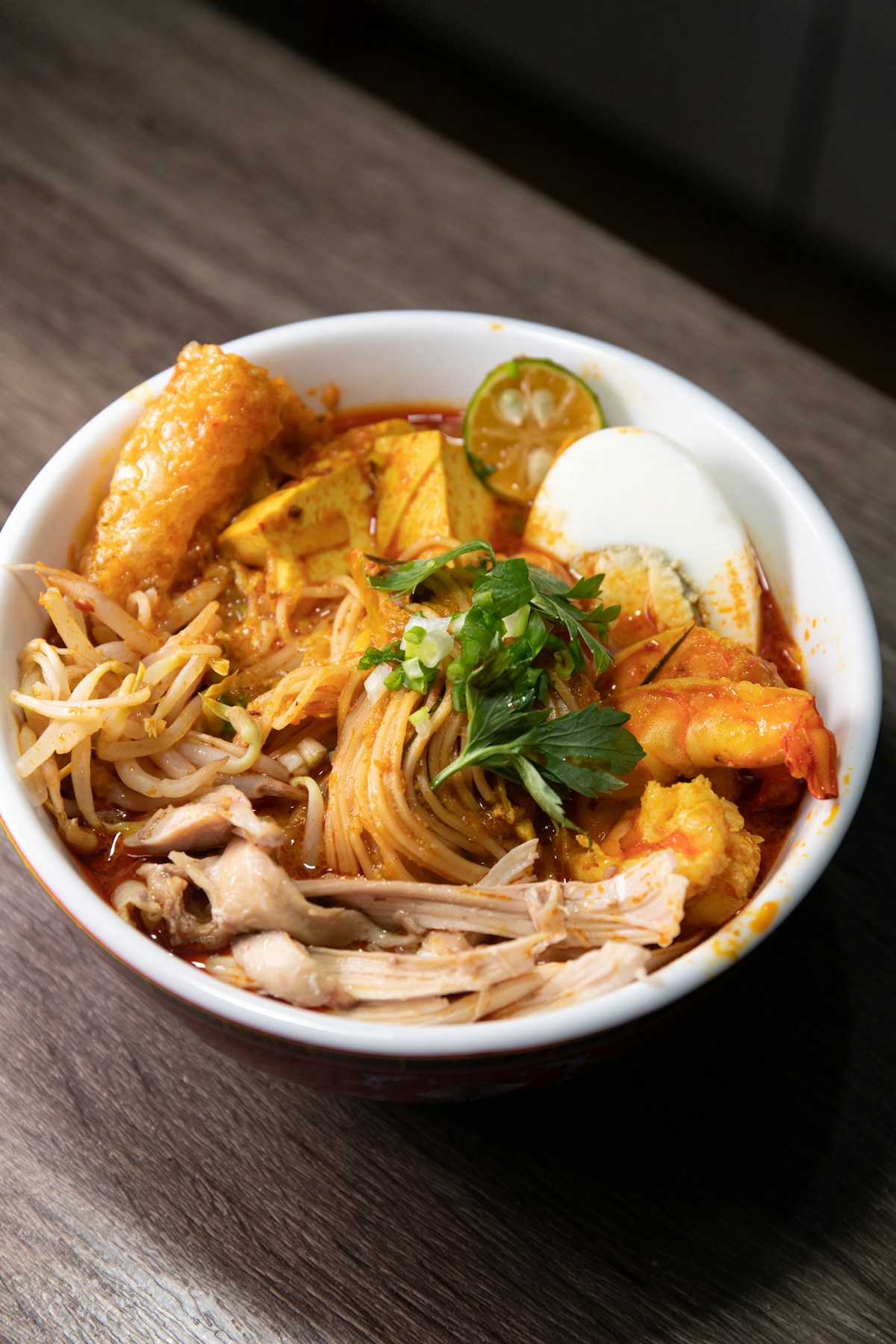
Bali’s street food scene operates mostly after dark, when the heat drops and the market stalls light up. The best eating is not on the tourist restaurant strips of Seminyak or Canggu - it is in the night markets of Denpasar, Gianyar, and Sanur, and in the angkringan-style carts that appear outside schools, temples, and transport hubs. Here is what to order and where to find it.
Nasi Jinggo - The Cone Rice Parcel
Nasi jinggo is a Balinese street food staple that costs IDR 5,000–10,000 as of 2026. A small portion of rice is wrapped in banana leaf into a cone or parcel, packed with a tablespoon of spiced minced pork or chicken (sometimes tempe), a pinch of fried noodles, and sambal. It is a snack-sized portion rather than a full meal - eat two or three.
Street vendors sell them from woven baskets on motorcycles in the early morning and from carts near markets in the evening. The portions are deliberately small: they originated as a cheap, filling option for workers who could not afford a full warung meal. In Denpasar, nasi jinggo vendors cluster near Pasar Badung from around 6 am.
Sate - Skewers from IDR 20,000
Sate from street grills comes in several versions in Bali:
- Sate lilit (minced fish or pork on lemongrass skewers) - the distinctly Balinese preparation, approximately IDR 3,000–5,000 per skewer as of 2026
- Sate tusuk (cubed meat on bamboo skewers, equivalent to standard Indonesian sate) - chicken or pork, approximately IDR 2,500–4,000 per skewer
- Sate kambing (goat) - less common in Bali than elsewhere in Indonesia
A portion of ten skewers with rice and peanut sauce or sambal costs IDR 20,000–50,000 at a market stall as of 2026. Charcoal-grilled sate from a street cart is one of the more reliable safe-eating options because the heat is high and the cooking is visible.
Mie Goreng and Nasi Goreng - Fried Noodles and Fried Rice
Both are available at virtually every warung cart operating in Bali’s markets and night strips. Mie goreng (fried noodles) uses egg noodles stir-fried with sweet soy sauce, shallots, garlic, egg, and vegetables. Nasi goreng (fried rice) is the same formula with steamed rice. Street-cart versions cost IDR 20,000–35,000 as of 2026 with a fried egg on top standard.
The quality spread is wide: a watery, under-seasoned plate is possible as easily as a properly wok-charred one. Look for carts where the wok is visibly hot (you should see smoke and hear the sizzle from a few metres away) and turnover is high.
Pisang Goreng - Fried Banana Fritters
Pisang goreng is Indonesia’s most ubiquitous street snack. A banana (usually kepok or raja variety - starchier than dessert bananas) is dipped in a rice flour batter and fried until golden. They cost IDR 3,000–7,000 each as of 2026 and are sold from pushcarts throughout the day. At markets, you will find variations: pisang goreng with grated cheese, with condensed milk, or with chocolate spread. These are market embellishments - the plain version is the original and generally more satisfying.
Martabak - Stuffed Savoury and Sweet Pancake
Martabak is a street food category unto itself. The savoury version (martabak telur) is a flat, crispy pastry filled with minced beef or chicken, egg, and spring onion - closer to a thin stuffed omelette than a pancake. The sweet version (martabak manis) is a thick, spongy yeasted pancake folded over fillings: cheese and butter, chocolate, peanut, or combinations.
Both versions cost IDR 30,000–60,000 as of 2026 for a half or whole portion. Martabak vendors operate from illuminated carts - the sweet versions are cooked in cast-iron pans with a distinctive honeycomb structure visible as they cook. Night markets in Kuta and Legian have several competing martabak carts; in Denpasar, the carts near Jalan Gajah Mada are a reference point.
Jajan Pasar - Traditional Market Cakes
Jajan pasar (market cakes, also called jaja in Balinese) are traditional rice flour and coconut sweets sold at morning markets. Common types include:
- Klepon - green glutinous rice balls filled with palm sugar, rolled in grated coconut (IDR 2,000–3,000 each as of 2026)
- Dadar gulung - rolled green crepes filled with sweet shredded coconut (IDR 3,000–5,000 each)
- Laklak - small round Balinese rice pancakes served with palm sugar syrup and grated coconut (IDR 5,000 for a small plate)
- Lupis - compressed glutinous rice in banana leaf, served with palm sugar
These are morning items: by 9 am most have sold out. Pasar Badung in Denpasar and Pasar Gianyar in Gianyar have the best selection.
Where to Find Street Food in Bali
Gianyar Night Market (Pasar Malam Gianyar) is the most frequently cited destination for serious street food eating in Bali. It opens around 6 pm and runs until 10–11 pm. The draw is the babi guling stalls - roast suckling pig portions from IDR 35,000–55,000 as of 2026 served from large trays, carved to order. The market is in the town of Gianyar, approximately 20 minutes east of Ubud by scooter or taxi.
Kreneng Night Market in Denpasar operates along a covered street and caters almost entirely to Balinese residents rather than tourists. Prices are lower (mie goreng from IDR 18,000, sate from IDR 2,000 per skewer as of 2026) and the variety is wide: Balinese, Javanese, and Madurese stalls operate side by side.
Sanur Night Market (Pasar Sindu) is on the beachfront road in Sanur and slightly more tourist-facing than Kreneng. Seafood is prominent - grilled fish and prawns, IDR 50,000–120,000 depending on size and type as of 2026. It is accessible from central Sanur on foot.
Ubud Pasar Malam near the football field opens from around 5 pm. It is the most convenient night market for visitors based in Ubud, with a broad mix of Balinese warung food at IDR 20,000–50,000 per dish as of 2026.
Legian–Kuta Night Strip along Jalan Legian has a concentration of martabak carts, sate vendors, and corn-on-the-cob carts. More tourist-oriented pricing, but still considerably cheaper than restaurant dining.
Food Safety
Street food in Bali is generally safe when basic principles apply:
- Cooked to order over direct heat is the safest option. Avoid food that has been sitting out in the heat for an indeterminate time.
- Grilled sate, fried rice, and freshly fried items are low risk. Unrefrigerated pre-cooked dishes (especially pork and offal) at unattended stalls are higher risk.
- Water and ice: bottled water only. Market ice used for drinks (es campur, es teh) is typically from block ice produced in refrigerated facilities and is considered acceptable by most experienced travellers, but carry bottled water as backup.
- Fruit from stalls: peel-your-own fruits (rambutan, salak, mangosteen) are safe; pre-cut fruit displayed openly in heat is riskier.
The general rule: the more you can see the cooking process and the higher the customer turnover, the more confident you can be.
Book a Bali Street Food Tour
The best of Bali’s street food is logistically scattered - Gianyar Night Market is a 45-minute drive from Seminyak, the Kreneng market breakfast scene is off every tourist route, and the vendors worth finding in Ubud’s side streets require knowing which turns to take. A guided street food tour connects these points and adds context: the difference between nasi campur styles across Bali’s regions, why satay lilit uses minced fish rather than the Java-style cubed meat, and what a proper babi guling operation looks like before it arrives on a plate. It’s also the safest way to eat confidently at high-turnover stalls.
Browse Bali street food tours and cooking experiences
Plan Your Visit
The Bali street food circuit runs across the whole island - Gianyar is in East Bali, the best Seminyak warungs are in the south, and Ubud’s morning markets are in the centre. Staying centrally in Ubud or Seminyak keeps most of the street food you’ll want to eat within a reasonable distance. Browse hotels in Bali and book in advance during peak season (July–August and December).
See Also
- Balinese food guide - the dishes behind the street food: babi guling, bebek betutu, and what to order
- Best restaurants in Ubud - Ubud’s warung scene and the transition from street food to sit-down dining
- Warung guide Indonesia - how warungs work and why they’re Bali’s best value food option
- Vegan and vegetarian Bali - plant-based options on the Bali street food circuit