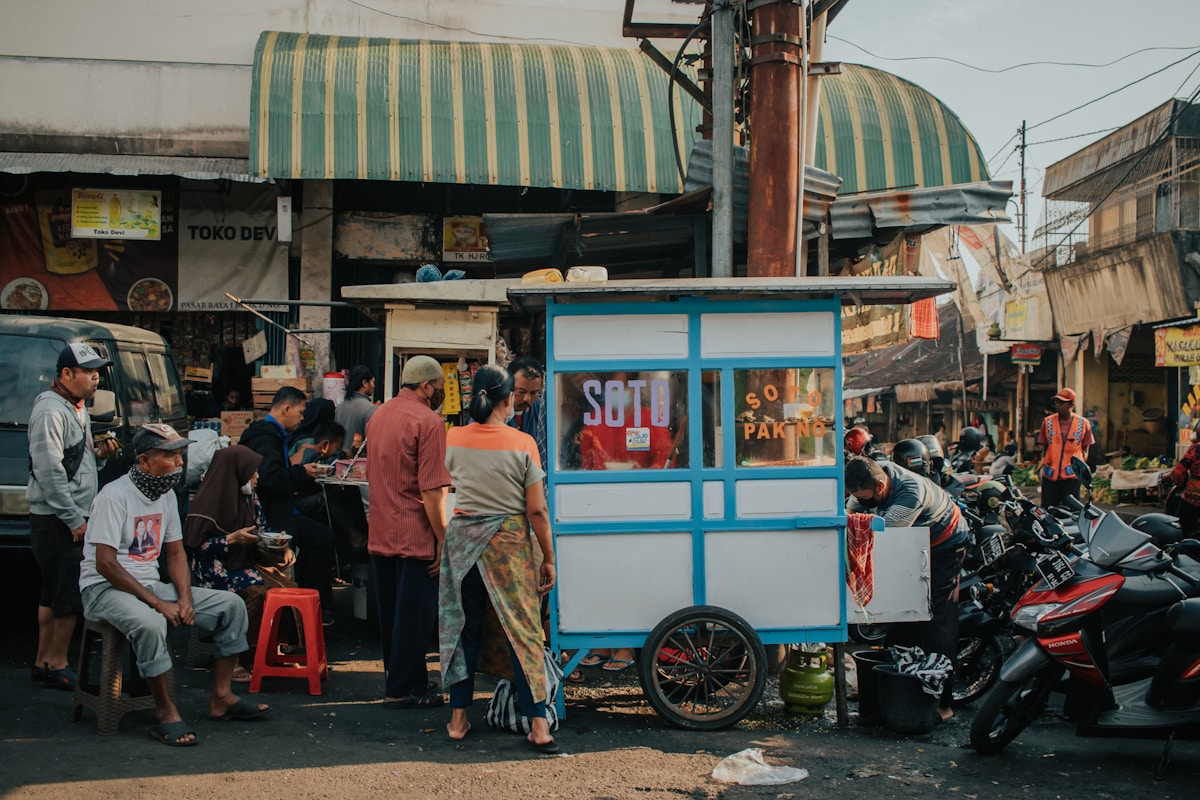
Walk any street in Indonesia - from a Jakarta side lane to a Flores fishing village - and within a few minutes you will pass a warung. A warung is a small, family-run food stall or eating house: sometimes a permanent structure with four walls and a menu board, sometimes a converted front room of someone’s house with six plastic chairs and a pot of rice keeping warm on a gas burner. They are the backbone of everyday eating in Indonesia, and learning to use them well is more useful than any restaurant recommendation.
What a Warung Is
The word warung simply means small shop or stall. In food contexts it splits into two main types:
Warung makan (or warung nasi) is a food stall. It serves cooked meals - rice-based plates, noodle dishes, soups - usually for lunch and dinner. Many open early for breakfast with rice porridge (bubur ayam) or fried rice left over from the night before.
Warung kopi is a coffee and snack stall. It serves kopi tubruk (ground coffee poured directly into a cup with hot water, drunk once the grounds settle), tea, cold drinks, and light snacks - fried tempeh, instant noodles, crackers. In Aceh, warung kopi has a specific cultural weight as a place for community gathering, but the format is found everywhere.
The overlap is common: many warung kopi serve simple food, and many warung makan sell coffee and cold drinks.
How to Order
At a warung nasi with a display counter (the most common format), walk up to the counter and point at what you want. The server will assemble a plate: a mound of steamed rice with two or three accompaniments you indicate. No Indonesian required, though knowing a few words helps.
Some warungs operate on the Padang system: dishes are placed on your table and you take what you want, paying only for what you eat. This is common at Minangkabau (Padang) warungs but also at many general Indonesian eating houses.
At a warung with a written menu, the menu is often handwritten on a board and may not have English. Standard items to look for:
- Nasi goreng - fried rice
- Mie goreng - fried noodles
- Nasi campur - mixed rice plate
- Ayam goreng - fried chicken
- Ikan goreng - fried fish
- Sayur - vegetables
- Tempe/tahu - fermented soybean cake / tofu
- Es teh - iced sweet tea
- Air putih - plain water
Point and nod. Smile. The transaction is understood.
What to Pay
Warung pricing as of 2026:
| Dish | Typical range |
|---|---|
| Nasi goreng (fried rice) | IDR 15,000–30,000 |
| Mie goreng (fried noodles) | IDR 15,000–30,000 |
| Nasi campur (mixed rice plate) | IDR 20,000–50,000 |
| Ayam goreng (fried chicken) | IDR 20,000–40,000 per piece |
| Ikan goreng (fried fish) | IDR 25,000–60,000 depending on size |
| Tempe/tahu (per portion) | IDR 5,000–15,000 |
| Es teh (iced sweet tea) | IDR 5,000–10,000 |
| Kopi (coffee) | IDR 5,000–15,000 |
A full meal - rice, one protein, one vegetable, a drink - typically costs IDR 30,000–70,000 per person as of 2026. This is the budget end of eating in Indonesia and there is no meaningful way to eat cheaper without cooking yourself.
Tipping is not expected at warungs. Pay the stated amount, say terima kasih (thank you), and leave. There is no service charge and no expectation of rounding up.
How Warungs Differ by Island
The same format, very different food:
Bali: Warungs in Bali may serve pork - suckling pig (babi guling), pork satay, pork lawar - because Bali is majority Hindu. This is unusual within Indonesia. In tourist areas (Ubud, Seminyak, Canggu), warung menus are in English and prices are 30–50% higher than equivalent food in Denpasar. A warung in Kuta charging IDR 60,000 for nasi goreng is not extraordinary; the same dish in a Denpasar side-street warung costs IDR 18,000.
Java: Warungs in Java are halal by default - no pork. The food reflects regional variation: a warung in Yogyakarta is more likely to serve gudeg (sweet jackfruit curry) as a side option; a warung in Surabaya may offer rawon (black beef soup) as a daily special.
Lombok: Lombok is majority Muslim (Sasak people), and all warungs are halal. The local specialty is ayam taliwang (grilled chicken with a fiery sambal) - readily available at warungs in Mataram and around Senggigi. IDR 40,000–70,000 for a whole small chicken as of 2026.
Flores: In Catholic-majority Flores, pork returns to warung menus. Se’i (smoked meat - traditionally pork, though beef versions exist) is a Flores specialty and appears at warungs in Maumere and Ende.
Sulawesi: In Christian-majority North Sulawesi (Manado), warung menus can include extreme preparations - dog, bat, and forest rat are technically available at specialist warungs in Tomohon, though these are not standard across the island.
Maluku and Papua: Remote islands often have a single family warung serving whatever is locally available. Expect simple fish and rice. Prices are higher in remote areas due to supply chain costs - nasi goreng in a Papua warung may cost IDR 35,000–50,000 as of 2026.
Finding the Best Warungs
The most reliable indicators of quality are visible without tasting anything:
- Full tables of local customers. A warung with twelve Indonesians eating lunch and two tourists is a better sign than the reverse.
- Handwritten menu on a chalkboard or laminated sheet. Printed English menus indicate a tourism pricing layer on top of the food.
- The rice is fresh. Ask “nasi panas?” (hot rice?) - if yes, the batch is recent.
- Plastic chairs and no tablecloths. This is not a sign of quality per se, but the correlation between decor investment and food quality is inverse in Indonesia’s warung economy.
- High turnover at the display counter. Food that moves quickly has been cooked recently.
Beach Warungs
Along Bali’s beaches, warungs occupy a particular ecosystem: they are often the only food option on a stretch of sand, they sell overpriced Bintang beer and grilled seafood to tourists, and they expect you to stay and spend rather than eat and leave. Beach warung pricing is typically 50–100% above inland warung pricing as of 2026. The tradeoff is location: eating grilled fish five metres from the ocean at sunset at Jimbaran Bay is a specific experience, and IDR 120,000–200,000 per person for a seafood plate there is priced accordingly.
The Warung Economy
Warungs are not just a food format - they are a micro-enterprise model. Most are owned and operated by a single family, often with one person cooking and another serving. The margin per plate is thin: a IDR 25,000 nasi goreng plate may generate IDR 8,000–12,000 of profit after ingredients, gas, and any rent. The economic logic depends on volume and low overhead.
Choosing a warung over a tourist restaurant does not require justification on cultural grounds alone: the food is frequently better, the portions are more honest, and the money stays in the immediate community rather than a management chain. For most of what a visitor needs - a filling, accurate, reasonably priced meal - a warung is the right answer throughout Indonesia.
Book a Guided Warung Food Tour
Reading about warungs is useful; eating at the right ones with a local guide is faster and more revealing. A guided food tour in Bali or Java that takes in three or four warungs over a half-day covers what a week of solo eating only approximates - the specific ordering customs, the dishes that don’t appear on any translated menu, and the distinction between a family warung and a tourist-facing operation that uses the same name. Most Indonesia food tours are essentially warung tours dressed differently; the best ones make that explicit.
Browse Indonesian food tours and warung experiences
Plan Your Visit
Warungs are everywhere in Indonesia - there is no wrong base. Bali and Yogyakarta have the highest density of food-focused accommodation and the most accessible warung circuits for first-time visitors. Browse hotels across Indonesia to find a base that works for the region you’re exploring.
See Also
- Indonesian food guide - the dishes you’ll find in Indonesian warungs: nasi goreng, soto, and the national canon
- Balinese food guide - the Bali-specific warung tradition: nasi campur, lawar, and babi guling
- Bali street food guide - the Bali street food circuit where warungs operate at their most authentic
- Vegan and vegetarian Bali - navigating warung menus as a plant-based traveller