December is one of our favourite months to visit Bali. Yes, it is the wet season, but “wet season” in Bali does not mean constant grey skies. It means tropical downpours of two to three hours in the afternoon, mornings that are almost always clear and sunny, and a landscape that turns a deeper, more saturated green than at any other time of year. Add peak surf on the west coast, some of Indonesia’s biggest New Year celebrations, and lower hotel prices before Christmas week, and the case for December becomes strong.
For a broader look at conditions across the archipelago this month, see our visiting Indonesia in December guide.
What the Rain Actually Looks Like
Average rainfall in Bali in December sits at around 250–300mm, with Ubud and the central highlands receiving more than coastal areas. Humidity runs at roughly 85%, which makes late afternoons feel heavy and sticky. But the pattern is consistent enough to plan around: mornings clear and dry, skies building through midday, heavy rain landing somewhere between 2pm and 5pm, usually clearing again by early evening.
What this means practically is that you plan outdoor activities for the morning. Rice terrace walks, temple visits, waterfall hikes, and market browsing all work perfectly before noon. Afternoons are when you retreat to a warung for lunch, a café for iced coffee, or your villa pool. It is not a washout. It is a rhythm.
The south coast (Kuta, Seminyak, Canggu) tends to be slightly drier than Ubud, and the north and east coasts (Lovina, Amed) are noticeably drier still. More on that below.
Surf Season Peaks on the West Coast
December is excellent for surfing on Bali’s west-facing breaks. The northwest swell window opens up properly in wet season, pushing consistent 1.5–2.5m waves to Canggu, Echo Beach, Batu Bolong, and Pererenan. These are not beginner breaks in December; the swell is bigger and the current stronger than in the dry season, but experienced intermediate and advanced surfers will find the best conditions of the year.
Beginners are better off at Kuta Beach, which remains workable with gentler reform waves year-round, or at the mellow beach breaks in Legian.
The east coast is the opposite of the west coast in December: it catches less swell and the water stays calmer. Sanur and Amed are quieter for surfing but better for snorkelling. See our full surfing in Bali guide for break-by-break detail. If you are staying in Canggu, our where to stay in Canggu guide covers the best accommodation options close to the breaks.
Ubud and the Rice Terraces at Their Greenest
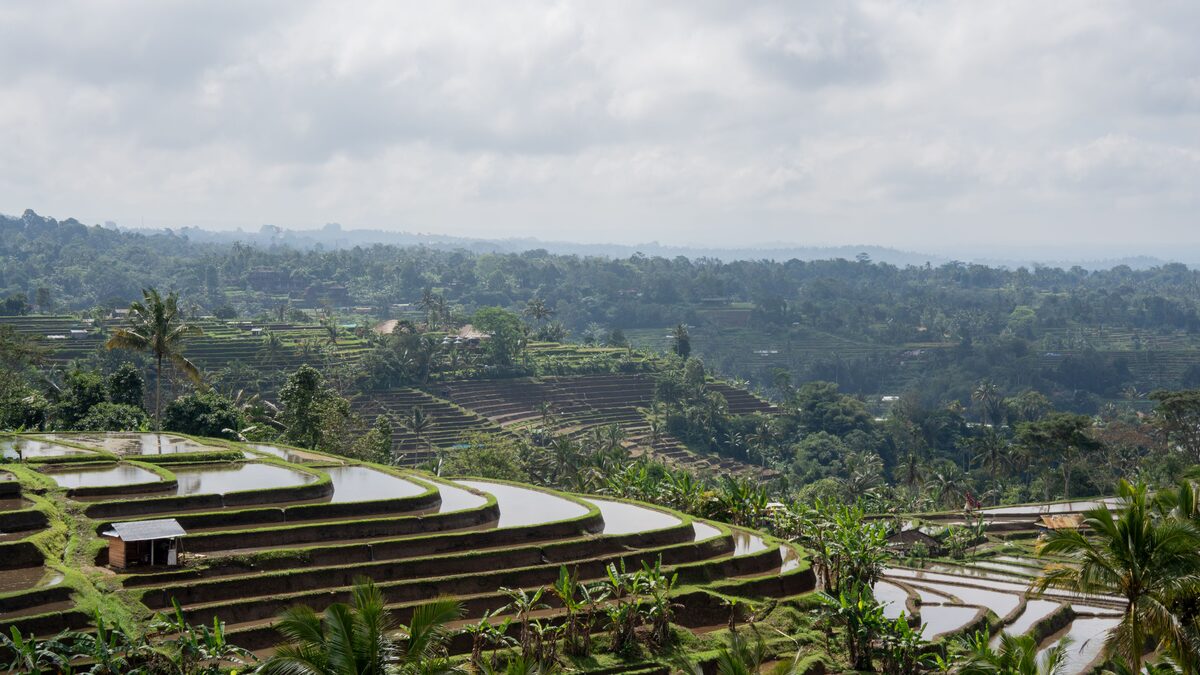
If you have ever looked at photographs of Bali’s stepped rice fields and thought they seemed almost impossibly green, those photographs were almost certainly taken in wet season. December and January are when Tegallalang and Jatiluwih reach peak lushness: the paddies are actively growing, the water channels are full, and every terrace glows a bright jade-green that the dry season cannot match.
Tegallalang Rice Terraces, 20 minutes north of Ubud, charges an entry fee of approximately IDR 50,000 (around USD 3 as of 2026) per person. The best light and the driest footing are before 9am. Jatiluwih, a UNESCO World Heritage site in the Tabanan Regency, is quieter and more expansive; a 35-kilometre road winds through the terraces, and an entry fee of around IDR 40,000 applies. Guided rice terrace walks through the irrigation channels (subak) of the Campuhan Ridge are also excellent in December, with the path flanked by tall grass and flowering plants.
For accommodation close to the rice terraces, our where to stay in Ubud guide covers the full range from budget guesthouses to jungle villas.
Temple Ceremonies in December
Balinese Hinduism runs on a 210-day Pawukon calendar, which means major ceremonies like Galungan and Kuningan fall on different Gregorian dates each year. In some years they land in late November or December; in others they fall months away. Check the current Balinese calendar before your trip. When Galungan does coincide with your visit, you will see bamboo penjor poles lining every road and families dressed in white and yellow attending temple prayers, one of the most atmospheric things you can witness in Bali.
Regardless of Galungan timing, December sees regular temple activity. Odalan ceremonies (temple anniversaries) happen year-round across Bali’s roughly 20,000 temples, and it is common to stumble upon a procession or ceremony on any given morning. Dress code for temple visits: sarong and sash, available to borrow at most major temples for a small fee. See our Bali temple tours guide for the most rewarding temple experiences and etiquette tips.
New Year’s Eve: Where to Celebrate
Bali hosts some of Southeast Asia’s biggest New Year’s Eve parties, concentrated in the south of the island.
Kuta and Legian beach strip runs a free outdoor celebration that draws tens of thousands of people. Fireworks launch from multiple points along the beach at midnight. It is chaotic, crowded, and excellent fun if you embrace it.
Seminyak steps things up with ticketed beach club parties. Potato Head Beach Club and Ku De Ta (now Alila Seminyak) both host large NYE events with live music, DJs, and countdown fireworks. Tickets range from IDR 600,000 to IDR 2,500,000 (approximately USD 38–155 as of 2026) depending on the venue and package.
Ubud takes a different approach. The town itself is quieter on NYE, but several high-end restaurants and resorts run set-menu dinners with live traditional music and a midnight toast. If you want to see in the New Year without the bass line, Ubud is the right call. See where to stay in Seminyak if you want to be within walking distance of the beach parties.
Christmas (25 December) is a bigger commercial event in south Bali than it is elsewhere in Indonesia, with most beach clubs and rooftop bars running themed dinners. It is not a public holiday in this predominantly Hindu island but the hospitality industry treats it as one.
Diving in December: Where to Go
Diving visibility varies significantly around Bali in December. Rain and river runoff reduce clarity on the south coast, making Nusa Dua and Padang Bai less reliable for diving. The east coast is a different story.
Amed and Tulamben (on the northeast coast) maintain good visibility of 15–20 metres through the wet season, sheltered from the main swell and less affected by runoff. The famous USAT Liberty wreck at Tulamben, one of Indonesia’s most accessible dive sites, is diveable year-round; visibility occasionally drops to 12m in December but is often better. Water temperature sits at around 27–28°C.
Nusa Penida, a 45-minute fast boat from Sanur, offers manta ray encounters year-round at Manta Bay. Visibility can dip to 10–15m in December due to plankton blooms, but those same blooms are what draw the mantas. Mola mola (oceanic sunfish) sightings tail off by November, so December is not the best month for them.
For the full diving picture around the island, see our Bali diving guide. Divers staying in the northeast should look at our where to stay in Amed guide; the town sits right on the best dive sites.
Hotel Pricing: Two Very Different Periods
December pricing splits cleanly into two phases.
1–20 December is genuine shoulder season in Bali. Many hotels and villas in Ubud, Canggu, and even Seminyak drop rates by 20–30% compared to July and August peak. A mid-range villa in Canggu that costs USD 120/night in July might be USD 85–95 in early December. This is the best value period of the second half of the year.
21 December–2 January is the opposite. Christmas and New Year demand pushes hotels to their highest prices of the entire year, often 50–100% above standard rates. Popular villas and boutique hotels in the south can hit USD 300–500/night in the Christmas week corridor. Budget properties near Kuta fill up by October for this period.
If you are visiting for Christmas or NYE, book 2–3 months in advance. If you have flexibility, arriving before 20 December gets you the best value. Our guides for where to stay in Ubud and where to stay in Seminyak cover properties across all budget ranges.
Which Areas Receive the Least Rain
If minimising rain exposure matters for your trip, the geography of Bali works in your favour; the island is small enough to move around, and the north and east coasts receive significantly less rainfall than the south and centre.
Amed and the northeast coast receive around 100–130mm in December, roughly half the rainfall of Seminyak and less than a third of Ubud. Mornings here are often fully dry. If you are coming primarily for diving, snorkelling, or a quieter beach experience, the northeast is the best base in December.
Lovina on the north coast is similarly dry and calm. It does not have the same nightlife infrastructure as the south, but for dolphin watching (the boats go out at 5am) and relaxed beach days, it is a good option.
Ubud receives the most rain of any popular tourist area in December; 300mm+ is common in a heavy year, but the pattern remains predictable: clear mornings, afternoon showers. Most visitors find they adapt within a day.
Our guide to Bali’s best beaches includes notes on which beaches are most suitable in wet season, and our Nusa Islands guide covers day trips to Nusa Penida, Lembongan, and Ceningan - all run year-round in normal conditions. For an overview of the whole island before you plan, the Bali island hub is the best starting point.
December in Bali is not a compromise. It is a different, greener, cheaper, more surf-oriented version of the island, with one of Southeast Asia’s best NYE celebrations thrown in. Come before the 20th if prices matter; come for the last two weeks if atmosphere is the priority.