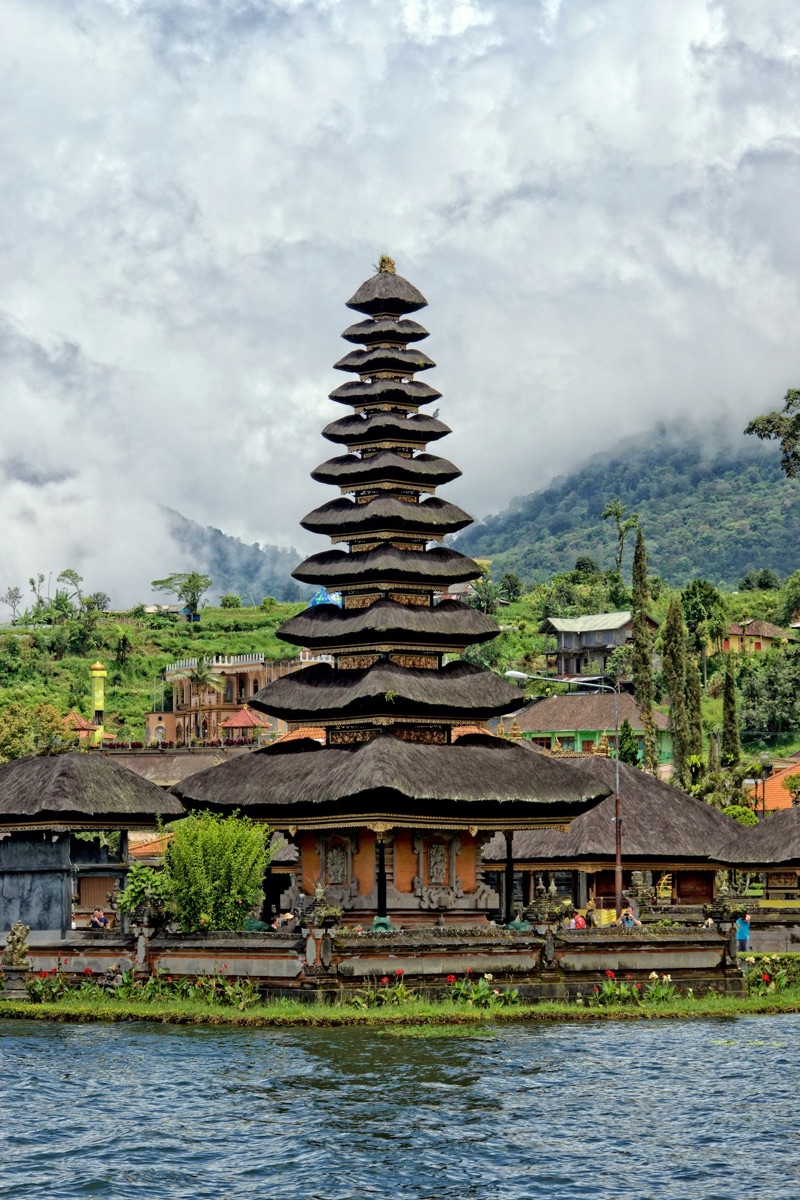
Bali’s Hindu temples are not monuments from a dead past - they are living places of worship visited by pilgrims every day. Arriving at the right time, dressed appropriately, and knowing what to expect separates a meaningful visit from a frustrating one. This guide covers the six temples most worth your time: what makes each distinctive, what it costs to enter, what you must wear, and the best way to get there from the main tourist bases.
Note: Borobudur and Prambanan - the great Buddhist and Hindu temple complexes of Java - are covered in their own detailed guides. This guide focuses on Bali’s temples specifically.
Tanah Lot
Tanah Lot is the most photographed temple in Bali: a black stone pagoda perched on a sea stack just offshore, silhouetted against the sunset. It sits 20 km northwest of Seminyak.
What to know before you go
The temple itself is only accessible to Hindu worshippers during active ceremonies. Non-Hindu visitors explore the surrounding coastal headland and rock formations - and at low tide, can wade across to the base of the sea stack. The site draws large sunset crowds, so arrive at least 90 minutes before dusk if you want a good position on the cliff paths.
Entry fee (as of 2026): approximately IDR 75,000 (adults), IDR 35,000 (children under 10) - roughly USD 4.50 and USD 2.20.
Best time to visit: Late afternoon (4–5 pm) for golden-hour light. Arriving after 6 pm means the crowds have thinned but you lose the warm light. Morning visits are crowd-free but the seaward light is harsh.
Dress code: Sarong and sash are mandatory and are available to rent or borrow at the entrance for a small fee (typically IDR 10,000–20,000). Shorts and sleeveless tops are fine underneath as long as the sarong is worn.
Getting there from main areas
- From Seminyak: 35–45 minutes by hired driver or Grab, approximately IDR 100,000–150,000 each way. No direct public transport.
- From Ubud: 1.5–2 hours by driver, approximately IDR 250,000–350,000. Often combined with Ulun Danu Beratan in a full-day north-west run.
- From Kuta: 40–55 minutes, similar cost to Seminyak.
Uluwatu Temple (Pura Luhur Uluwatu)
Uluwatu sits on a dramatic 70-metre cliff at the southern tip of Bali’s Bukit Peninsula, 23 km south of Kuta. The temple commands uninterrupted views of the Indian Ocean and is one of Bali’s six kahyangan jagat - directional temples protecting the island from evil spirits.
What to know before you go
The resident macaque monkeys are notorious thieves. Keep sunglasses, cameras, hats, and anything loose secured or stowed. Staff are positioned around the site to help retrieve stolen items, but it is far easier to prevent the theft in the first place.
The nightly Kecak fire dance, performed in an open-air amphitheatre cut into the cliff edge, runs at sunset and is genuinely spectacular. Tickets cost approximately IDR 100,000 (as of 2026) and sell out on busy evenings - book through your accommodation or via GetYourGuide.
Entry fee (as of 2026): approximately IDR 50,000 per person.
Best time to visit: 30–60 minutes before sunset to catch both the golden light and the Kecak performance. The temple and headland paths are at their most crowded at this time; if you want a quieter visit, come in the morning when few tour groups have arrived.
Dress code: Sarong and sash mandatory. Provided at the entrance.
Getting there from main areas
- From Kuta / Seminyak: 30–45 minutes by Grab or driver, approximately IDR 80,000–120,000 each way.
- From Ubud: 1.5 hours, approximately IDR 300,000–400,000. Often paired with Nusa Dua or Jimbaran in a south Bali day.
- From Seminyak: 30 minutes, approximately IDR 80,000–100,000.
Besakih - the Mother Temple
Pura Besakih is the largest and holiest temple complex in Bali, located on the southwestern slopes of Mount Agung at approximately 1,000 metres elevation. The complex contains over 80 individual temples spread across an extensive terraced site. Active worship takes place every day.
What to know before you go
Besakih has had a long-running issue with aggressive guides who demand payment for access beyond the initial entrance gate, often claiming that specific inner areas require a “certified guide” as a condition of entry. This practice has reduced significantly in recent years following local government intervention, but it still occurs. The official position is that you can explore the main temple areas without hiring a local guide. If approached, remain politely firm. Purchasing a sarong from vendors outside is not mandatory - rentals are available at the gate.
Because Besakih is a living place of worship rather than a tourist attraction, ceremonies are held constantly. You may find sections of the complex closed to non-Hindu visitors during major ceremonies (check current dates with your accommodation).
Entry fee (as of 2026): approximately IDR 60,000 per person (includes sarong and sash). Parking fee approximately IDR 5,000–10,000.
Best time to visit: Early morning (7–9 am) before tour groups arrive and before cloud obscures the views of Mount Agung behind the complex. By midday, the mountain is often cloud-covered and the site is busy.
Dress code: Sarong and sash mandatory. Provided at entrance.
Altitude note: At 1,000m the temperature is noticeably cooler than the coast - bring a light layer if visiting early morning.
Getting there from main areas
- From Ubud: 1–1.5 hours by driver, approximately IDR 300,000–400,000 return (driver waits). No practical public transport.
- From Seminyak / Kuta: 2–2.5 hours. Worth combining with a stop in Ubud or Sidemen.
- From Candidasa: 1 hour - Besakih is well-placed for east Bali visitors.
Tirta Empul
Tirta Empul is a Hindu water temple built around a sacred spring that has been in continuous use since 962 CE. It sits at the village of Tampaksiring, 12 km north of Ubud. The main attraction is the purification ritual performed in the spring-fed bathing pools: worshippers move between 13 stone spouts, submerging beneath each to pray and cleanse.
What to know before you go
Visitors may participate in the purification ritual if they wish - wear a sarong that you don’t mind getting wet, or bring a change of clothes. The water is cool and remarkably clear. If you prefer to observe rather than bathe, you can walk the perimeter of the pools without entering.
The spring complex is backed by a hillside where President Sukarno’s former summer palace (Tampaksiring Palace) overlooks the site. The palace interior is not open to the public.
Entry fee (as of 2026): approximately IDR 50,000 per person.
Best time to visit: Early morning (7–9 am) for the quietest experience. By 10 am tour buses arrive. Friday and Saturday evenings see the most active local participation in ceremonies.
Dress code: Sarong and sash mandatory (especially important if entering the bathing pools). Waterproof or lightweight sarong recommended if you plan to bathe.
Getting there from main areas
- From Ubud: 20–30 minutes by Grab or driver, approximately IDR 60,000–80,000 each way. Easily combined with Gunung Kawi (a short detour nearby).
- From Seminyak / Kuta: 1.5–2 hours by driver. Often included in organised Ubud full-day tours.
- From Kintamani: 30–40 minutes - convenient if combining with the Mount Batur area.
Ulun Danu Beratan
Pura Ulun Danu Beratan is a multi-pagoda temple complex built on the shores of Lake Beratan, 50 km north of Ubud in the Bedugul highlands. The largest pagoda (11-tiered meru) appears to float on the lake surface on photographs - this effect is strongest early morning when the water is calm and mountain mist hangs over the surrounding hills.
The temple is dedicated to Dewi Danu, goddess of lakes and rivers, and plays an important role in the island’s subak irrigation system, which is a UNESCO World Heritage Site.
What to know before you go
The Bedugul area sits at around 1,200 metres elevation - significantly cooler and cloudier than coastal Bali. Bring a light jacket. Morning clouds lift by 9–10 am most days; arriving by 7 am on a clear morning produces the classic mirror-surface lake shots. By 10 am the tourist coaches arrive.
The complex includes several smaller temples and gardens that are worth wandering beyond the main photo spot.
Entry fee (as of 2026): approximately IDR 75,000 (adults), IDR 50,000 (children). Parking fee approximately IDR 5,000.
Best time to visit: 7–9 am on a clear morning. The reflection effect on the lake is strongest in calm, early conditions.
Dress code: Sarong and sash mandatory. Provided at entrance.
Getting there from main areas
- From Ubud: 1–1.5 hours by driver, approximately IDR 250,000–350,000. Commonly paired with Tanah Lot in a full north-west day circuit.
- From Seminyak / Kuta: 1.5–2 hours by driver. Often packaged into a “highlands day trip” including the Bali Botanic Garden and Jatiluwih rice terraces.
- From Lovina (north coast): 45 minutes south over the mountain pass.
Goa Gajah (Elephant Cave)
Goa Gajah is a rock-carved cave sanctuary near Ubud dated to the 9th–10th centuries. The cave entrance - a gaping carved stone face - was cleared and opened to visitors only in 1954, when bathing pools and ancient artefacts were discovered during excavation. A stream and ornamental garden sit below the cave entrance.
The name (“elephant cave”) is thought to derive either from the carved face at the entrance or from the nearby Petanu River, historically called the Elephant River.
What to know before you go
Goa Gajah is compact and can be explored in 45–60 minutes. It pairs well with Tirta Empul (30 minutes by car) for a half-day east-of-Ubud temple route. The cave interior contains a Ganesh statue and three lingga - photography inside is permitted but flash can be disruptive to worshippers.
Stone steps and slippery surfaces make this unsuitable for visitors with limited mobility. The carved face entrance requires ducking to enter.
Entry fee (as of 2026): approximately IDR 50,000 per person.
Best time to visit: Early morning (8–9 am) before tour groups. The site is rarely crowded compared to Tanah Lot or Uluwatu.
Dress code: Sarong and sash mandatory. Provided at entrance.
Getting there from main areas
- From Ubud: 15–20 minutes by Grab or driver, approximately IDR 50,000–70,000 each way. One of the most accessible temples from Ubud.
- From Seminyak / Kuta: 1.5 hours, approximately IDR 250,000–300,000 return. Best combined with a full Ubud day.
- From Kuta: 1.5 hours by driver.
Practical notes across all temples
Dress code essentials
Every temple on this list requires a sarong and sash (selendang). These are provided or available to rent at each entrance - you do not need to bring your own. If you plan to visit multiple temples in a day, purchasing your own sarong (from IDR 30,000–80,000 at any market) saves the small rental fees and avoids having to return a wet one. Shoulders must be covered in some of the more strictly observed complexes; a light scarf or shirt satisfies this requirement.
Timing and crowds
Most temples are busiest between 10 am and 3 pm when organised tours arrive. Early morning (7–9 am) and late afternoon visits are significantly quieter. For Uluwatu and Tanah Lot, sunset is the peak crowd time - worth it for the light, but arrive early to secure a good position.
Temple etiquette
- Do not point your feet toward shrines or altars.
- Do not climb or sit on temple walls or statues.
- Women who are menstruating are traditionally asked not to enter the inner sanctuaries - signs at entrances make this clear.
- Photography of ongoing ceremonies requires discretion and usually a respectful distance.
Organised tours vs self-arranged transport
Organised temple tours from Ubud or Seminyak typically cost IDR 350,000–600,000 per person (as of 2026) and cover 3–5 temples in a day with a guide and all entry fees included. They are convenient for first-time visitors who want context.
Hiring a private driver for the day (typically IDR 500,000–800,000 for 8–10 hours) offers more flexibility - you set the pace, choose your temples, and aren’t tied to a group itinerary. Many drivers have solid knowledge of the sites and will explain the cultural context as you go.
Suggested temple combinations
- Half-day from Ubud: Goa Gajah + Tirta Empul - both within 30 minutes of Ubud, covers ancient cave and holy spring in a morning.
- Full-day north circuit: Ulun Danu Beratan + Tanah Lot - highland lake temple in the morning, sunset cliff temple in the evening.
- Full-day east Bali: Besakih + Sidemen - Mother Temple in the morning, scenic Sidemen valley for lunch, return via Tirta Empul.
- Classic Bali sunset: Uluwatu + Kecak dance - the single best evening activity in south Bali.
For temple tours with availability today or tomorrow, check our last-minute tours page - most Bali temple tour operators release unsold spots at reduced rates.
Book a Bali temple tour
If you want a guided experience without the logistics of arranging your own transport, these tours cover the highlights reliably:
- Tanah Lot Temple Half-Day Sunset Tour (from $25 per person) - 6-hour guided tour with hotel pickup from Seminyak, Canggu, or Ubud. Arrives at Tanah Lot in time for the sunset with a knowledgeable local guide.
- Bali Sacred Temples & Sunset Private Tour (from $26 per person) - 9-hour private full-day tour covering Goa Gajah, Gunung Kawi, and Tanah Lot at sunset. Good value for pairs or small groups sharing a private vehicle.
- Besakih & Lempuyang Gates of Heaven Full-Day Tour (from $51 per person) - East Bali circuit covering Tirta Gangga Water Palace, Lempuyang’s Gates of Heaven, and Besakih Mother Temple in one long day.
- Uluwatu Temple Tour with Optional Kecak Dance Ticket (from $15 per person) - guided cliff walk through the 10th-century Uluwatu complex, with the option to add a sunset Kecak fire dance ticket.
All tours include free cancellation up to 24 hours in advance. Browse the full selection of Bali temple tours and activities on Klook - instant confirmation, mobile tickets.