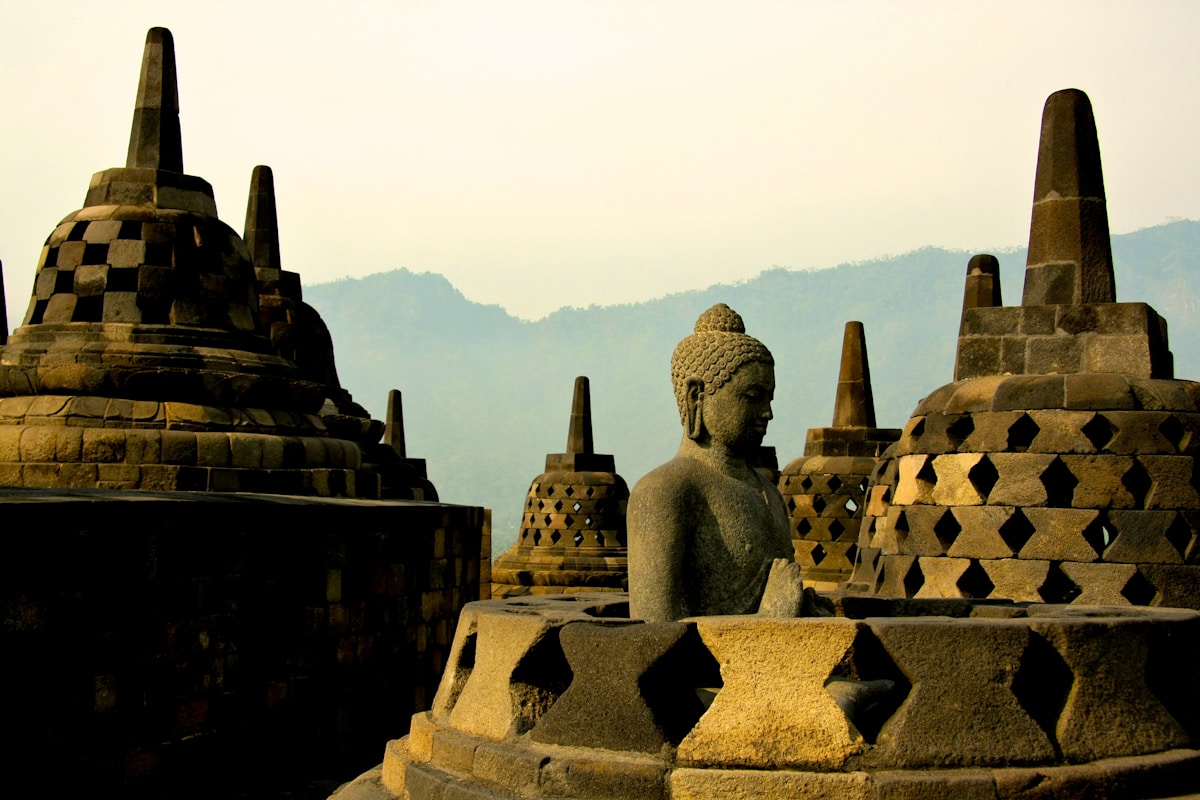
Borobudur is one of the most extraordinary Buddhist monuments on the planet - a 9th-century pyramid of volcanic stone rising from the plains of Central Java, surrounded by mist-covered volcanoes. Built by the Sailendra dynasty around 800 CE and rediscovered by the colonial era’s engineers in 1814, it was designated a UNESCO World Heritage Site in 1991. No photograph quite captures the scale of it. You need to stand on the upper terrace, with the Merapi volcano on the horizon and 504 stone Buddha statues surrounding you, to feel its full weight.
This guide covers everything you need to know before you go: entry fees, the sunrise experience, what to actually look at once you’re there, how to get from Yogyakarta, and what to wear.
Entry Fees and Ticket Options
As of 2026, the standard foreign visitor entrance fee is approximately IDR 350,000–500,000 per person, depending on the ticket package selected. This fluctuates seasonally - prices are typically higher during Indonesian school holidays and peak travel periods (July–August, December–January). Children under 10 are generally admitted at a reduced rate.
The most popular option for international visitors is the Borobudur Sunrise Package, which costs significantly more (around IDR 850,000–1,000,000 as of 2026). This gives access to the upper platforms before the site opens to general visitors - roughly 4:30–6:00am. Places are strictly limited, and the experience books out weeks in advance during high season. If this is a priority for your trip, secure tickets as early as possible.
A combined ticket with Prambanan is available and represents reasonable value if you plan to visit both temples on the same day - as most organised day trips do.
Check the official Borobudur Authority website or a verified booking platform for current pricing before you travel, as fees are reviewed periodically. Book Borobudur tickets on Tiqets for instant confirmation and mobile entry - no printing required.
What You’ll See
Borobudur is not a temple in the conventional sense - there is no inner sanctum or deity shrine. It functions more as a mandala in three dimensions: a monument designed to be walked, level by level, as a form of meditation and spiritual progression.
The structure has nine stacked platforms: six square terraces at the base and three circular ones at the top. The total height is approximately 35 metres.
The relief panels are the first thing to stop you in your tracks. Running along the lower and middle galleries are 2,672 individual carved panels depicting the life of Siddhartha Gautama and scenes from Buddhist cosmology. Walking the entire perimeter at each level, reading the panels left to right as designed, covers approximately 5 kilometres. Most visitors take a selective approach - the most narratively clear panels are on the first and second galleries of the eastern staircase.
The 504 Buddha statues sit in niches along the outer balustrades, each making a specific hand gesture (mudra) that changes by compass direction and terrace level: east faces east with the earth-touching gesture, north faces north with the gesture of fearlessness, and so on. The uppermost circular terraces hold 72 perforated stone bell-shaped stupas, each containing a seated Buddha.
The main stupa at the summit is undecorated and hollow - symbolising the void, the final stage of enlightenment. On clear mornings you can see four volcanoes from up here: Merapi, Merbabu, Sumbing, and Sindoro.
The Sunrise Tour Experience
Watching dawn break over the Kedu Plain from the upper terrace of Borobudur is, by most accounts, one of the best travel experiences in Southeast Asia. The temple faces east, and on a clear morning the sky behind the volcanoes shifts from deep indigo to gold over about 30 minutes.
The sunrise package is run through the Borobudur Authority. Participants enter via a separate gate and are guided to the upper platform while it is still dark - torches are provided. The combination of the low light, the scale of the monument, and the near-silence (general admission crowds have not yet arrived) is hard to replicate later in the day.
Practical notes for the sunrise tour:
- Arrive at the gate at least 20 minutes before the stated start time - groups are admitted strictly by time slot
- Bring a warm layer; the pre-dawn air at altitude can be cooler than expected even in Indonesia
- A long zoom lens helps for volcano shots but is not necessary
- Booking well in advance is non-negotiable in July and August
Getting There From Yogyakarta
Borobudur sits approximately 42 kilometres northwest of Yogyakarta city centre - around 1.5 hours by road in normal traffic.
By organised tour: The most convenient option for most visitors. Full-day tours typically combine Borobudur with Prambanan, include transport from your hotel, an English-speaking guide, and sometimes lunch. Prices start from around IDR 350,000–600,000 per person for group tours; private driver-guide arrangements cost more. Klook’s Borobudur sunrise day trip includes hotel pick-up, a guide, and sunrise access from around IDR 500,000 per person.
By private driver or hired car: A private driver for the day costs approximately IDR 400,000–600,000 and gives you full flexibility over timing. This is the best option for the sunrise tour, as public transport does not operate early enough.
By Trans Jogja bus + local bus: A slow but cheap option for day visits. Take Trans Jogja route 2B to Terminal Jombor, then a bus or minibus to Borobudur. Budget at least 2–2.5 hours each way. Not practical for sunrise entry.
From Magelang: If you’re staying in Magelang city (18km away), travel time is significantly shorter - around 30 minutes by taxi or grab car.
What to Wear and Bring
- Sarong: Mandatory at the entrance for anyone wearing shorts or skirts above the knee. Sarongs are provided free at the ticket gate - you wrap it around your waist before ascending.
- Comfortable footwear: You’ll be walking on uneven stone steps. Trainers or solid sandals with grip work well; flip-flops on the upper terraces can be hazardous.
- Sun protection: The upper terraces have no shade. A hat and SPF are essential from about 8am onwards.
- Water: Bring your own. Vendors sell drinks at the base, but prices increase and availability reduces as you climb.
- Camera: No tripods are permitted on the upper platforms.
Best Time to Visit
Sunrise (4:30–6:00am, sunrise package required): The iconic experience. Booked out frequently in peak season.
Opening hours (6:30am–5:00pm general admission): Arriving at or just after opening gives you the best light for photography and the fewest crowds. By 9–10am, large tour groups begin arriving from Yogyakarta.
Avoid midday: The stone terraces amplify heat significantly between 11am and 2pm. If you arrive late morning, consider spending midday in the Manohara hotel grounds (adjacent to the complex) before returning to the upper terraces in the late afternoon.
Season: The dry season (May–October) gives clearer skies for volcano views. The wet season (November–April) brings cloud and afternoon rain but also a dramatic atmosphere, and crowds are thinner.
Combining Borobudur With Prambanan
The two temples are approximately 42 kilometres apart - roughly 1 hour by car - and are frequently combined into a single day trip from Yogyakarta. The most common itinerary is Borobudur in the morning (6:30–11:00am), lunch in Yogyakarta, Prambanan in the afternoon (2:00–5:00pm, in time for the golden hour light on the stone towers). Combined tickets are available at both sites. If you plan the Prambanan Ramayana Ballet on the same evening, allow extra time and pre-book your ballet tickets separately.
For guided Borobudur tours with short-notice availability, our last-minute tours page lists operators offering same-day and next-day departures from Yogyakarta.
Book via GetYourGuide
Prices are approximate starting rates based on GYG listings as of August 2026 - confirm current rates before booking.
| Tour | Duration | From |
|---|---|---|
| Borobudur Temple Guided Tour with Skip-the-Line Ticket | ~4 hours | ~$35 |
| Borobudur Sunrise Half-Day Tour from Yogyakarta | ~5 hours | ~$45 |
| Yogyakarta: Borobudur & Prambanan Full-Day Tour | ~10 hours | ~$85 |