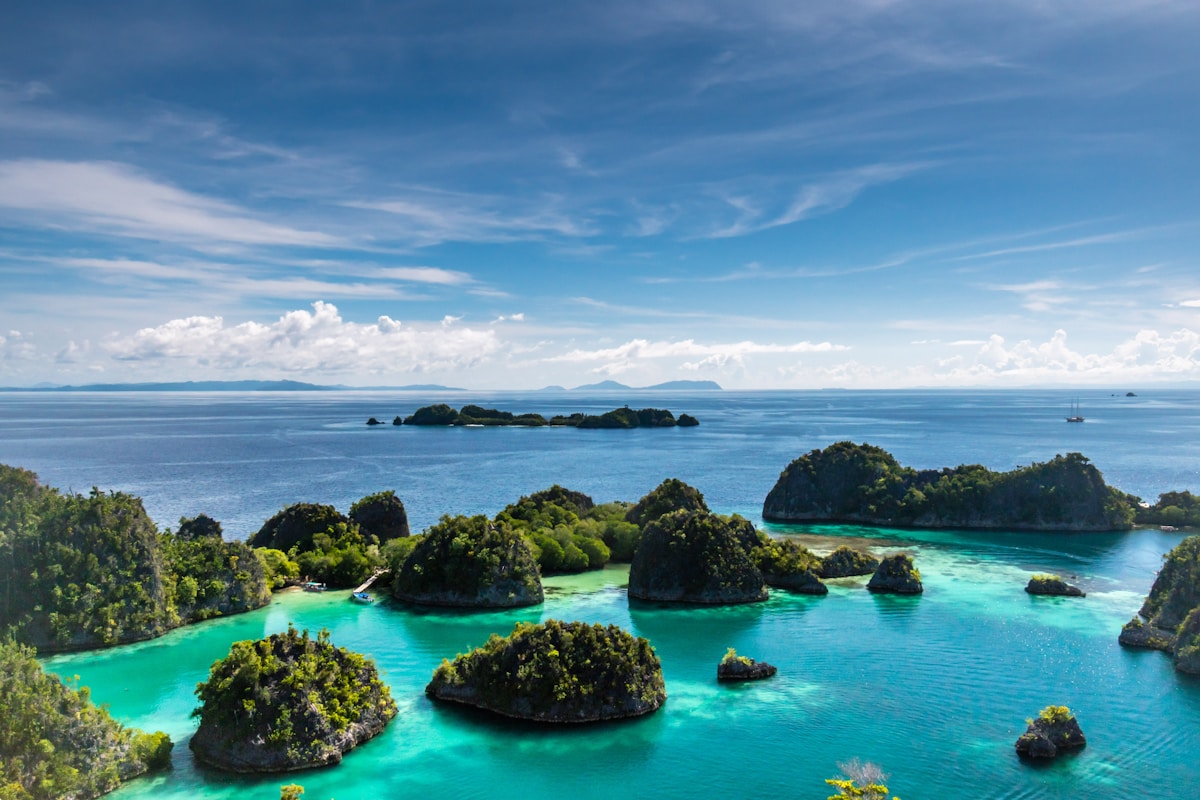
Raja Ampat is the most biodiverse marine environment on Earth. Scientists have recorded over 1,500 species of reef fish and 600 species of coral in its waters - more than anywhere else in the world. The name translates as “Four Kings,” referring to the four main islands: Waigeo, Batanta, Salawati, and Misool. Around them lie more than 1,500 smaller islands, islets, and exposed rocks forming an archipelago that stretches 200 kilometres from north to south in Indonesia’s West Papua province.
This guide covers the full picture: what you will find in the water, on the islands, and in the jungle - plus all the practical logistics for getting there and back.
Getting to Sorong
Sorong (SOQ) is the only entry point for Raja Ampat. The city sits on the western tip of the Bird’s Head Peninsula and has good domestic flight connections.
From Jakarta: Garuda Indonesia, Lion Air and Batik Air fly Jakarta (CGK) → Sorong directly or via Makassar. Journey time approximately 4–5 hours with connection. Fares from approximately IDR 1,200,000–2,500,000 one-way depending on advance purchase (as of 2026).
From Makassar (UPG): The most common routing for travellers from eastern Indonesia. Direct flights to Sorong take approximately 2.5 hours. Garuda, Batik Air and Wings Air all serve this route.
From Manado (MDC): Approximately 1.5–2 hours flying time. Useful if combining Raja Ampat with North Sulawesi diving.
Sorong Sultan Babullah Airport (SOQ) is a small but functional airport. There is an ATM in the arrivals hall - withdraw substantial rupiah here before proceeding to Waisai, as ATM availability in Raja Ampat is extremely limited.
Sorong to Waisai: The Fast Ferry
Waisai is the administrative capital of Raja Ampat regency on Waigeo Island, and the point where all visitors arrive after leaving Sorong.
Fast boat schedule: Departs Sorong at 9am and 2pm daily. Journey time approximately 2 hours. Fare approximately IDR 120,000 per person (as of 2026). Buy tickets at the harbour - there is no advance booking requirement for the public ferry.
Return ferries Waisai → Sorong: Depart at 8am and 1pm daily.
Private speedboat charter: Approximately IDR 2,500,000–4,000,000 per boat (not per person). Worth considering for groups of 4–5 travelling directly to remote islands beyond Waisai, or if your schedule doesn’t align with the public ferry times.
Marine park fee: Every visitor to Raja Ampat must pay the marine park entry fee of approximately IDR 1,000,000 per person (as of 2026), valid for one year. Pay at the government office in Waisai before travelling into the park.
Waisai Town
Waisai itself is a small port town - functional rather than scenic. It has a market, a handful of simple warungs, a few small shops selling basic supplies, and the ferry terminal. Most visitors spend only enough time here to pay the marine park fee and arrange onward transport to their accommodation.
The town has Telkomsel SIM card vendors and basic ATMs (with caveats - see the Money section below). Stock up on supplies, snacks and any medication here before heading to the outer islands.
The Four Main Islands
Waigeo
The largest of the four kings and the one where most visitors base themselves. Waisai, the administrative capital, sits on Waigeo’s south coast - this is where the ferry from Sorong arrives and where you pay the marine park entry fee. Most central islands homestays and dive resorts are on or near Waigeo or the smaller islands of the Dampier Strait just to its south.
The diving around Waigeo’s southern coast - particularly along the Dampier Strait that separates it from Batanta - is world-class: Cape Kri, Blue Magic, Manta Sandy and The Passage are all within range of a central islands base.
Misool
The southernmost and most remote of the four main islands. Misool receives far fewer visitors than the north but is considered by many professional divers to offer the finest diving in the entire archipelago. The walls, seamounts and bommies around Misool hold pelagics and schooling fish in densities rarely seen elsewhere - and the no-take zone managed around Misool Eco Resort has visibly recovered since the early 2000s, with fish biomass measurably higher inside the protected area.
Misool Eco Resort is the principal base in the south, functioning as both a luxury resort and a liveaboard dock. Rates start from approximately USD 350 per night including diving, meals and guiding. The resort also operates as a marine conservation programme.
One feature of Misool that is often overlooked: ancient hand-stencil rock paintings on cliff walls bordering the lagoons, estimated to be several thousand years old. A guided paddle or boat trip around the lagoons passes them.
Getting to Misool independently requires either a liveaboard itinerary going south or a connecting boat from Sorong - no regular scheduled ferry connects Waisai to Misool. Most visitors see Misool only on multi-day liveaboard trips.
Batanta and Salawati
These two islands are less visited than Waigeo and Misool. Batanta has dense jungle and is a productive site for birding expeditions. Salawati’s surrounding reefs are part of the same extraordinary ecosystem; neither island has significant tourist infrastructure.
Wayag: The Iconic Viewpoint
Wayag is the image most closely associated with Raja Ampat - dozens of karst limestone mushroom islands emerging from a shallow, brilliantly clear lagoon in northern Waigeo. The viewpoint hike climbs a fixed-rope trail in 30–45 minutes and delivers a panorama that is as extraordinary as the photographs suggest: layers of forested limestone rising from water that cycles between turquoise, jade and deep cobalt.
Reaching Wayag requires a chartered speedboat from Waisai of approximately IDR 3,000,000–5,000,000 for a 4–5 person boat (roughly 3–4 hours each way). Because of the distance, Wayag is typically a full-day excursion from a central islands base. Check weather conditions before committing - the crossing is rough in strong winds.
Below the viewpoint, the lagoon is calm enough for snorkelling. Sharks and rays move through the clear water and are visible from the surface.
Pianemo: The Accessible Alternative
Pianemo is a cluster of karst islands in the northwest of Waigeo, roughly 1.5–2 hours from Waisai by speedboat. A viewpoint on a small hill - approximately 10 minutes of climbing via a fixed wooden staircase - gives a near-identical panorama to Wayag. Entry to the viewpoint is approximately IDR 50,000 per person.
For visitors short on time or budget, Pianemo is the practical choice. For those who want the full experience and are willing to spend a full day on a boat, Wayag is worth the extra effort. On a longer visit, there is no reason to choose - go to both.
Marine Biodiversity
The Coral Triangle - the region bounded by Indonesia, Malaysia, the Philippines, Papua New Guinea, the Solomon Islands and Timor-Leste - is the global centre of marine biodiversity, and Raja Ampat sits at its apex. Approximately 75% of the world’s known coral species exist within the archipelago. The diversity of life here is not just high by Indonesian standards - it is the highest documented anywhere on Earth.
Why: Raja Ampat sits at the confluence of the Pacific and Indian Oceans. The convergence generates nutrient-rich upwellings and current systems that sustain extraordinary life across every level of the food chain, from pygmy seahorses at 18m to whale sharks and pods of spinner dolphins on the surface.
Diving
Raja Ampat diving operates year-round, with the optimal season running October through April - calmer seas, predictable conditions, and visibility commonly exceeding 25 metres.
Signature dive sites:
Cape Kri (near Kri Island, Dampier Strait) - the world record holder for fish species counted on a single dive: 374 species documented in one dive by marine biologist Dr Gerald Allen. Reef sharks, manta rays and barracuda schools are standard sightings.
Manta Sandy (near Arborek village) - a cleaning station at 12–18m where reef mantas queue in the current. On a good day, 10–20 mantas circle. December and January see peak aggregations, but the station is productive year-round.
Melissa’s Garden (south coast of Gam Island) - a current-fed coral garden with the densest healthy hard coral coverage in the region: field after field of staghorn and table coral that escaped the widespread 1998 bleaching events.
Sardine Reef (near Mansuar) - known for massive baitball formations, with tuna and jacks hunting below and frigate birds wheeling above the surface.
Blue Magic (Dampier Strait) - an open-water seamount in strong current. Schools of barracuda, grey reef sharks, wobbegong sharks resting on ledges, and passing manta rays. Advanced divers recommended.
The Passage - a submerged channel cut through karst limestone, barely wide enough for a diver to spread their arms. The walls are carpeted in soft corals, sea fans and tunicates. Depth 3–16m; suitable for Open Water divers.
Misool sites (Magic Mountain, Boo Windows, Fiabacet) - soft coral density among the highest recorded anywhere; pelagics and schooling fish in numbers rarely seen at northern sites. Accessible primarily by liveaboard.
Liveaboard vs shore-based: A liveaboard is the recommended approach for first-time visitors, providing access to both the central islands and Misool on a single trip. Shore-based resorts on Kri, Mansuar and Arborek work well for extended stays focused on the central sites. See our Raja Ampat diving guide for full details on operators, certification requirements and costs.
Snorkelling
Raja Ampat is exceptional for snorkellers. The house reefs at many homestays have sharks, turtles and reef fish visible from the surface in clear water. Non-divers are well served throughout the central islands. The lagoon at Wayag offers shark sightings at snorkel depth; Manta Sandy can be visited by snorkellers - mantas pass close to the surface at the right tide.
Wildlife Beyond the Reef
Birds of Paradise
West Papua is one of the last places where birds of paradise can be reliably seen in the wild. Two species are endemic to Raja Ampat: Wilson’s Bird of Paradise and the Red Bird of Paradise. Both require a guided dawn trek to a known display tree.
Local guides from villages on Waigeo lead these treks for approximately IDR 300,000–500,000 per person, departing before 5am. Sightings are not guaranteed but probability is high with an experienced local guide who knows the current display sites. The male Wilson’s Bird of Paradise is one of the most visually extraordinary birds in the world - the effort required to see it is minimal relative to the reward.
Walking Sharks
Epaulette sharks - small, brown, spotted sharks roughly 80cm long - are found throughout Raja Ampat’s shallow reefs. At low tide they walk across exposed reef using modified pectoral fins. They are entirely harmless, and watching them move across the reef at night with a torch is one of the more unusual wildlife encounters available in Indonesia.
Sea Turtles and Dugongs
Green and hawksbill turtles are common across all dive and snorkel sites. Dugongs have been sighted around seagrass beds near Salawati and southern Misool, though encounters are irregular and cannot be planned for.
Spinner Dolphins and Whale Sharks
Spinner dolphins are frequently encountered on boat transfers between islands. Whale sharks pass through Raja Ampat waters periodically - most common in December to January around Misool and the outer islands, though sightings cannot be predicted with certainty.
Accommodation
Raja Ampat’s accommodation market differs fundamentally from other Indonesian islands. Village community homestays form the backbone, not hotels. Choosing the island matters more than the budget tier, as each zone has different accessibility and atmosphere.
Budget (from approximately USD 30–50/night including meals, as of 2026)
Family-run homestays on Gam Island, Arborek, Kri, and surrounding smaller islands host guests in simple but clean rooms, typically including three meals per day. This is the recommended approach for most travellers and the most direct way to support local communities. Electricity runs on generators, typically 6–10pm only. Bring a charged power bank. Kordiris Homestay & Resort on Kri offers clean rooms close to excellent snorkel and dive spots from approximately USD 35–50/night including meals. Advance booking is strongly recommended for peak season (October–April); most homestays are bookable via WhatsApp.
Mid-Range (from approximately USD 80–150/night including meals, as of 2026)
Raja Ampat Biodiversity Eco Resort (Kri Island, from approximately USD 80–150/night including meals) has a PADI IDC centre on site and is one of the most established mid-range eco-lodge options in the archipelago, with private bathrooms, more reliable power, and guided snorkel and dive packages included. Kri Eco Resort (Kri Island, from approximately USD 100–180/night including meals) offers a similar eco-lodge format with well-maintained rooms and direct reef access from the property. Papua Paradise Eco Resort (Batanta Island, from approximately USD 120–200/night) sits in a quieter position further from the main dive routes but with excellent coral health immediately nearby.
Luxury (from approximately USD 350+/night, as of 2026)
Misool Eco Resort (southern Misool, from approximately USD 350+/night including meals) is the leading luxury option in the archipelago: a conservation-focused property with a private marine protected area, overwater and land bungalows, and a comprehensive reef protection programme. Booking windows for peak season often close six to twelve months in advance. Raja Ampat Dive Lodge on Waigeo offers elevated comfort in the more accessible northern zone of the archipelago with full-time power, air conditioning, and polished service.
For a full breakdown of resort islands, jungle bungalows, and village homestay options, see our Raja Ampat accommodation guide.
Search hotels in Raja Ampat on Booking.com
Money & Connectivity
Cash is essential. Raja Ampat operates almost entirely on cash in Indonesian rupiah. Waisai has ATMs but they frequently run out of notes, particularly during peak season. The outer islands have no cash facilities at all.
Before you arrive: Withdraw generous reserves of rupiah from ATMs in Sorong (the airport ATM is reliable) or from Makassar / Manado before flying west. Budget at least IDR 500,000 per person per day beyond accommodation and meals - this covers boat trips, tips, guided excursions, snacks and the marine park fee if not yet paid. Card payments are not accepted at homestays, local boats, guides or market stalls.
Mobile data: Telkomsel SIM cards work in Waisai and on some central islands near Kri and Arborek. Signal is absent or extremely patchy on the outer islands. Download offline maps (OsmAnd or Maps.me) and any content you need before leaving Sorong.
When to Visit
October to April is the main season - calmer seas, predictable fast-boat conditions, and underwater visibility commonly exceeding 25 metres. December and January are peak booking months; book accommodation well in advance.
May to June is a shoulder period: still good conditions but with a higher chance of rough days.
July to September brings stronger southeast winds, particularly affecting boat crossings to Wayag and the outer islands. Some sites remain accessible; liveaboard operators adjust itineraries to sheltered areas. Check with your specific operator before booking.
Food and Eating
Dining in Raja Ampat is simple outside of Waisai and the larger resorts. Most accommodation includes meals in the rate; independent restaurants in the Western sense are rare on the smaller islands.
In Waisai, RM Pondok Wijaya and RM Panorama serve standard Indonesian rice and noodle dishes, grilled fish, and local soups for approximately IDR 30,000–60,000 per meal. Fresh grilled fish - yellowfin tuna, barramundi, snapper - is the reliable choice across the archipelago. Bottled water costs IDR 10,000–20,000 at village warung stalls; resorts typically provide filtered drinking water.
For a full breakdown of eating options by island, see our Raja Ampat food guide.
Practical Notes
Motion sickness: Speedboat crossings between islands can be rough, particularly May–September. Carry medication if you are susceptible.
Conservation: Pay the marine park fee. Do not touch coral. Keep fins off the reef. Leave nothing in the water. Raja Ampat’s exceptional marine biodiversity is directly linked to 20 years of enforced protection funded by visitor fees.
Time zone: West Papua operates on WIT (Waktu Indonesia Timur), UTC+9 - three hours ahead of Bali/Lombok.
Book tours and day trips in Raja Ampat - most include transport from your guesthouse and a local guide familiar with the island’s best spots.
More Raja Ampat Guides
- How to get to Raja Ampat: logistics, permits & costs - flights to Sorong, Waisai ferry, conservation permit, and budget breakdown
- Things to do in Raja Ampat - diving, snorkelling, Wayag viewpoints, and village homestays
- Where to stay in Raja Ampat - resort islands, homestay villages, and liveaboard options compared
- Food guide to Raja Ampat - resort dining, local warungs, and what to expect on a liveaboard
- Raja Ampat diving guide - dive sites, operators, certification requirements and costs
- Indonesia liveaboard diving - multi-day liveaboard routes including Raja Ampat and Komodo