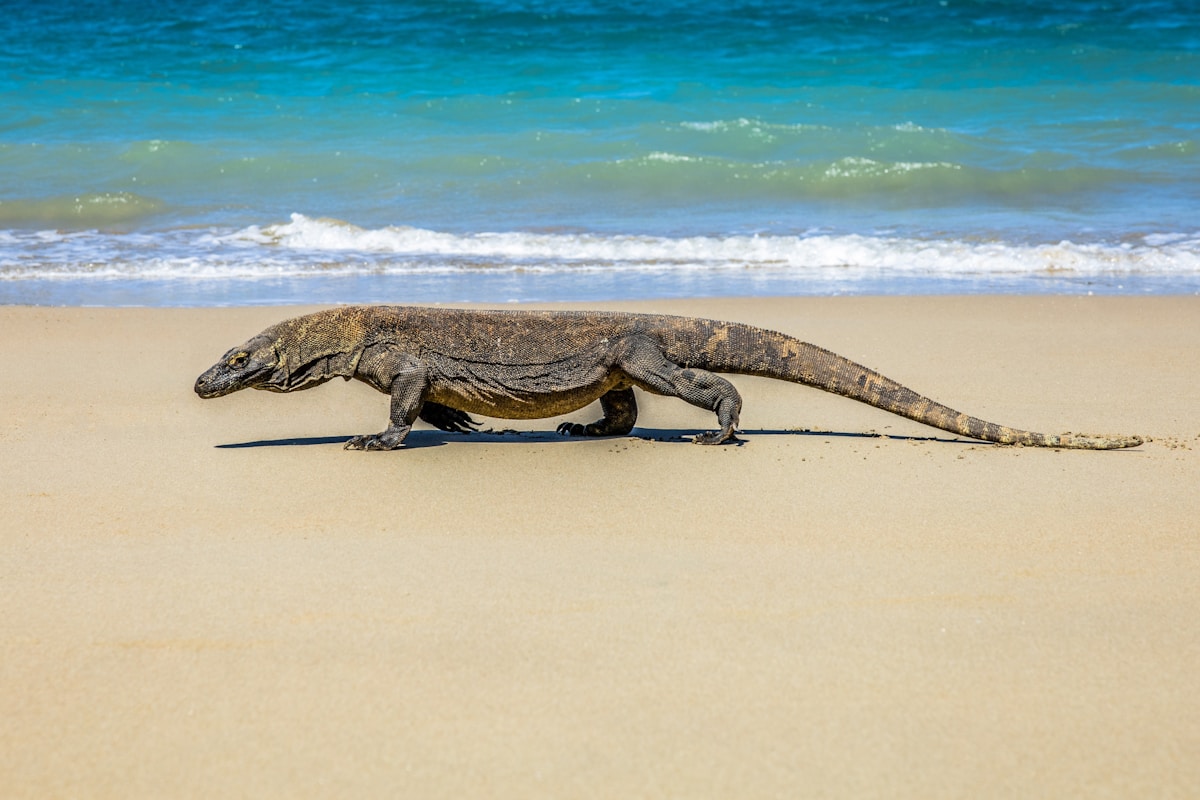
Komodo dragons are unlike any other animal encounter available to travellers. They are genuinely dangerous, genuinely enormous, and genuinely wild - not zoo animals, not trained performers, but apex predators living out their biology on a handful of islands in eastern Indonesia. Understanding what they are and how to behave around them makes the difference between a safe, extraordinary experience and a preventable incident.
Biology
Scientific name: Varanus komodoensis
Size: Adults reach up to 3 metres in length and 90 kilograms in weight. Males are significantly larger than females. They are the world’s largest living lizard by both length and mass.
Lifespan: 30 or more years in the wild. They grow slowly - a 3-metre dragon may be 20–30 years old.
Venom: For decades it was believed that Komodo dragons killed primarily through bacterial infection from their saliva - a mouth supposedly colonised by dozens of lethal bacteria. More recent research has identified venom glands in the lower jaw that produce anticoagulant compounds. A bite from a dragon causes wounds that bleed profusely and resist clotting. The venom is not fast-acting in the way of a venomous snake, but it prevents the prey animal’s body from sealing the wound. Combined with bacteria, a dragon bite is a serious medical emergency requiring immediate evacuation and hospital treatment.
Senses: Dragons sense their environment primarily through smell. Their forked tongue flicks constantly to collect airborne particles, which are analysed by the Jacobson’s organ in the roof of the mouth. They can detect a dead or wounded animal from a reported distance of up to 9.5 kilometres. Their eyesight is adequate but secondary to smell. Hearing is limited.
Speed: Komodo dragons appear slow and ponderous. They are not. Over short distances, they can sprint at approximately 20 kilometres per hour - faster than an unprepared adult can run on rough ground. Do not assume you can outrun one.
Diet: Wild pigs, deer, water buffalo, goats, and smaller Komodo dragons. They ambush prey rather than pursuing it - a single powerful bite to a leg or belly, then they follow the wounded animal until it collapses. They eat rarely but enormously: a dragon can consume 80% of its body weight in a single feeding.
Where They Live
Komodo dragons exist in the wild only in Komodo National Park and on the western coast of Flores. The wild population is estimated at approximately 3,000–6,000 individuals, though precise counts are difficult. The main populations are on:
- Komodo Island - the largest population; most famous habitat
- Rinca Island - second largest population; considered by many rangers to offer more reliable daily sightings
- Gili Motang - a smaller island in the park; fewer visitors, smaller dragon population
- Padar Island - historical habitat; dragons are now very rarely seen here, possibly due to prey depletion
All of these islands are within Komodo National Park, which is a UNESCO World Heritage Site designated in 1991 and also listed as a Biosphere Reserve.
Flores: Wild dragons are present along the western coast, primarily around the towns of Labuan Bajo, Riung, and the Batu Tiga area. Sightings near Labuan Bajo town are rare but not impossible - dragons occasionally enter garden areas.
Komodo dragons are not found anywhere else on earth. There are captive specimens in zoos, but the wild population is entirely confined to this small region of eastern Indonesia.
Safety With Rangers
All treks on Komodo Island, Rinca, and Gili Motang are conducted with a ranger escort. This is compulsory, not optional. Rangers carry forked wooden sticks - not as weapons, but as tools for redirecting a dragon’s attention and blocking a charge. They are experienced in dragon behaviour and know how to read the subtle signals that indicate a dragon is shifting from passive to active.
Rules for visitors:
- Maintain at least 5 metres of distance from any dragon at all times
- Stand upright - never crouch, kneel, or sit on the ground. A crouching human has a threat profile similar to wounded prey. Standing upright signals that you are not vulnerable.
- Move away slowly if a dragon moves toward you - do not run. Running may trigger a chase response. Backed retreat while facing the animal is the correct action.
- Do not wear red or orange - colour perception in dragons is debated, but rangers advise against colours that may attract attention
- Do not carry or eat food on the trail - the smell of food can attract dragons from significant distances
- Menstruating visitors should inform their ranger - dragons can detect blood; some operators recommend waiting until menstruation has ended
Tip your ranger at the end of the trek: approximately IDR 50,000–100,000 per ranger is standard.
Rinca Versus Komodo Island - Which to Choose
The most common question for first-time visitors:
Rinca Island is approximately 2 hours from Labuan Bajo by boat versus 3 hours to Komodo Island. It is the standard first stop on one-day tours and the most time-efficient option. The terrain is open savannah and dry forest. Dragon sightings near the ranger station kitchen and water sources are highly reliable - the rangers know where dragons congregate. A short 1-hour trek suits most fitness levels and reliably delivers several dragon encounters.
Komodo Island takes longer to reach but offers more varied terrain and the option of longer treks (2–4 hours) that go deeper into the landscape. Komodo Island also has Pink Beach on its eastern side - a blush-pink sand beach caused by red coral fragments, included on most boat tours as a snorkelling stop.
For most visitors: Rinca is the better choice for guaranteed dragon sightings and time efficiency. Komodo Island is worth the additional travel time if you want longer trekking options or are combining with Pink Beach.
Booking Your Visit
Independent access to the islands is not possible. All visits are made as part of a guided boat tour from Labuan Bajo (the main town on western Flores). Tours range from one-day group trips at approximately IDR 600,000–1,000,000 per person to multi-day private charters. See the Komodo island hub guide and the Labuan Bajo city guide for full tour pricing and logistics.
The national park entry fee is separate from the tour boat cost - approximately IDR 250,000 per visit for foreign visitors as of 2026, though fees have been revised multiple times in recent years. Confirm the current fee structure with your tour operator before booking.
Book Komodo tours and boat trips from Labuan Bajo - most include transport from your guesthouse and a local guide familiar with the island’s best spots. Bookaway covers the main ferry routes between the islands - book in advance during peak season when boats fill quickly.
Search hotels in Komodo on Booking.com
See Also
- Komodo Island guide - the full guide to Komodo National Park: boat tours, dive sites, and when to visit
- Komodo boat trips guide - day tours and overnight cruises from Labuan Bajo
- Komodo diving guide - the park’s best dive sites, currents, and manta ray season
- Labuan Bajo travel guide - the gateway town: where to stay, how to book tours, and airport transfers
- 10-day Komodo and Flores itinerary - combining Komodo with the Trans-Flores Highway