Semarang Travel Guide: Colonial Old Town & Temples
Semarang's Kota Lama quarter, Sam Poo Kong temple, Lawang Sewu's ornate halls, and lunpia spring rolls make Central Java's capital worth a night.
Guides for Semarang
Search hotels in Semarang on Booking.com
Semarang is the capital of Central Java province and one of the oldest port cities on Java’s north coast, with a history shaped by Dutch colonial trade, Chinese merchant communities, and Javanese culture layered on top of each other across several centuries. It sits on the coast where a series of rivers drain down from the Dieng Plateau highlands to the south, and it has a distinct character that sets it apart from the better-known tourist cities of Yogyakarta and Solo: quieter, less packaged for international visitors, and more representative of everyday urban Java. The city rewards a day or two of unhurried exploration, particularly in its colonial and Chinese quarters.
Neighbourhoods and Orientation
Central Semarang divides into a few clearly distinct zones. Kota Lama (the Old Town) clusters around the Tawang train station in the north, where Dutch colonial warehouses, churches, and commercial buildings line the canals. The Pecinan (Chinatown) district directly south of Kota Lama contains some of the city’s best street food and the Sam Poo Kong temple complex. Simpang Lima is the modern commercial centre, about 3 km south of the old town, with shopping malls and mainstream hotels. The colonial government building Lawang Sewu sits roughly between these two zones, near the Tugu Muda roundabout.
Key Attractions
Kota Lama (Old Town) - The most atmospheric part of Semarang, a compact district of 18th- and 19th-century Dutch colonial buildings in various states of preservation and restoration. The area around the Gereja Blenduk (a domed Protestant church built in 1753) and the surrounding canal streets is the photogenic core. Entry to the street-level old town is free; several warehouses and heritage buildings have been converted into cafés and event spaces with no entry charge. Best visited in the morning before it gets hot; the light is better and the streets less crowded.
Sam Poo Kong Temple - A Chinese-Javanese temple complex approximately 5 km southwest of the city centre, built on the site where the Chinese Muslim admiral Zheng He is said to have landed and sheltered during a voyage in the early 15th century. The main pavilion is painted in vivid red and green, with carved wooden columns and incense smoke drifting through the halls. Entry approximately IDR 10,000 as of 2026, open 8am–7pm daily. The complex includes multiple smaller shrines and a large courtyard used for community events. It remains an active place of worship, not just a tourist attraction.
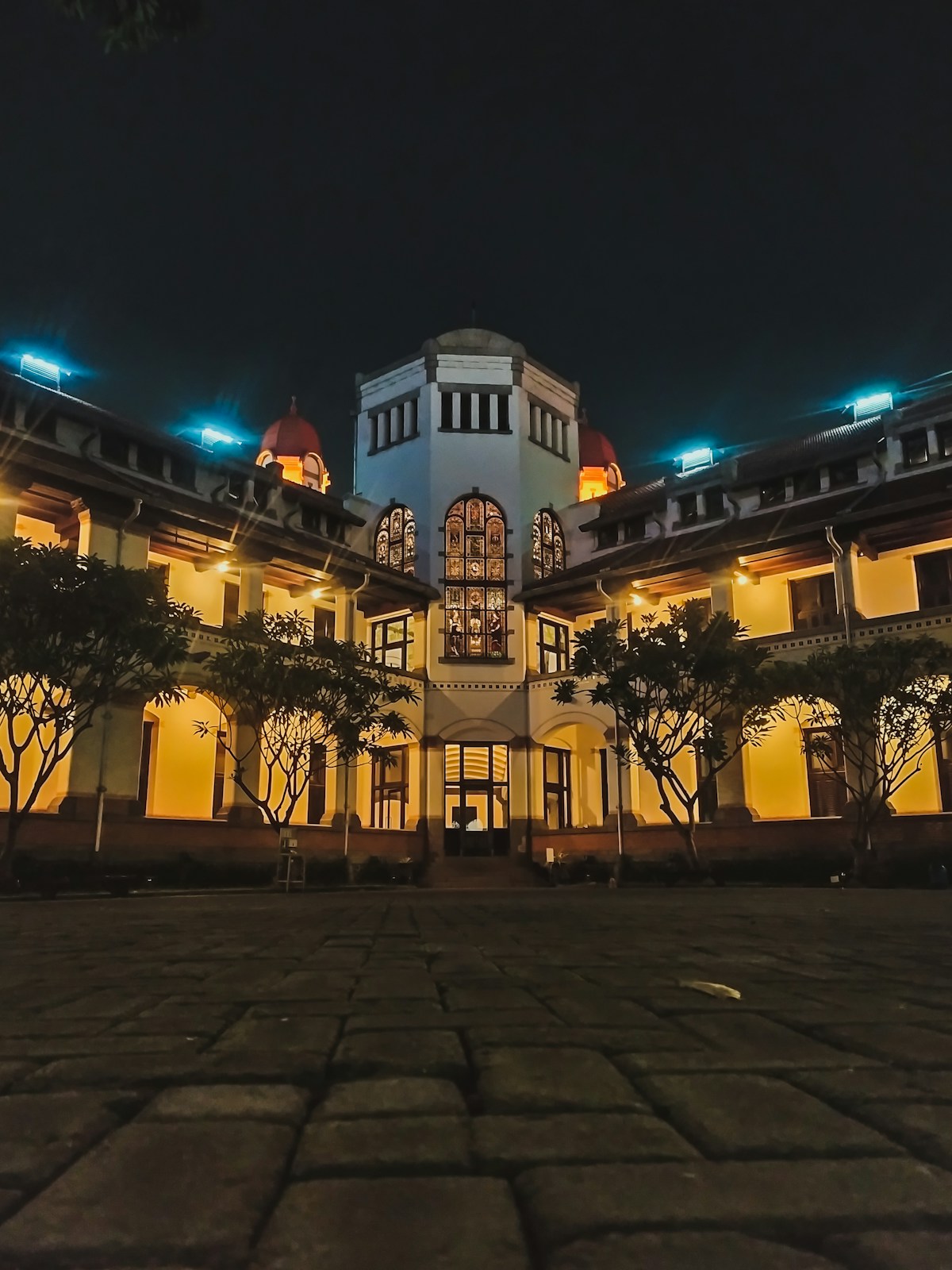
Lawang Sewu (Thousand Doors) - A large Dutch colonial office building completed in 1919 for the Netherlands East Indies Railway Company. The name refers to its distinctive facade of arched windows and doorways, though the actual count is considerably fewer than a thousand. The building is architecturally significant - two main wings with ornate ironwork, stained glass skylights, and a central courtyard - and is now managed as a heritage museum. Entry approximately IDR 10,000 as of 2026, open 7am–9pm daily. The basement, used as a detention facility during the Japanese occupation, can be visited on a guided tour at an additional charge of approximately IDR 5,000. The building’s scale and condition make it one of the finest preserved colonial structures on Java.
Lunpia (Spring Roll) Trail - Semarang is credited with producing one of Indonesia’s most distinctive spring roll variants: lunpia semarang, filled with bamboo shoots, prawns, and egg, served with sweet chilli sauce. The original and most famous source is Lunpia Gang Lombok, a small stall on Gang Lombok street in the Pecinan district, operating since the 1870s. A serving of four to six pieces costs approximately IDR 30,000–50,000 as of 2026. Queues form by mid-morning; arrive before 10am for the freshest batch.
Bandeng Presto - The other Semarang food specialty is milkfish (bandeng) pressure-cooked until the bones soften and become edible. Packaged bandeng presto is sold at shops throughout the city as a take-home food item, but it can also be eaten fresh at local restaurants. The dish is distinctly Semarang in origin and not widely replicated elsewhere.
Hotels
Ciputra Hotel Semarang (upscale) - A large full-service hotel in the Simpang Lima commercial district, with a good pool, multiple restaurants, and reliable service. The most consistent upscale option in the city. From approximately USD 50 per night as of 2026.
Quest Hotel Semarang (mid-range) - A clean, modern business-oriented hotel with compact but well-equipped rooms, located close to the city centre. Efficient and good value for the price bracket. From approximately USD 35 per night as of 2026.
Budget guesthouses (losmen) - The Kota Lama and Pecinan districts have a range of family-run guesthouses with basic air-conditioned rooms, some in heritage shophouses. From approximately IDR 200,000 per night as of 2026. These vary significantly in condition; checking recent reviews is worthwhile.
Restaurants
Lunpia Gang Lombok - The reference address for Semarang’s signature dish (see above). Cash only; the menu is essentially one item. IDR 30,000–50,000 per serving as of 2026.
Mie Kopyok Pak Dhuwur - A local institution serving mie kopyok, a Semarang-specific noodle dish: yellow noodles in a light broth with lontong (rice cake), fried shallots, and a garlic-heavy seasoning. Inexpensive at approximately IDR 20,000–30,000 per bowl as of 2026. The food stall operates morning hours only; closed by early afternoon when the batch runs out.
Restoran New Champs - A Chinese-Indonesian restaurant in the city centre that has been operating for several decades, serving the kind of Chinese Semarang cooking - rich braised pork, crispy duck, various fried rice and noodle dishes - that the city’s Peranakan community developed over generations. Approximately IDR 80,000–150,000 per person as of 2026.
Tahu Gimbal - Not a specific restaurant but a street food format unique to Semarang: fried tofu and shrimp fritters served over rice cake with peanut sauce. Available from carts and small warungs throughout the city for approximately IDR 15,000–25,000 as of 2026.
Getting There and Getting Around
By train from Yogyakarta - The most practical connection. Argo Sindoro and Kamandaka services link Yogyakarta’s Tugu station to Semarang Tawang station in approximately 1 hour; fares from approximately IDR 40,000–80,000 as of 2026 depending on class and train. The Tawang station is itself a colonial-era building of some architectural interest, sitting at the edge of the Kota Lama district.
By train from Jakarta - Several services operate on the Jakarta–Semarang route via the north coast rail line, with journey times of approximately 5.5–6.5 hours. The Argo Muria express is the fastest option; economy fares from approximately IDR 90,000, executive class from approximately IDR 180,000 as of 2026.
By air - Ahmad Yani International Airport (SRG) handles domestic routes from Jakarta, Bali, Surabaya, and other Indonesian cities. The airport is close to the city centre, approximately 20 minutes by taxi. Flights from Jakarta take approximately 1 hour.
Within the city, online ride-hailing (Grab, Gojek) is the most practical option. The old town is compact enough to walk once you are in it. City buses (Trans Semarang) cover the main corridors with air-conditioned vehicles at low fares.
Best Time to Visit
Semarang’s coastal location makes it hot and humid year-round, typically 27–33°C. The wet season (November–March) brings afternoon rain; the dry season (April–October) is more comfortable. Weekdays are preferable - the city sees mainly domestic tourism, and weekend crowds at Sam Poo Kong can be substantial.
Practical Tips
The Kota Lama area has been subject to ongoing flooding from the adjacent river system, partly due to land subsidence along the north Java coast. Some streets can be impassable after heavy rain. The area around Tawang station is also one of the most authentic parts of the old town and can be combined with train arrivals or departures without any extra travel. Most food in the Pecinan district is pork-inclusive; halal warungs are widely available elsewhere in the city.
Browse tours and day trips in Semarang - a half-day with a local guide is one of the most efficient ways to get oriented on arrival. For airport transfers into Semarang, Kiwitaxi offers fixed-price pickups from the main airports - no surge pricing and the driver meets you at arrivals.
More Semarang Guides
- Things to do in Semarang - Kota Lama, Sam Poo Kong, Lawang Sewu, and day trips to Demak and Karimunjawa
- Where to stay in Semarang - old town hotels, business district options, and budget accommodation
- Food guide to Semarang - lumpia Semarang, bandeng presto, wingko babat, and the best local warungs
- Karimunjawa island guide - the coral island group day-tripped from Semarang: snorkelling, beaches, and getting there
- Yogyakarta travel guide - 3 hours west by train: Borobudur, Prambanan, and Javanese cultural life
- Dieng Plateau travel guide - the volcanic highland 3 hours west: ancient Hindu temples and coloured crater lakes
- Java train travel guide - using Indonesia’s rail network to travel between Semarang, Yogyakarta, and beyond
Book an experience
Top experiences in Semarang
Explore the best tours and activities in Semarang , with instant confirmation and free cancellation on most bookings.