Minangkabau Highlands Guide: Bukittinggi, Sianok Canyon
Minangkabau Highlands: origin of rendang, Sianok Canyon WWII tunnels, and the world's largest matrilineal culture - 90 min from Padang.
Guides for Bukittinggi
The Minangkabau Highlands of West Sumatra sit between 700 and 1,400 metres above sea level in the mountainous interior of the island - a landscape of crater lakes, volcanic peaks, and terraced rice valleys shaped by millennia of Minangkabau civilisation. The Minangkabau are one of the world’s largest matrilineal ethnic groups: land, family names, and property pass through the mother’s line, and the traditional clan houses (rumah gadang) with their dramatic curved buffalo-horn rooflines are owned by the women of the family. The highlands produced rendang, nasi Padang, and a philosophical tradition of adat (customary law and social harmony) that distinguishes West Sumatran culture from the rest of Indonesia.
Bukittinggi is the principal gateway to the Minangkabau Highlands for international visitors. It sits at 930 metres in the Agam regency, with a climate so different from the Indonesian coast that it requires a light jacket in the evenings. The town’s name means “high hill” and the landscape earns it: a deep volcanic canyon cuts directly through the southern edge of town, Dutch colonial fortifications sit on the ridge above, and the traditional rumah gadang architecture dominates the surrounding villages. At a comfortable 18–28°C year-round, Bukittinggi draws Indonesian domestic travellers seeking respite from coastal heat as much as it draws international visitors.
What to See in Bukittinggi
Sianok Canyon (Ngarai Sianok) is the defining feature of the town - a 15-kilometre gorge dropping roughly 100 metres, created by tectonic movement along the Great Sumatran Fault. The best free viewpoints are along the canyon rim near Panorama Park (entry approximately IDR 5,000 as of 2026). Below the park, a network of Japanese WWII tunnels dug in 1942–1944 runs through the canyon walls - entry to the tunnels costs approximately IDR 12,000 and the guided walk takes 30–45 minutes. The tunnels were used for storage, command operations, and reportedly as holding cells; the history is grim and the guided interpretation covers it honestly.
Fort de Kock stands on a forested hilltop above the town centre, connected to the main clock tower area by a pedestrian bridge. The Dutch built the fort in 1825 during the Padri War, and while most of the original fortifications have eroded, the location offers good views across the canyon and the surrounding highland valleys. Entry costs approximately IDR 7,000.
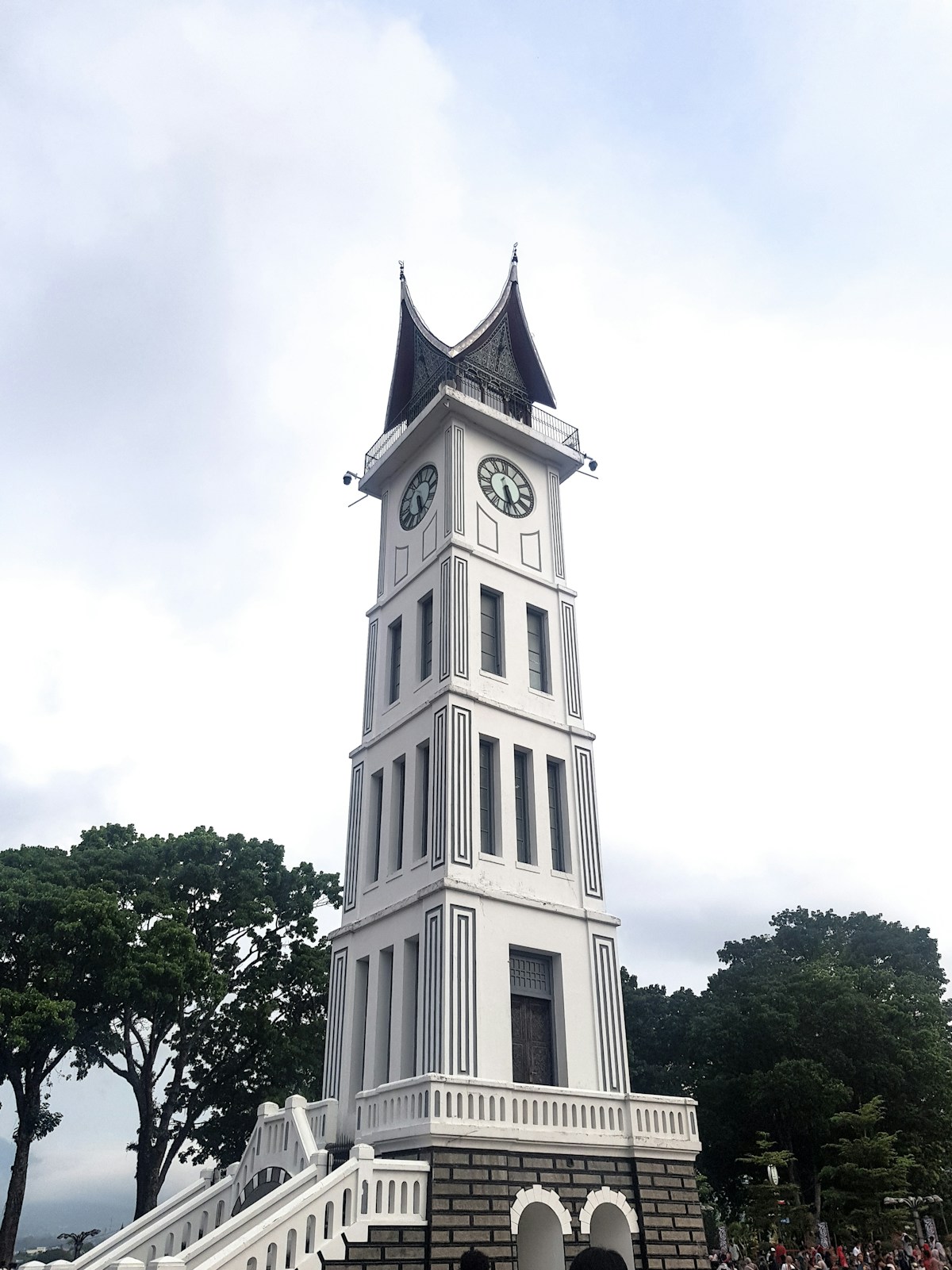
The Pasar Atas clock tower (Jam Gadang) is Bukittinggi’s most photographed landmark - a 1926 Dutch colonial clock tower with a Minangkabau-style roof retrofitted after independence. The market surrounding it is the main commercial hub of the town centre, selling spices, batik, embroidered Minangkabau textiles (songket), and street food. Entry is free.
Bundo Kanduang Museum (Rumah Adat Baanjuang) displays traditional Minangkabau adat objects including ceremonial dress, weapons, and household items in a restored rumah gadang. Entry costs approximately IDR 5,000. It is small but the architecture alone justifies a visit - the sweeping buffalo-horn roofline of a large rumah gadang is striking up close.
Beyond the Town: Villages and Crafts
The Minangkabau villages south of Bukittinggi - particularly Pandai Sikek (silver and wood carving) and Koto Gadang (silverwork, 3 kilometres from the canyon rim) - are accessible by motorcycle or hired car and offer working craft workshops where purchases go directly to artisans. Silver filigree and embroidered cloth are the traditional specialities; prices are negotiable and significantly lower than in Padang or tourist shops.
Lake Maninjau sits 38 kilometres west of Bukittinggi at the bottom of a steep caldera road - 44 hairpin bends descending to a flooded volcanic crater lake. Day trips by hired motorcycle (approximately IDR 100,000–150,000/day hire) or car are common; the lake itself is calm and the surrounding villages quiet.
Where to Eat in Bukittinggi
Pagi Sore Padang operates the same nasi Padang spread that made the format famous across Indonesia. This is home territory for the cuisine. Budget approximately IDR 40,000–70,000 per person.
Sate Mak Syukur is the town’s most celebrated single dish - sate Padang, made with beef offal cooked in a thick yellow curry sauce served over satay skewers, is the Minangkabau version and considered the original. A full portion costs approximately IDR 30,000–50,000. The queue at peak lunch hours is a reliable quality indicator.
Café Merdeka occupies a position above the canyon rim and serves a mixed Indonesian and Western menu. The views justify the slight price premium; budget approximately IDR 50,000–100,000 per person. It is busy at weekends with domestic visitors and quieter on weekday mornings.
Where to Stay in Bukittinggi
Novotel Bukittinggi is the most polished option in town, with a pool and views toward the canyon. Rates start from approximately USD 50 per night as of 2026. Book 5–7 days ahead at weekends when Padang domestic visitors arrive in volume.
The Hills Hotel Bukittinggi offers comfortable mid-range rooms on the elevated western side of town with highland views. Rates from approximately USD 40 per night. Better for a quieter stay than the town-centre options.
Benteng Hotel is a reliable budget option close to Fort de Kock, with basic but clean rooms. Rates from approximately USD 20 per night. Practical for overnight stopovers on a Sumatra overland route.
Search all hotels in Bukittinggi on Booking.com
Day Trips and Tours From Bukittinggi
Most tour operators cluster near the Jam Gadang clock tower market on Jalan Ahmad Yani. They can arrange transport and guides on short notice for weekday departures; book the afternoon before for weekend trips.
Lake Maninjau (38 km west) - a flooded volcanic caldera reached via a road of 44 numbered hairpin bends. Hired car for the day costs approximately IDR 250,000–350,000 including driver; motorcycle hire IDR 100,000–150,000 per day. Waterside warungs serve fresh lake fish. Round-trip with lakeside time takes approximately 5–6 hours. Operators at the clock tower offer combined Lake Maninjau and craft village packages for IDR 200,000–300,000 per person shared, or IDR 400,000–600,000 by private vehicle.
Craft village visits - Pandai Sikek (12 km south) for Minangkabau songket weaving on traditional backstrap looms; Koto Gadang (3 km, accessible via a canyon-rim footpath) for silverwork filigree. Both can be covered in a half-day by ojek or hired car (IDR 150,000–200,000 round trip). Buying directly from artisan workshops costs significantly less than in Padang tourist shops.
Rafflesia flower sightings - The world’s largest flower blooms unpredictably in highland forest near Batang Palupuh, approximately 15 km north. Local guides track bloom locations; a 2–3 hour guided walk costs approximately IDR 100,000–150,000 per group. Only worth visiting when a flower is active (blooms last 5–7 days) - confirm with your hotel or the Bukittinggi tourism information post the day before.
For hotel recommendations across all budgets, see our where to stay in Bukittinggi guide.
Getting to Bukittinggi
Bukittinggi does not have its own airport. The nearest is Minangkabau International Airport (PDG) at Padang, 90 kilometres south.
From Padang: shared minibuses (angkot/travel) depart regularly from the Padang city bus terminal throughout the day, taking approximately 90 minutes and costing approximately IDR 30,000 per person. A hired car from Padang costs approximately IDR 200,000–250,000 for a direct transfer and allows stops along the route.
From Medan: long-distance buses connect the two cities overnight (approximately 12–14 hours); this is a practical option for travellers continuing north through Sumatra rather than returning to Padang.
Practical Notes
Bukittinggi’s cool climate means evenings are genuinely cool compared to the rest of Indonesia - bring a layer. The town is compact and walkable between the clock tower, Fort de Kock, and the canyon viewpoints. Motorcycles are available for hire if you plan to explore surrounding villages. Weekend crowds from Padang and Pekanbaru can make the central area busy on Saturday afternoons; arrive on a weekday for a more relaxed experience.
Browse tours and day trips in Bukittinggi - a half-day with a local guide is one of the most efficient ways to get oriented on arrival. For airport transfers into Bukittinggi, Kiwitaxi offers fixed-price pickups from the main airports - no surge pricing and the driver meets you at arrivals.
More Sumatra Guides
- Padang travel guide - the coastal gateway to Bukittinggi: seafood, Minang cuisine, and Mentawai surf connections
- Lake Toba travel guide - Sumatra’s other highland highlight: the world’s largest volcanic lake, 10 hours north
- Bukit Lawang orangutan trek - Sumatra’s premier orangutan experience, accessible via Medan
- Padang food guide - understanding West Sumatran Minang cuisine: rendang, gulai, and the nasi Padang tradition
- Sumatra adventure itinerary - a full route combining Bukittinggi, Lake Toba, and Bukit Lawang
Book an experience
Top experiences in Bukittinggi
Explore the best tours and activities in Bukittinggi , with instant confirmation and free cancellation on most bookings.