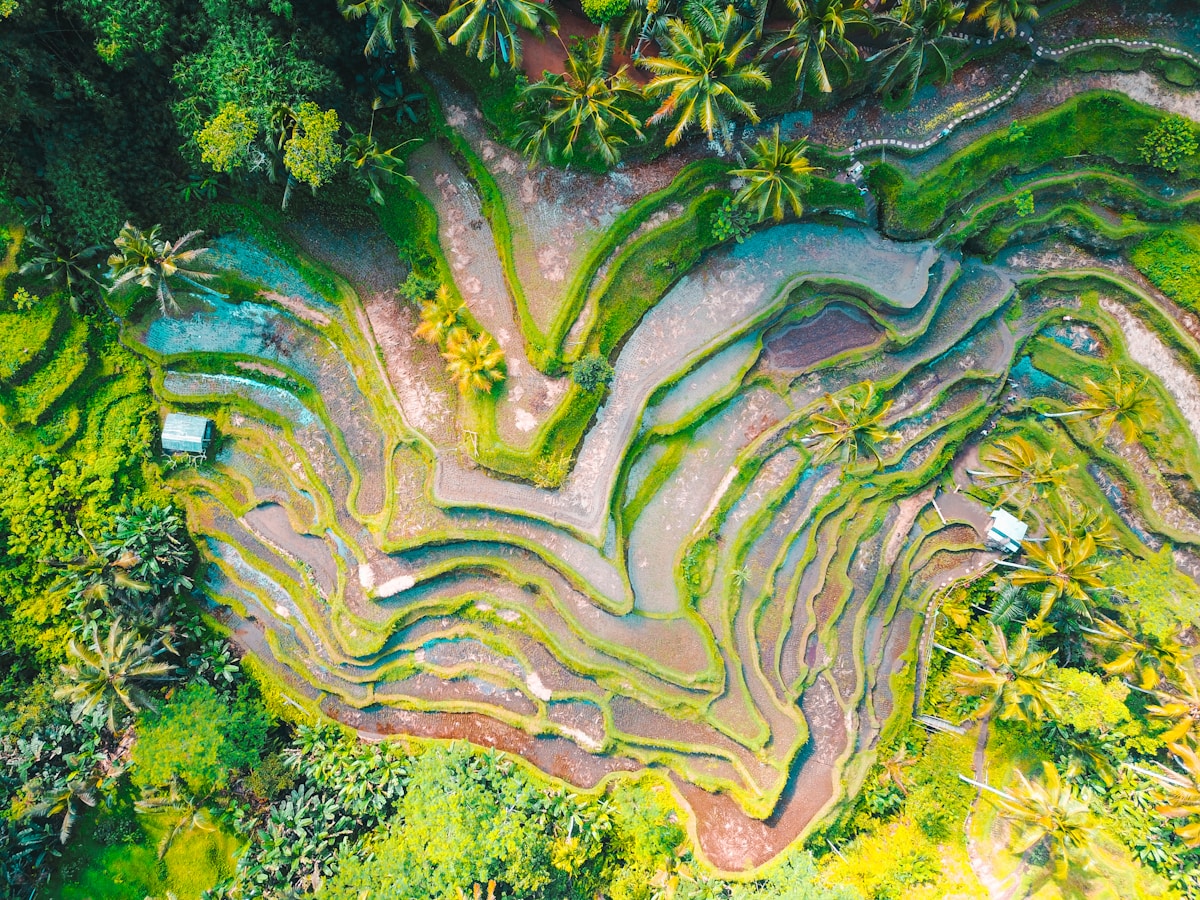
Ubud is the cultural centre of Bali - and arguably of all Indonesia’s tourism geography. The town and its surrounding villages hold a remarkable concentration of things worth doing: rice terrace walks, Hindu water temples, active craft workshops, morning markets, cooking schools, and forest sanctuaries, all within a roughly 10 km radius. GetYourGuide lists over 600 bookable experiences in and around Ubud alone, spanning early-morning temple visits to afternoon wood-carving lessons to full-day photography tours of the paddies. The difficulty is filtering for quality. Below is a focused breakdown of the tours that deliver most consistently.
Tegallalang Rice Terrace and Temple Day Tour
The Tegallalang rice terraces sit about 10 km north of central Ubud - a layered cascade of flooded paddy fields dropping into the Campuhan valley. The irrigation here follows the subak system, a 9th-century cooperative water management network that UNESCO recognised in 2012. A guided tour adds genuine depth to what would otherwise be a photo stop.
Most full-day cultural tours out of Ubud combine Tegallalang with three or four other sites: Tirta Empul holy spring, a coffee and cocoa plantation (where you can try kopi luwak, though quality varies enormously - look for tours that include a single-origin alternative tasting), Gunung Kawi temple complex, and Kintamani volcano viewpoint. Tour duration is typically 8–9 hours; prices from USD 30 per person on shared tours, USD 55–75 for a private vehicle.
Key timing note: The terraces between 7am and 8:30am are at their best - morning mist sits in the valley, the light is soft, and coach groups haven’t arrived yet. Guides who offer earlier departures are worth the alarm clock. By 10am the swing operators on the ridge are in full effect and the access path is congested.
Tirta Empul Purification Temple
Tirta Empul is Bali’s most sacred water temple - a complex of purification bathing pools fed by natural springs that Balinese Hindus believe were created by the god Indra. The ritual involves submerging under a sequence of 13 spouts in the main pool, each representing a different prayer or purification intention. Visitors are welcome to participate; a sarong and temple scarf are required and can be borrowed at the entrance.
The site is 14 km northeast of central Ubud and almost always included in full-day cultural tours. Entry is IDR 50,000 (approximately USD 3) per person. A guide who can explain the order of spouts and the appropriate conduct in the pools transforms the visit - it’s a live religious practice, not a museum exhibit, and the context matters.
What to watch: Avoid the middle of the day. Tirta Empul is busy between 10am and 2pm when tour buses pile in. If your tour schedule allows, request an 8am arrival at the temple - the pools are calmer and the morning light through the frangipani trees is noticeably better.
Campuhan Ridge Walk and Village Tour
The Campuhan Ridge Walk is a 2 km walking trail on a narrow ridge between two river valleys just west of central Ubud - one of the few places near town where you can walk through open country without crossing a main road. The trail passes through open scrubland and small village gardens before descending to a series of artist studios and cafés near Jalan Raya Sanggingan.
Guided ridge walks typically run as half-days (3–4 hours, including the village section), priced from USD 20–30 per person. The better operators combine the walk with a stop at a traditional Balinese healer (balian) family compound in Penestanan village, or include a session at a working silversmith or woodcarving workshop in the backstreets between Ubud and Mas.
The walk itself is easy - flat to gently undulating - and suitable for all fitness levels. Early morning (6:30–8am) is the best time: temperatures are mild, the light is directional, and you have the ridge largely to yourself. After 9am it heats up considerably and foot traffic increases.
Ubud Cooking Classes
Ubud has a mature, well-reviewed cooking class market and the quality ceiling is genuinely high. The best experiences follow a consistent structure: a dawn visit to Ubud’s main market (Pasar Ubud) or the Gianyar night market to select ingredients, followed by a 3–4 hour cooking session preparing a full Balinese meal.
A standard curriculum covers: jukut urap (spiced vegetable salad), lawar (minced meat with coconut and spices), satay lilit (minced fish satay), nasi goreng (fried rice), and black rice pudding for dessert. The ingredient work - grinding spice paste from fresh turmeric, galangal, shrimp paste, lemongrass, and candlenuts using a stone mortar - is genuinely hands-on.
Top-rated operators in Ubud include Payuk Bali (small groups of 6–8, emphasises traditional techniques, USD 45–55 per person) and Casa Luna cooking school in Honeymoon Guesthouse (running since 1992, focuses on Balinese royal cuisine, USD 55–70). Cooking class tours in Ubud can also be booked through GetYourGuide, which lists several operators with recent reviews and verified cancellation terms.
Budget options in the villages surrounding Ubud - Penestanan, Nyuh Kuning, Lodtunduh - run similar formats for USD 25–35 with smaller groups and more informal atmospheres. The cooking quality is often excellent; the facilities are less polished.
Booking note: Classes that start with a market visit must leave by 7am - the market winds down by 9am. If a class lists a “market visit” but departs at 9am, ask what specifically you are visiting; it is likely a supplier, not the main Pasar Ubud.
Cycling Through the Rice Paddies
Bali cycling tours - typically a downhill route from Kintamani’s highlands to the lowland paddy fields east of Ubud - are one of the most popular half-day experiences on the island, and with reason. The downhill format means minimal effort; the route passes through working rice fields, a traditional family compound, a woodcarving village, and a coffee plantation. Most tours end with a Balinese lunch in a pavilion overlooking the paddies.
Tours depart from highland meeting points at around 8am and run approximately 4–5 hours. Prices from USD 35–45 per person including bike, helmet, guide, and lunch. Rice terrace tours around Ubud lists several cycling and walking options. Bike quality varies by operator - check recent reviews for mentions of well-maintained equipment and responsive guides.
Physical note: The standard route is almost entirely downhill - total descent around 700 metres over 15 km. The challenge is the heat and humidity after 10am rather than any technical difficulty. Participants should be comfortable on a bicycle; no off-road or mountain biking experience is required.
Sacred Monkey Forest Sanctuary
The Mandala Suci Wenara Wana - more commonly called the Ubud Monkey Forest - is a 12.5 hectare nature reserve and Hindu temple complex in the centre of town, home to approximately 1,260 long-tailed macaques across four groups. The forest contains three 14th-century temples and is an active site of religious practice for the local community.
It can be visited independently (entrance IDR 80,000, approximately USD 5) or as part of a wider Ubud orientation tour. Guided tours through the sanctuary add context on the temple architecture and the macaque social hierarchies, though the main attraction - watching the monkeys navigate the stone paths and temple walls - is evident without a guide. Duration: 45–75 minutes.
Practical note: The macaques are habituated to tourists but unpredictable. Do not carry food, keep sunglasses on your face rather than on your head (they steal them), and secure bag zips. Staff are stationed throughout the forest and intervene quickly when monkeys become aggressive.
Kecak Fire Dance - Evening Day Trip to Uluwatu
The Kecak fire dance at Pura Uluwatu is one of the more reliably memorable things to do in Bali - a 45-minute performance set at a clifftop temple 60 metres above the Indian Ocean, performed at sunset by a chorus of approximately 70 bare-chested men whose rhythmic chanting (“cak-cak-cak”) replaces all musical instruments. The story is from the Ramayana epic.
From Ubud the temple is approximately 1.5 hours south. Tour operators run evening transfers departing at around 4pm, returning by 9pm. The package typically includes transport, the performance ticket (IDR 150,000 per person, approximately USD 9), and sometimes dinner at a clifftop restaurant nearby. Expect USD 25–40 per person including transport.
Timing: The performance starts at 6pm and times precisely with sunset behind the temple’s sea stack - one of the better-staged tourist experiences in Indonesia. Arrive 20–30 minutes early for a good seat on the stone steps. The temple itself has resident macaques who are particularly skilled at extracting belongings; follow the same precautions as the Monkey Forest.
Practical Notes for Ubud Tours
Private vs shared: For the standard temple and rice terrace day, shared minibus tours are fine and represent good value. For cooking classes, which are inherently group activities, the shared format is integral. For the Campuhan Ridge Walk or any custom half-day, a private driver-guide (USD 40–60 for 6–8 hours) gives you control over pace and allows detours to sites that interest you specifically.
What to wear: Ubud’s temples require covered knees and shoulders - a sarong is required at all major sites and can be borrowed at the entrance. Comfortable walking shoes are worthwhile for Tirta Empul and Gunung Kawi, both of which involve stone steps and uneven paving. For the rice terrace walks, sandals are adequate but footwear that can get muddy is better.
Tipping: USD 5–10 per person per day is the standard expectation for Balinese guides. Cooking class instructors typically receive IDR 50,000–100,000 per person. Tips are not always expected but are genuinely valued.
For the widest selection of Ubud tours with transparent pricing and cancellation terms, GetYourGuide’s Ubud listings are the most comprehensive starting point. Klook also lists cooking classes and cycling tours with competitive pricing for the same operators.