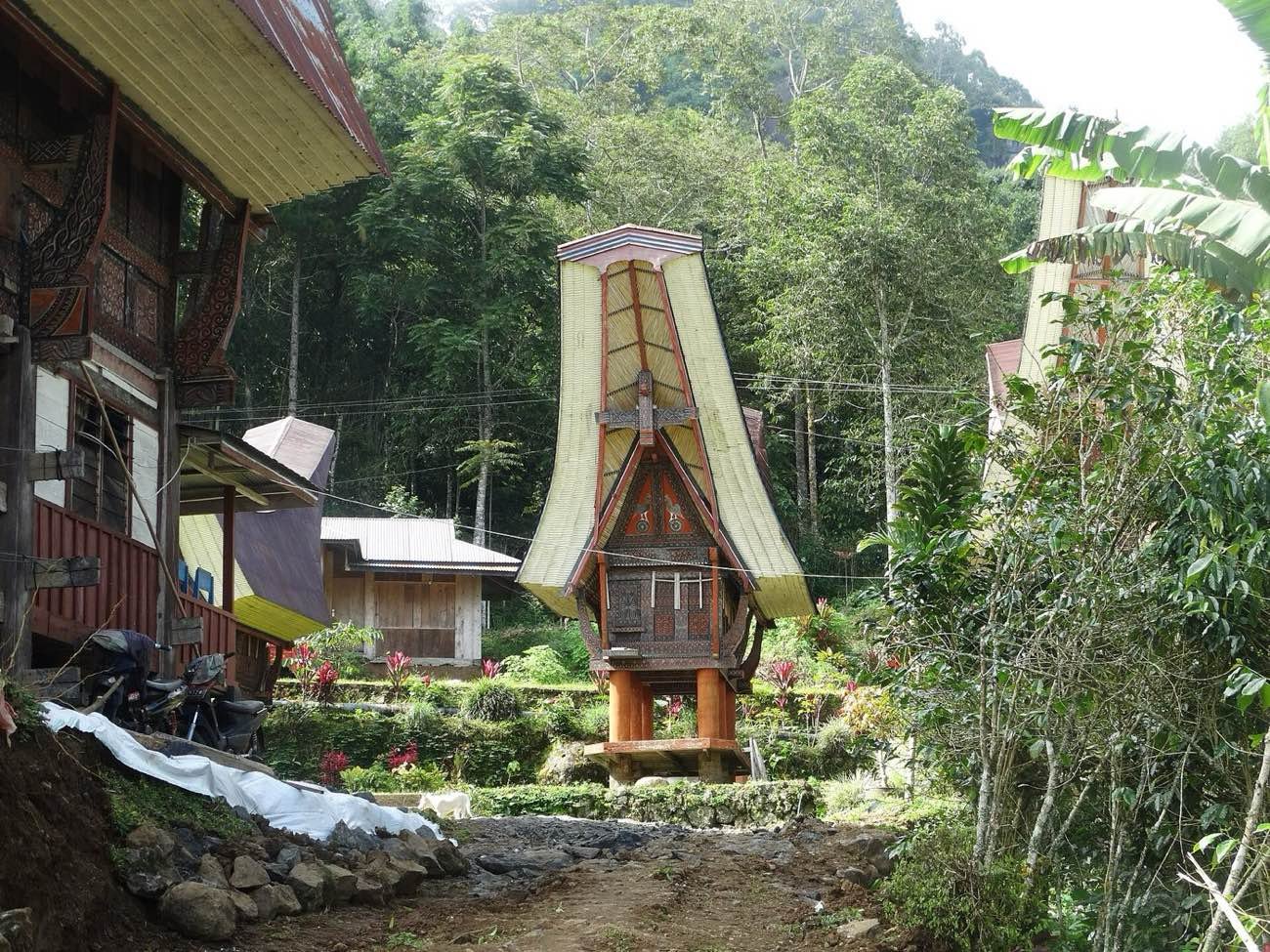
Tana Toraja rewards a planned itinerary more than most Indonesian destinations. The sites are spread across a highland valley, access to ceremonies depends on local contacts, and the road from Makassar eats a full day at each end. Our Tana Toraja travel guide covers the region as a whole; this page is the plan: what to do, in what order, and what each stop costs.
Before You Go: Two Rules That Shape the Trip
First, hire a guide for at least one day. Sites are reachable without one, but a guide explains the symbolism and can find out whether a ceremony is happening nearby. Guides charge approximately IDR 300,000-500,000 per day as of 2026, and your guesthouse can arrange one.
Second, dress and behave as a guest. Dark, modest clothes are expected at any ceremony, and you should ask before photographing people. Our guide to Toraja funeral traditions explains the stages and etiquette in detail.
1. Lemo Cliff Graves
Lemo is the most dramatic of the cliff burial sites: a sheer limestone face with balconies cut by hand, each holding tau-tau, the wooden effigies of the dead, dressed in contemporary clothes and gazing across the rice fields. New effigies are added after each major funeral. Entry is approximately IDR 30,000, and the site is about 11 km south of Rantepao. Go in the morning, when the light falls on the cliff face.
2. Londa Cave Burials
Londa is a cave grave inside a limestone outcrop, visited with a lantern and a resident guide. Skulls and bones gathered over generations sit alongside newer coffins. Entry is approximately IDR 30,000 and the guided walk takes about 45 minutes. Bring a torch of your own if you want to look at the details, and wear shoes with grip because the cave floor is uneven.
3. Ke’te Kesu Traditional Village
Ke’te Kesu is the most complete traditional village in the region. Tongkonan, the boat-roofed longhouses, face each other across a shared ceremonial space, with rice granaries opposite. A short walk behind the village leads to cliff graves. Entry is approximately IDR 30,000. It makes a good first stop, because seeing how a village is laid out helps the graves make sense.
4. Bori Kalimbuang Megaliths
Bori Kalimbuang is a field of standing stones raised at different points in Torajan history to mark major ceremonies, and stones are still being added. Entry is free or by donation. It takes under an hour and pairs well with a half-day around Rantepao.
5. Rantepao Market and Local Food
Rantepao is the traveller base, and its market is the cheapest place to eat. Torajan food uses pork heavily, reflecting the region’s Christian majority, and pa’piong, meat cooked in bamboo, is the dish to try. We cover restaurants in the Toraja hub; for this itinerary, simply build lunch around the market or the main strip.
6. Attend a Ceremony, If One Is Offered
Rambu Solo funerals run over several days with buffalo and pig sacrifices, and they are community events, not performances. If your guide or guesthouse says a family welcomes visitors, go, dressed in dark clothes with a small gift. Rambu Tuka, celebrations such as house dedications, is the other ceremony type. Never plan a trip around a guaranteed funeral: dates are not published.
Suggested Routes
One day (from Rantepao): Ke’te Kesu in the morning, Londa before lunch, Lemo in the afternoon, market dinner. A guided half-day or full-day tour in Toraja is the simplest way to cover this efficiently.
Two days: Add Bori Kalimbuang and a village walk with a guide on day two. Leave the afternoon open in case a ceremony is on.
Three days: Use the third day for a longer guided walk through rice-terrace villages, or as the buffer you will want if you are hoping to attend a funeral.
Getting There and Where to Base Yourself
Tana Toraja lies roughly 320 km north of Makassar. By road the trip takes approximately 8 hours; night buses cost approximately IDR 150,000-250,000 and a car with driver approximately IDR 700,000-1,000,000 as of 2026. Flights to Toraja or Palopo shorten the journey, but check current schedules. Our Makassar city guide covers the gateway city, and our where to stay in Toraja page lists properties by budget.
When to Go
July to September is the busiest period for ceremonies, though smaller ones occur year-round. Evenings in the highlands drop to 15-18 C, and rain is possible at any time. For general planning information on Indonesia, see the official Indonesia tourism site.