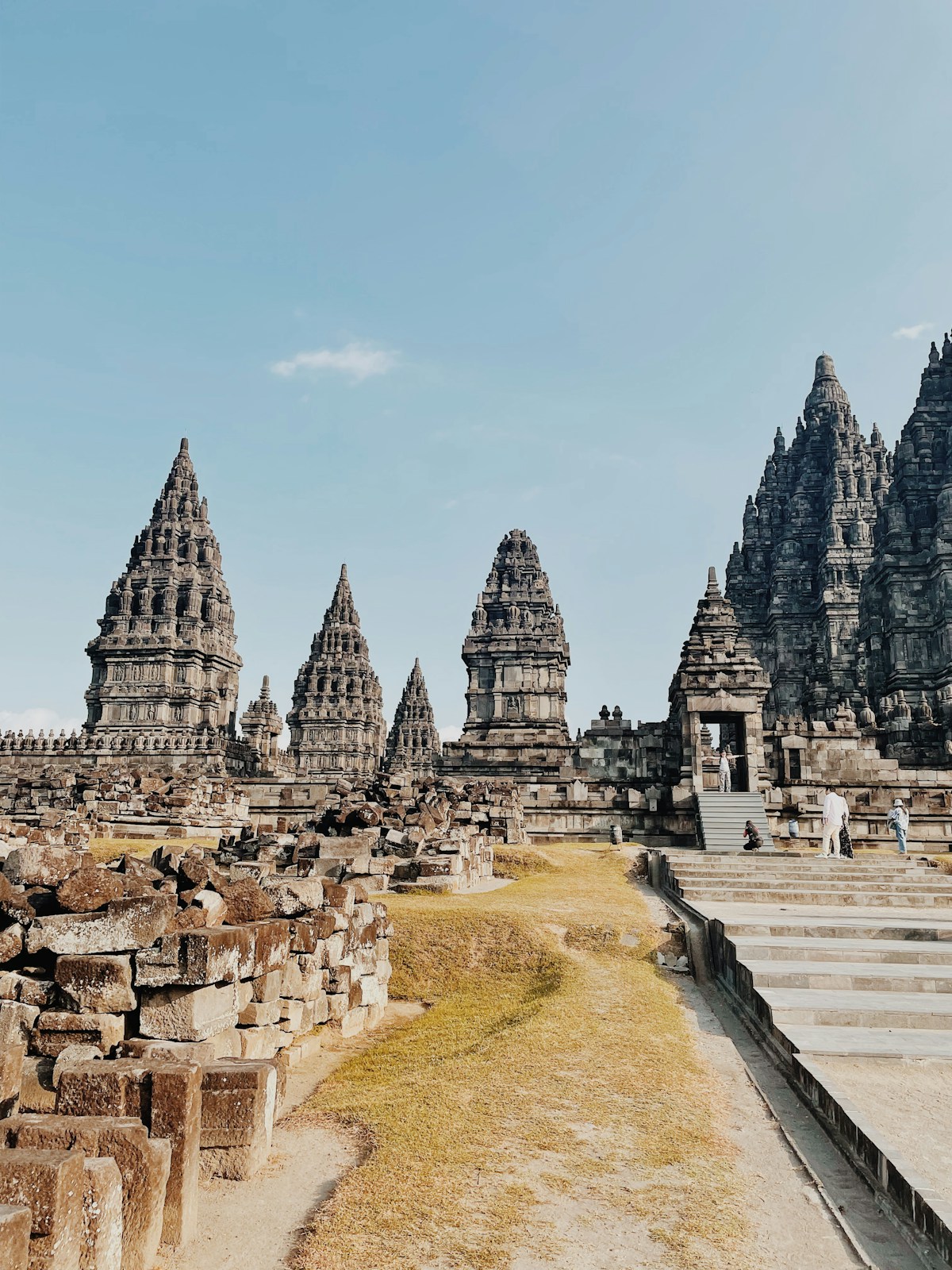
Prambanan is Indonesia’s largest Hindu temple complex and one of the most visually striking archaeological sites in Southeast Asia. Rising from the flat agricultural plains east of Yogyakarta, its six central towers - the tallest reaching 47 metres - are arranged in a tight cluster that becomes increasingly dramatic the closer you get. Where Borobudur unsettles you with its sheer scale and Buddhist serenity, Prambanan startles you with its density and height: towers upon towers, carved with thousands of figures from the Ramayana.
Built in the mid-9th century CE by the Hindu Sanjaya dynasty, Prambanan was abandoned a century later following a major volcanic eruption and earthquake, and lay in ruins until restoration work began in the 1930s. Today it is a UNESCO World Heritage Site and receives roughly 3 million visitors per year - making visit timing and advance booking genuinely important.
Entry Fees
As of 2026, the standard foreign visitor entrance fee for Prambanan is approximately IDR 350,000 per person. This covers the inner compound - the six central temples and the wider outer zone - and is valid for the full day.
A combined ticket with Borobudur is available and represents the best value if you’re visiting both sites, which most travellers do. The combined ticket typically costs around IDR 550,000–650,000 as of 2026, saving you the full Borobudur entrance fee separately. Both tickets are checked at entry, so keep them accessible.
Children under 10 usually enter at a reduced rate. Prices are reviewed periodically by the Borobudur-Prambanan Authority - confirm current fees on the official website or through your booking platform before visiting.
The Three Main Temples
The inner zone of Prambanan contains three primary temples, each dedicated to one god of the Hindu Trimurti:
Candi Shiva (the tallest, 47 metres): The central and most elaborate temple, dedicated to the destroyer and transformer. Inside you’ll find four chambers - north, south, east, and west - each containing a statue. The east chamber holds the primary Shiva lingam; the north chamber contains the elephant-headed Ganesha; the south holds Agastya the sage; and the west holds Shiva’s consort Durga, shown slaying the buffalo demon. The 24-metre relief band running around the outer gallery depicts scenes from the Ramayana.
Candi Brahma (south): Dedicated to the creator deity, this tower stands to the south of the Shiva temple. Its inner chamber contains a four-faced statue of Brahma. The outer gallery continues the Ramayana narrative - scenes from Brahma begin where the Shiva gallery ends.
Candi Vishnu (north): Dedicated to the preserver, this tower mirrors Brahma to the north. Inside, a four-armed Vishnu stands on the back of Garuda. The outer reliefs here depict the Krishnayana: stories from the life of Krishna, Vishnu’s avatar.
Facing each of the three main temples are three smaller vahana temples, housing the divine mounts: Nandi the bull (facing Shiva), Hamsa the goose (facing Brahma), and Garuda (facing Vishnu). The Garuda statue is the national symbol of Indonesia.
Beyond the inner compound, the outer zone contains the partially reconstructed remains of 224 smaller perwara (attendant) temples, most of which are still in ruined states.
The Ramayana Ballet
One of Yogyakarta’s most memorable evenings is watching the Sendratari Ramayana performed against the floodlit backdrop of Prambanan’s towers. The open-air ballet runs on selected nights from May to October - the dry season - with the central Shiva tower illuminated behind the stage.
The performance tells the Ramayana story through classical Javanese dance, gamelan music, and elaborate costume: Rama’s exile, Sita’s abduction by the demon Ravana, Hanuman’s role in the rescue, and the final battle. Performances run for approximately 2 hours.
Ticket prices for the Ramayana Ballet typically range from IDR 150,000 (general seating, further from the stage) to IDR 400,000 for VIP seats with unobstructed views. Booking in advance is strongly recommended, particularly in July and August when performances sell out. Some packages include dinner before the show.
During the wet season (November–April), an indoor version of the ballet is staged at the Trimurti Indoor Theatre on the Prambanan grounds, with the same dance troupe but without the outdoor backdrop. This is also worth attending.
Getting There from Yogyakarta
Prambanan is 17 kilometres east of Yogyakarta city centre - significantly closer than Borobudur, and more accessible by public transport.
By Trans Jogja bus: Route 1A and 1B run from central Yogyakarta (including the train station area) directly to Prambanan. Journey time is 45–60 minutes depending on traffic. Cost is approximately IDR 3,500. This is the most budget-friendly option and works well for daytime visits. Note: the last bus back from Prambanan departs in the early evening - check schedules if you’re attending the Ramayana Ballet.
By taxi or Grab: Direct from central Yogyakarta in 30–40 minutes, costing approximately IDR 80,000–120,000 each way. The most practical option if you’re attending the evening ballet.
By motorbike or scooter: A popular choice for independent travellers. The road from Yogyakarta to Prambanan (Jalan Solo) is a straight, well-maintained dual carriageway.
By organised tour: Most Prambanan day tours also include Borobudur. If combining both temples independently, the most efficient route is Borobudur first (morning), Prambanan in the afternoon.
Best Photography Spots and Times
Outer square at golden hour: The best photography of Prambanan’s silhouette - three towers rising above the lower ruins - comes in the 45 minutes before sunset, shooting from the northeast corner of the outer compound. The towers catch warm light while the sky transitions behind them.
Close-up relief detail: The Ramayana relief panels on the outer gallery of the Shiva temple are most sharply lit in mid-morning (8–10am). A wide-angle lens is useful inside the galleries; a longer focal length works for the tower exteriors from a distance.
Avoid midday: The stone compound retains heat intensely between 11am and 2pm. Shadows are harsh and unflattering for photography.
Interior chambers: No flash photography inside the temples. Use a wide-angle lens at high ISO, and be patient - the Vishnu and Shiva statues inside the dark chambers are worth the effort.
Walking Distances and Practical Tips
The inner compound of Prambanan is compact - the six central temples can be walked at a comfortable pace in 1–1.5 hours. The full outer zone, including the perwara temple ruins, adds another hour if you want to explore beyond the main cluster.
Wear: Light, breathable clothing. The site requires respectful dress - no sleeveless tops on the upper levels; a scarf or layer helps. Sturdy footwear is important; the interior steps of the main towers are steep and worn.
Site restaurants and cafes are located outside the main gate - there is minimal food available within the inner compound. Eat before entering or after exiting.
Audio guides are available for hire at the ticket gate and provide good context for the relief panels and deity iconography.
Combining Prambanan With Borobudur
The classic Yogyakarta day: Borobudur in the morning, Prambanan in the afternoon. The temples are 42 kilometres apart - roughly 1 hour by hired car. This itinerary works well as a self-managed trip with a private driver, or through a guided day tour. Budget the full day: Borobudur from opening (6:30am) until midday, lunch in Yogyakarta, Prambanan from 2pm until sunset. If you’re attending the Ramayana Ballet that evening, dinner fits neatly between the temple visit and the 7:30pm show start.
Book via GetYourGuide
Prices are approximate starting rates based on GYG listings as of August 2026 - confirm current rates before booking.
| Tour | Duration | From |
|---|---|---|
| Yogyakarta: 3-Hour Prambanan Tour with Pickup & Entry Fee | 3 hours | ~$25 |
| Yogyakarta: Prambanan Temple Afternoon Guided Tour | 3 hours | ~$30 |
| Yogyakarta: Explore Prambanan & Sewu Temple Tour | 3–4 hours | ~$35 |
| Yogyakarta: Borobudur & Prambanan Full-Day Tour | ~10 hours | ~$85 |