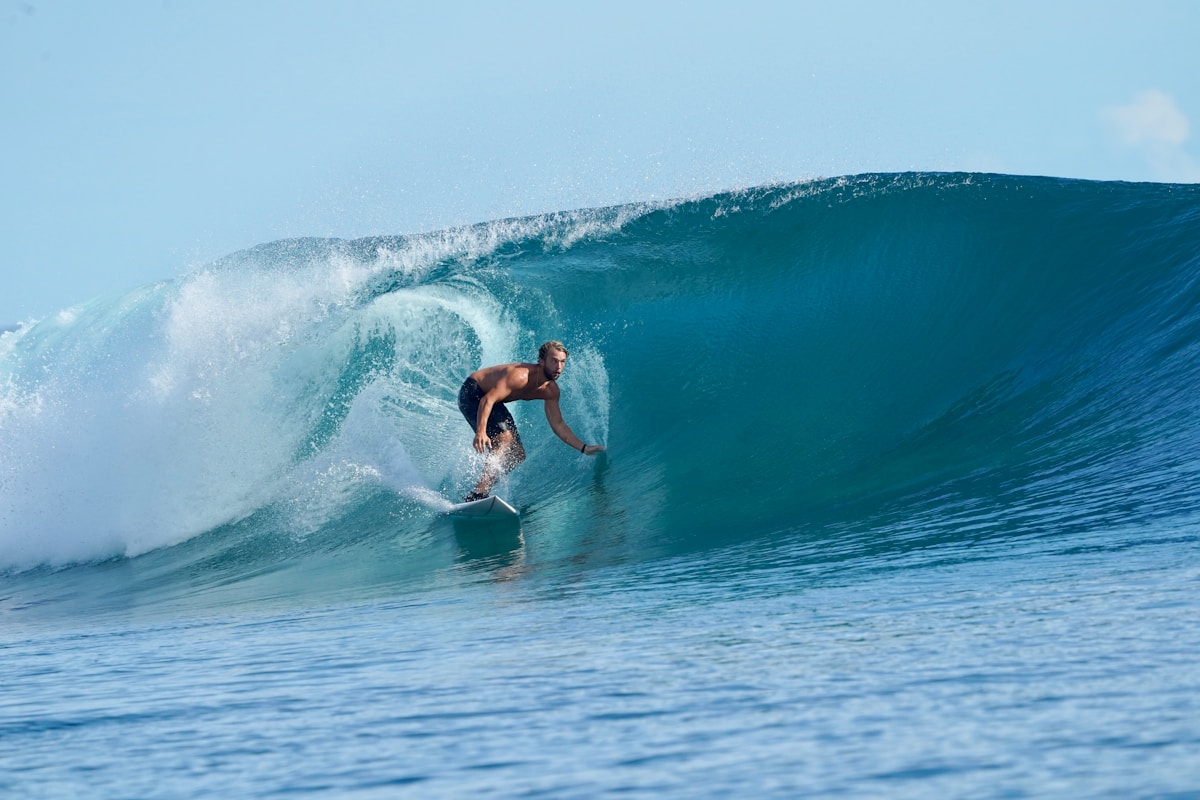
The Mentawai Islands are one of the most concentrated collections of high-quality surf breaks on earth. A chain of four main islands - Siberut, Sipora, North Pagai, and South Pagai - stretching 150 kilometres off the coast of West Sumatra, they sit directly in the path of long-period Southern Ocean swells. From April to October those swells arrive with mechanical consistency, standing up on shallow reef ledges to produce barrels that most surfers spend years chasing.
This is not a beginner destination. The breaks are almost entirely reef - sharp coral at head height or shallower - and the water is warm but unforgiving. Come prepared.
Why the Mentawais Work
The geography is the reason. The islands sit roughly 150 kilometres west of Sumatra, far enough offshore that the seabed shelves sharply from deep water onto reef platforms. Long-period swell from the south and southwest - generated by Southern Ocean storms - arrives relatively unimpeded, stands up abruptly on these platforms, and produces thick-lipped, fast waves that peel for distance.
The combination of consistent swell direction, predictable offshore winds during the dry season (southeast trades blow perfectly offshore on the west-facing breaks), and shallow coral architecture creates the wave quality that has made the Mentawais a reference point in global surfing since the early 1990s.
The Main Breaks
Macaronis (Macaroni’s) - Advanced
The most photographed wave in the archipelago and arguably the best right-hander in Indonesia. Located off the northeast tip of North Pagai near Botik village, Macaronis breaks over a relatively uniform coral shelf and produces long, walling rides with multiple barrel sections. At 4–6 feet it is playful and fast; at 6–8 feet on a south swell it delivers sustained tube rides of 5–10 seconds.
Character: Right-hand reef break, fast and hollow with multiple barrel opportunities. Works best on south to southwest swell with southeast winds. Difficulty: Advanced. Shallow at low tide; the take-off zone is crowded on good days. Crowd: High - it is the most in-demand break in the islands. Charter operators anchor nearby and access via dinghy.
Lance’s Right (Hollow Trees / HTs) - Expert
One of the world’s great rights. HTs breaks in Lagundri Bay on the southern tip of Nias - wait, no. Lance’s Right (also called Hollow Trees or HTs) is in the southern Mentawais on North Pagai. It breaks with a thick, sucking take-off section followed by a long hollow wall that covers shallow reef for 200 metres on a solid swell. The combination of power and water thickness over the reef makes wipeouts consequential.
Character: Right-hand reef break. Long hollow walls, powerful barrel at the entry section. Best on 5–8 foot south-southwest swell. Difficulty: Expert. Heavy wipeout zone, shallow inside, strong current on big days. Crowd: One of the most sought-after spots in the chain; numbers are managed by the concentration of camps in the area.
Lance’s Left - Advanced to Expert
The left-hander that faces Lance’s Right across the bay. Less consistent than the right but produces longer walls and more open face for turns. On a large south swell with light east winds it is world-class.
Character: Left-hand reef break. Longer ride than HTs, more room for vertical surfing between barrel sections. Difficulty: Advanced to Expert.
Pitstops - Intermediate to Advanced
Located in the northern Mentawais near the Playground area, Pitstops is one of the few breaks in the islands that works for intermediate surfers. It breaks over a deeper reef than HTs or Macaronis, producing longer walls with more time to set up turns and less consequence on wipeouts. Still a reef break - fins and coral contact are real risks - but the margin for error is wider.
Character: Right-hand reef break, slightly more forgiving than southern breaks. Difficulty: Intermediate to advanced. Best for surfers ready to step up from beach breaks.
Bank Vaults - Advanced
A short, extremely hollow right that breaks in very shallow water. It fires on a solid south swell and produces compressed barrel sections over sharp reef. Not a wave for the cautious.
Character: Short, thick right-hander over very shallow reef. Comparable to Padang Padang in Bali for power and shallowness. Difficulty: Advanced to Expert.
E-Bay - Intermediate to Advanced
A left-hander in the central Mentawais that breaks with more consistency and a longer ride than Bank Vaults. Works across a wider swell window and is more accessible to intermediate-advanced surfers. Often included in charter itineraries as a rest stop between heavier breaks.
Rifles - Expert
Located in southern South Pagai, Rifles is one of the more remote and rarely surfed breaks in the chain. A long left that breaks with outstanding quality on the right swell, it rewards surfers willing to travel further than the standard circuit.
Surf Season
| Month | Swell Consistency | Wind | Notes |
|---|---|---|---|
| April | Good | Light; transitional | Lower crowds, shoulder pricing |
| May | Good to very good | SE building | Strong value window |
| June | Excellent | SE offshore | Peak season begins; book ahead |
| July | Excellent | SE offshore | Most consistent month; most boats in water |
| August | Excellent | SE offshore | Peak season; premium pricing |
| September | Very good | SE easing | Shoulder; quieter with good surf |
| October | Variable | Transitional | Swell gaps longer; prices drop |
| Nov–Mar | Poor to flat | Variable/onshore | Wet season; most camps closed |
The season runs April to October. The core window is June to August: swell is most frequent and powerful (average swell height 4–8 feet, with 8–12 foot plus swells several times per season), southeast winds are most reliable, and conditions are cleanest. This is also peak pricing and peak boat density.
Getting There: Padang to the Mentawais
All trips originate from Padang, the capital of West Sumatra. Reaching Padang:
- By air from Bali: Approximately 2–2.5 hours. Direct flights with Lion Air, Batik Air, and Citilink from Ngurah Rai (DPS). Fares from approximately IDR 400,000–900,000 one-way as of 2026.
- By air from Jakarta: Approximately 1.5 hours. Multiple daily flights, similar fare range.
From Padang to the islands:
- Public fast ferry (Mentawai Fast): Departs Muaro Harbour, Padang. Crossing to Tuapejat (Sipora) approximately 3–4 hours; to Sikakap approximately 4–5 hours. Cost approximately IDR 150,000–200,000 per person as of 2026. Best for reaching land-based camps in Sipora or North Pagai. Ferry schedules change seasonally - confirm departure times directly.
- Charter operator speedboats: Most charter and camp operators include transfer from Padang as part of their package. Speedboats take 4–7 hours depending on destination. Longer but direct and part of the price.
Charter Boats vs Land Camps
The two formats suit different types of trips and budgets.
Charter Boats (Surf Charters)
A surf charter is a live-aboard vessel - typically a traditional Indonesian wooden boat or modern fibreglass charter - that anchors at breaks and moves between spots as swell and conditions dictate. A captain, crew, and usually a surf guide are included.
Advantages:
- Maximum flexibility: if a break is poor, the boat moves
- Access to remote or rarely surfed breaks away from camp clusters
- The experience of waking up anchored at a world-class break with no commute
Disadvantages:
- Motion sickness for rough crossings
- Limited space; 8–12 surfers is standard capacity
- Accommodation is shared cabins or open-air sleeping on some budget boats
Price range (as of 2026):
| Charter class | Price per person per night | What’s included |
|---|---|---|
| Budget wooden boat | USD 150–200 | Shared bunks, simple meals, transfers |
| Mid-range charter | USD 200–280 | Private or semi-private cabin, good meals, guide |
| Premium charter | USD 300–400+ | AC cabins, full bar, professional guide, photographer option |
A 7-night charter runs approximately USD 1,050–2,800 per person at current rates, with group discounts available for full-boat bookings (typically 8–12 people). Full-boat charter prices start at approximately USD 12,000–20,000 per week depending on vessel and season.
Operators: Mentawai Charter, Kandui Villas (land + charter), Krui Charter, and numerous independent captains operating through booking agents. Book 3–6 months ahead for peak season.
Land-Based Surf Camps
Land camps are fixed operations on one of the islands - typically on Sipora, North Pagai, or South Pagai - offering accommodation, meals, and daily boat transfers to the surrounding breaks.
Advantages:
- More stable sleeping (no boat motion)
- Often better food and facilities than budget charters
- Fixed location means you get to know the local breaks well
- Easier if you’re combining surfing with non-surfing partners
Disadvantages:
- Less flexibility - you surf what the camp can reach by day boat
- Some camps are positioned close to only 1–3 quality breaks
- Transfer time to distant breaks eats into surf time
Price range (as of 2026):
| Camp tier | Price per person per night | What’s included |
|---|---|---|
| Budget camp | USD 100–140 | Basic bungalow, meals, boat to nearby breaks |
| Mid-range camp | USD 150–200 | Better bungalows, AC, meals, guide |
| Premium camp | USD 200–300+ | Private villa, pool, gourmet meals, all transfers |
A 7-night land camp stay runs approximately USD 700–2,100 per person depending on tier. Several camps offer discounts for groups or longer stays.
Notable camps: Kandui Villas (North Pagai, premium), Macaronis Resort (adjacent to Macaronis break), Aloita Resort (Sipora), and various budget operations around Tuapejat and the southern islands. Camp availability changes season to season - verify directly.
Difficulty Levels and Suitability
| Level | Suitable breaks | Prerequisites |
|---|---|---|
| Intermediate | Pitstops, E-Bay, Burger World | Confident duck-diving; comfortable in 4–6ft reef surf; able to surf unassisted in crowds |
| Advanced | Macaronis, Lance’s Left, Rifles | Regular tube experience; confident over reef; strong paddle fitness |
| Expert | HTs (Lance’s Right), Bank Vaults | Barrelling reef experience; can handle 8ft+ waves; know when to pull back |
A rough guide: if you are not regularly surfing 5–6 foot beach break or reef in your home conditions, the Mentawais will be a stressful experience rather than an enjoyable one. Most camps can assess your level on arrival and guide you toward appropriate breaks.
What to Bring
Boards:
- Primary shortboard: 6’0”–6’4” with extra volume for paddle-heavy reef sessions
- Step-up/gun: 6’6”–7’0” for heavy days at HTs and Bank Vaults
- Spare fins, fin keys, and FCS/Future plugs for both systems
- Ding repair kit (fibreglass, resin, or a Solarez stick minimum)
Protection:
- Reef booties (optional but recommended for shallow sessions and rocky boat access)
- Helmets (optional; some surfers wear them at HTs and Bank Vaults)
- Rash guard - reef rash is the most common injury; a lycra suit with arm coverage reduces damage from shallow wipeouts
- Reef-safe sunscreen
Medical:
- Coral cuts become infected quickly in tropical water; carry betadine, tweezers, and antibiotic ointment
- Basic seasickness medication for charter crossings
- Travel insurance that covers surfing injuries - confirm your policy before departure
Electronics:
- Solar charger or power bank - power is limited or absent on budget boats
- Waterproof phone case or action camera
Crowds and Ethics
The Mentawais operate on an informal lineup hierarchy standard to most reef breaks: the surfer on the inside with the longest ride claims the wave. Charter boats and camps in peak season (July–August) can put 50–80 surfers in the water at the most popular spots. Macaronis and HTs are the most consistently crowded.
Camp and charter guides enforce a form of crowd management - boats take turns at breaks and guests are briefed on lineup etiquette. Respect the local system, read the pecking order, and don’t snake. The Indonesian surfers who grew up on these waves have priority in every sense.
Health and Safety
Medical facilities: There is a small hospital in Tuapejat (Sipora) and a clinic in Sikakap. Serious injuries require evacuation to Padang. Charter operators and established camps carry first-aid supplies and have emergency protocols; verify this before booking.
Malaria: West Sumatra and the Mentawai Islands are a malaria risk area. Consult a travel medicine clinic for current prophylaxis recommendations before departure.
Water: Drink only bottled or purified water. Camps and boats provide this; carry a purification solution as backup.
Browse surf charters and camps departing from Padang - activities can be booked last-minute in most cases, though peak season (July–August) fills up quickly.
See Also
- Surfing in Indonesia: Best Breaks for Every Level - Bali, Lombok, G-Land, and the broader Indonesian surf map
- Indonesia visa guide - entry requirements, visa on arrival, and extensions
- Snorkelling in Indonesia - the Mentawai reefs have some of the least-dived marine environments in the country