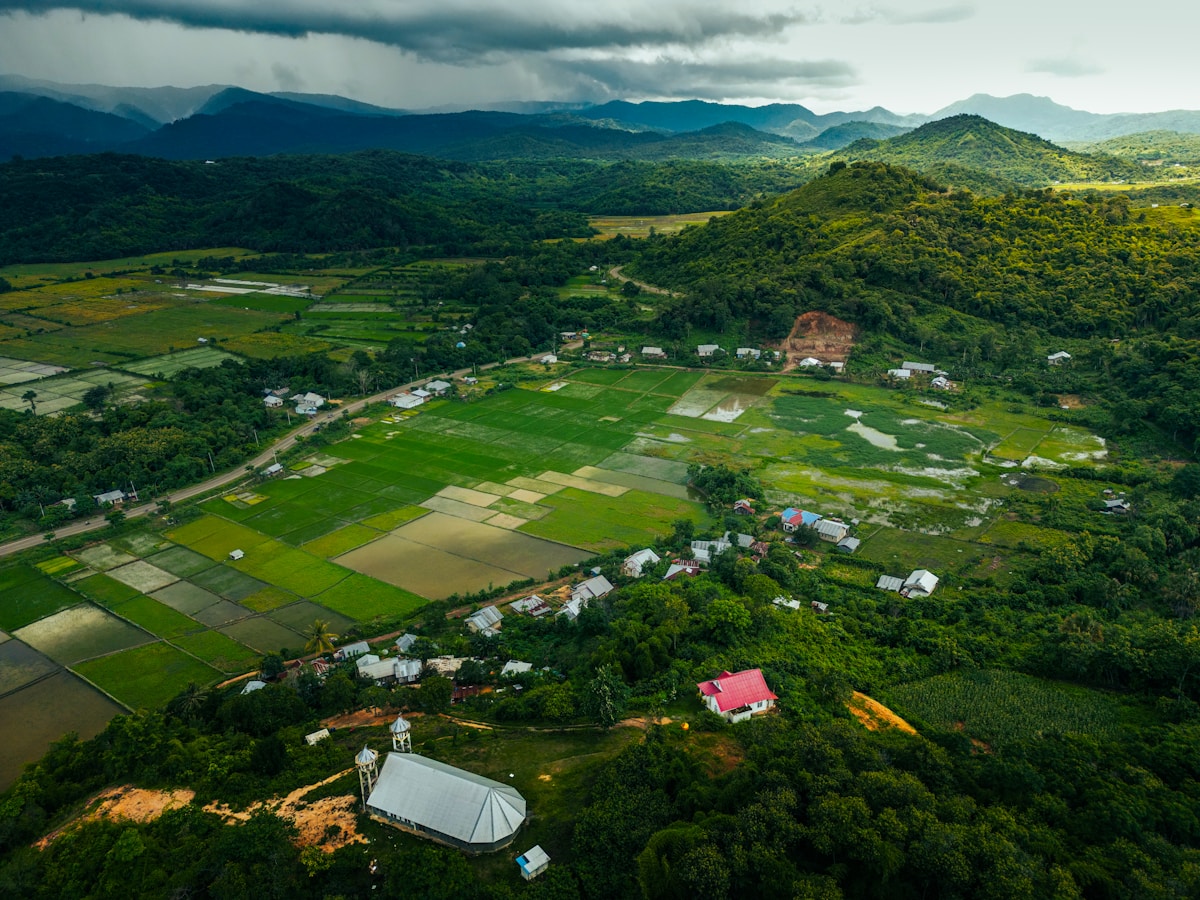
Ruteng: Spider Web Rice Fields, Flores Highlands
Ruteng travel guide: Lingko spider web rice fields, Liang Bua cave and cool highland village walks between Bajawa and Labuan Bajo, at 1,100m.
Guides for Ruteng
Search hotels in Ruteng on Booking.com
Ruteng is a highland town in western Flores at approximately 1,200 metres above sea level, capital of Manggarai Regency, and one of the most distinctly different stops on the Trans-Flores overland route. It sits cooler and cloudier than Labuan Bajo to the west - temperatures typically 16–24°C - surrounded by rice-growing highlands that the Manggarai people have shaped into one of the world’s more unusual agricultural patterns: circular, spider web-shaped paddy fields (Lingko) that radiate outward from a central point in concentric arcs, following a land allocation system rooted in traditional Manggarai communal law. The town also sits near one of the most significant palaeontological discoveries of the 21st century, at a cave that was home to a miniature species of early human less than 100,000 years ago.
Key Attractions
Lingko Spider Web Rice Fields (Cancar) - The Lingko fields at Cancar village, approximately 10 km east of Ruteng, are the most accessible and photographed example of the Manggarai circular field system. From the hillside viewpoint, the fields fan out from a central post (teno) that marks the point from which each clan’s strip radiates outward, like a wheel. Each segment belongs to a different family, narrowing toward the centre and widening toward the outer rim. Entry approximately IDR 10,000 as of 2026. The best viewing is in the morning before haze develops; mid-morning light on the terraces is ideal for photography. Reachable by ojek from Ruteng for approximately IDR 20,000–30,000 each way.
Liang Bua Cave - Located approximately 15 km northeast of Ruteng, Liang Bua is the archaeological site where, in 2003, Indonesian and Australian researchers discovered skeletal remains of a distinct species of small-bodied human - Homo floresiensis - nicknamed the “Hobbit” in media coverage due to its approximate 1-metre stature. Remains dated to approximately 50,000–100,000 years ago were found alongside stone tools and dwarf elephant remains. The cave is a large, cathedral-like limestone chamber with a high domed ceiling and a cool, dark interior. Entry approximately IDR 20,000 as of 2026, open 8am–5pm. An on-site informational panel explains the discovery. For visitors with an interest in human evolutionary history, it is a significant site - physically modest but scientifically remarkable as one of the most surprising hominid discoveries of recent decades.
Todo Village and Manggarai Cultural Sites - Todo, approximately 28 km south of Ruteng, is the historical seat of the Manggarai kingdom and contains traditional clan houses, megalithic tomb structures, and artefacts from the pre-colonial period. The Mbaru Niang (conical clan houses with thatched roofs stacked in tiered rings) are distinctive Manggarai architecture. Entry fees and guided access are arranged locally; approximately IDR 20,000–30,000 as of 2026.
Cunca Rami Waterfall - A tiered waterfall in the jungle approximately 40 km northwest of Ruteng, accessible by a 30-minute hike through lowland forest from the trailhead. Entry approximately IDR 20,000 as of 2026. Best visited in the wet season when the water flow is strongest, but reachable year-round.
Mount Ranaka - An active volcano approximately 12 km south of Ruteng, with a trail to the crater rim taking approximately 3–4 hours from the trailhead. The volcano last showed elevated activity in 2009. Guides are recommended; approximately IDR 150,000–200,000 per group as of 2026 from operators in Ruteng. The highland views from the slopes are the main reward.
Ruteng Pu’u Traditional Village - A traditional Manggarai village approximately 4 km from the town centre, with clan houses and communal drum houses preserved in their traditional form. Entry free; donations appropriate. A shorter alternative to the longer drive to Todo for those with limited time.
Hotels
Hotel Rima (budget-mid) - The most consistently recommended hotel in Ruteng for value: clean rooms, central location, and helpful staff who can arrange transport and guide services. From approximately IDR 250,000 per night as of 2026.
Agung Hotel (budget) - A simpler guesthouse option near the town centre with basic rooms and shared facilities. The most affordable option for overnight stays. From approximately IDR 200,000 per night as of 2026. Good for one-night stopovers on the overland Trans-Flores route.
Homestays - Some families in and around Ruteng offer homestay accommodation at approximately IDR 150,000–180,000 per night including breakfast as of 2026. These vary in comfort; asking guesthouses in town for recommendations is worthwhile.
Restaurants
Local restaurants serving nasi jagung - Ruteng’s highland Manggarai food tradition relies more heavily on corn than coastal areas. Nasi jagung (a cooked mixture of rice and ground corn) is the staple, served with simple accompaniments of dried fish, green vegetables, and chilli sambal. Several small restaurants near the market serve this for approximately IDR 15,000–25,000 per plate as of 2026.
Coffee warungs - Ruteng is surrounded by arabica coffee cultivation, and local coffee shops in the town centre serve freshly brewed Flores highland coffee by the cup for approximately IDR 10,000–15,000 as of 2026. The Manggarai district produces a distinctly earthy, full-bodied arabica that is different in character from the cleaner Bajawa highland coffees.
Market food - The Ruteng morning market is the main place to eat early in the day, with vendors selling corn porridge, sweet potatoes, fried snacks, and fruit from approximately 6am. A full breakfast from market stalls costs approximately IDR 15,000–20,000 as of 2026.
For hotel recommendations across all budgets, see our where to stay in Ruteng guide.
Getting There and Getting Around
From Labuan Bajo by bus - The most common arrival route. Buses cover the 130 km to Ruteng in approximately 4 hours on the Trans-Flores Highway; fares from approximately IDR 60,000–80,000 as of 2026. The road passes through hilly terrain with significant descent and ascent; morning departures from Labuan Bajo are the norm, arriving in Ruteng by midday.
From Bajawa by bus - The eastward route from Ruteng to Bajawa takes approximately 4–5 hours, with fares from approximately IDR 70,000–100,000 as of 2026. The scenic highland road between these two towns is one of the most dramatic sections of the Trans-Flores route.
By air - Frans Sales Lega Airport (RTG), approximately 2 km from the town centre, has limited domestic connections. Wings Air operates flights on some routes; availability is irregular. Flying into Labuan Bajo and busing to Ruteng is more reliable.
Around Ruteng - Ojek rides cover the main attractions: Cancar Lingko fields (IDR 20,000–30,000 each way), Liang Bua cave (IDR 40,000–60,000 each way), and town-area villages. Motorcycle hire is available at approximately IDR 80,000–100,000 per day as of 2026 for those wanting more flexibility. Most guesthouses can arrange guided day trips combining Lingko, Liang Bua, and Todo village.
Best Time to Visit
Ruteng’s highland altitude makes it cooler and wetter than coastal Flores. The dry season (April–October) offers clearer skies and better conditions for walking to viewpoints and waterfalls. The wet season (November–March) makes the rice fields greenest and most photogenic, at the cost of muddier tracks and overcast mornings. The temperature year-round warrants a warm layer for evenings.
Hiring Guides and Booking Transport
Local guides for Lingko and Liang Bua - Hotel Rima’s front desk can connect you with guides at short notice; full-day guided trips combining Lingko (Cancar), Liang Bua cave, and Ruteng Pu’u village run approximately IDR 300,000–450,000 per group of up to four people including transport and guiding. Half-day Lingko-only trips cost approximately IDR 150,000–200,000 per group. A guide adds meaningful context to both sites: the Lingko land allocation system and the Homo floresiensis discovery are explained in detail by someone who knows the sites.
Mount Ranaka guide booking - The Ranaka trailhead is approximately 12 km south of Ruteng. Guides are strongly recommended and arranged through guesthouses in town; cost approximately IDR 150,000–200,000 per group for the 3–4 hour crater climb. Allow a full morning: depart by 7am to reach the crater before clouds develop in the mid-morning heat.
Trans-Flores bus logistics - Buses between Labuan Bajo and Ruteng (westbound) and Bajawa (eastbound) depart from the Mena bus terminal in central Ruteng. The Labuan Bajo route (IDR 60,000–80,000, approximately 4 hours) runs morning departures around 7–9am; buy tickets at the terminal the day before or arrive early morning. Elteha and Langgur are the main operators. The eastbound route to Bajawa (IDR 70,000–100,000, 4–5 hours) follows the same pattern. No online booking system exists - all tickets are purchased at the terminal.
Motorcycle hire - Available from several shops near the main market at approximately IDR 80,000–100,000 per day as of 2026 for those wanting independence to visit Cancar, Liang Bua, and Cunca Rami on their own schedule. Ask at Hotel Rima for reliable hire contacts. A valid driving licence is required; roads outside town are unpaved in places and best approached on a semi-automatic or automatic bike rather than a manual.
Practical Tips
The Lingko spider web fields at Cancar are best viewed in the morning - by late afternoon the angle of light flattens the visual effect. The viewpoint involves a short walk up a slope; suitable footwear is useful. At Liang Bua, the cave interior is cool and slightly damp; the informational panels are in Indonesian and English. Ruteng is a conservative Catholic highland town; dress appropriately when visiting villages and church areas.
Browse tours and day trips in Ruteng - a half-day with a local guide is one of the most efficient ways to get oriented on arrival. For airport transfers into Ruteng, Kiwitaxi offers fixed-price pickups from the main airports - no surge pricing and the driver meets you at arrivals.
Ruteng sits in western Flores island - explore our full Flores guide for how to connect to Labuan Bajo, Bajawa, and the rest of the Trans-Flores route.
More Flores Guides
- Labuan Bajo travel guide - the gateway to Komodo: where to stay, what to see, and how to arrange boat tours, 130 km west
- Bajawa travel guide - Ngada traditional villages and volcanic highlands, 3–4 hours east along the Trans-Flores Highway
- Wae Rebo trek - the remote traditional village accessible by a 3-hour hike from Dintor, between Labuan Bajo and Ruteng
- 10-day Komodo and Flores itinerary - the full Trans-Flores route with Ruteng included as an overnight stop
- Komodo Island guide - Ruteng makes a natural overnight break between Labuan Bajo and Bajawa on a Flores circuit
Book an experience
Top experiences in Ruteng
Explore the best tours and activities in Ruteng , with instant confirmation and free cancellation on most bookings.